TL;DR
A single blog post almost never ranks on its own in a competitive niche. What ranks is a collection of interconnected posts that together signal to Google that a website genuinely understands a subject from every angle. That is what content clusters are. This post explains why the Tiger Tail project was built around 11 clusters instead of 110 individual posts, and what the structural difference actually means for rankings over time.
This is the fourth post in a series about building a 110-post SEO content strategy from scratch. You can read the full strategy overview here, the keyword mapping post here, and the research process post here.
Why One Post Is Almost Never Enough
Here is a situation most business owners recognise. You write a detailed, well-researched blog post on a subject you genuinely know. You publish it. You wait. Three months later it is sitting on page four of Google and bringing in almost no traffic. The content is good. The keyword is real. Nothing happened.
The most common diagnosis for this is that the post needs more backlinks, or better on-page SEO, or a longer word count. Sometimes those things help. But the more fundamental issue is often that a single post on a new or mid-authority domain does not give Google enough to go on.
Google does not just evaluate individual pages. It evaluates patterns across a domain. A website that has published one post about AI for law firms is a website that mentioned the topic once. A website that has published ten interconnected posts about AI for law firms, each covering a different aspect and all linking to the same parent page, is a website that demonstrably understands the subject. Those two situations produce very different ranking outcomes.
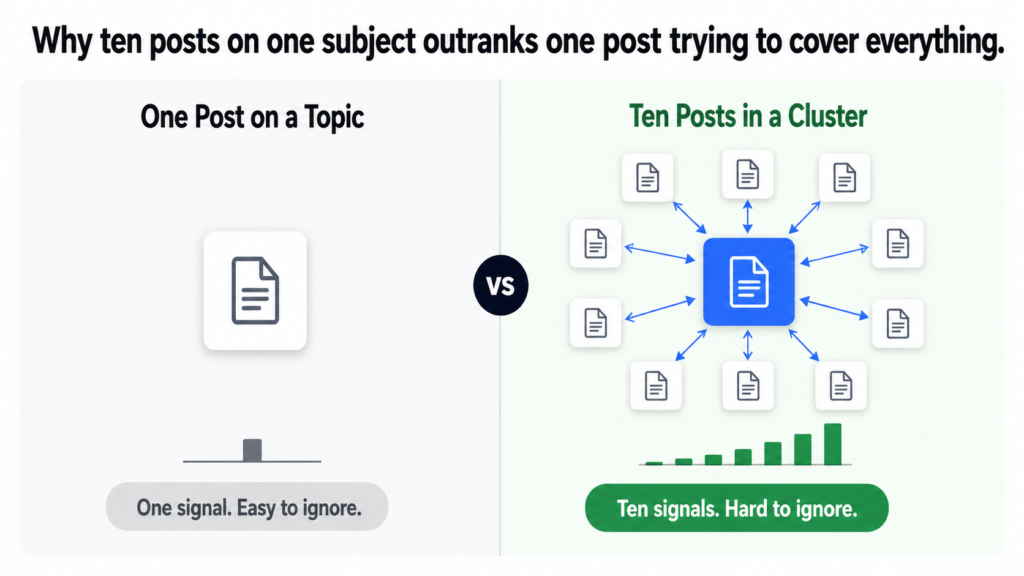
Topical authority is not about depth on one page. It is about breadth across multiple pages that together cover a subject more completely than any single competitor page can.
What a Content Cluster Actually Is
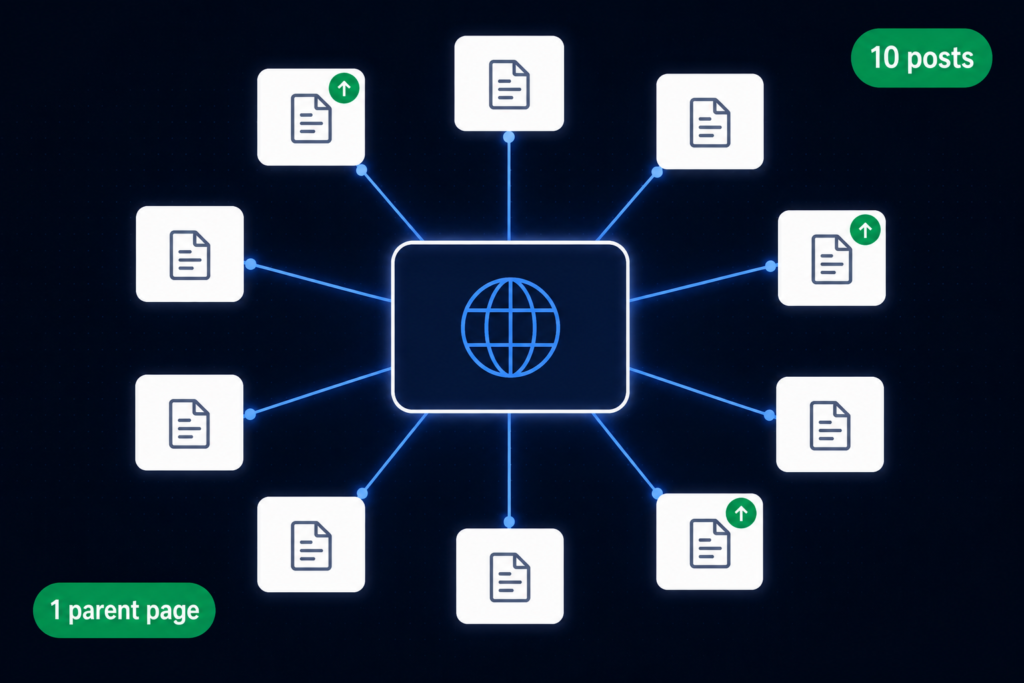
A content cluster is a group of related blog posts that all cover different aspects of the same subject, linked together and to a central parent page. The parent page targets a commercial keyword. The cluster posts target informational keywords around the same subject. Together they create a web of relevance that Google can follow in every direction and find consistent, substantive content.
The structure looks like this for the Tiger Tail legal cluster:
tigertail.co/ai-for-legal
Targets: “ai for law firms” — 1,300 monthly searches
Purpose: Convert visitors into leadsCLUSTER POSTS — all link back to parent page
Post 1: How Small and Mid-Size Law Firms Are Using AI in 2026
Post 2: How Much Time Are Your Lawyers Actually Spending on Billable Work?
Post 3: Legal Document Automation: How to Draft Faster Without Sacrificing Quality
Post 4: AI Contract Review: How to Cut Review Time From Hours to Minutes
Post 5: Client Intake Automation for Law Firms: Never Drop a Lead Again
Post 6: AI and Billing Ethics: What Every Lawyer Needs to Know About ABA Opinion 512
Post 7: How Law Firms Are Using AI to Win More Clients Without More Marketing Spend
Post 8: Matter Management Automation: How to Keep Every Case Moving
Post 9: Data Security and Confidentiality When Using AI at a Law Firm
Post 10: Solo and Small Firm AI: How Lawyers With Limited Budgets Can Compete
INTERNAL LINKING PATTERN
Every post links back to /ai-for-legal (parent page)
Every post links to 2-3 related posts within the cluster
Parent page links to the most relevant posts in the cluster
Ten posts. One parent page. Every post covers a different question a law firm partner might search for when researching AI. Together they build a complete picture of what the website knows about AI in legal. Individually, most of them would struggle to rank. As a cluster, each post lifts the others.
How Clusters Create Compounding Authority
The mechanism behind why clusters work is worth understanding properly because it changes how you think about content investment.
When Google crawls a new blog post, it evaluates that page partly on its own merits and partly on the context of the domain it sits on. A post published on a domain that already has nine related posts on the same subject starts with more context than a post published in isolation. Google can see that the domain consistently covers this topic. The new post is not a one-off mention. It is part of a pattern.
As the cluster grows, internal links pass authority between posts. A post that earns a backlink from an external source does not just benefit itself. Through internal linking, it passes some of that authority to every other post in the cluster and to the parent page. The whole cluster benefits when any one post performs well.
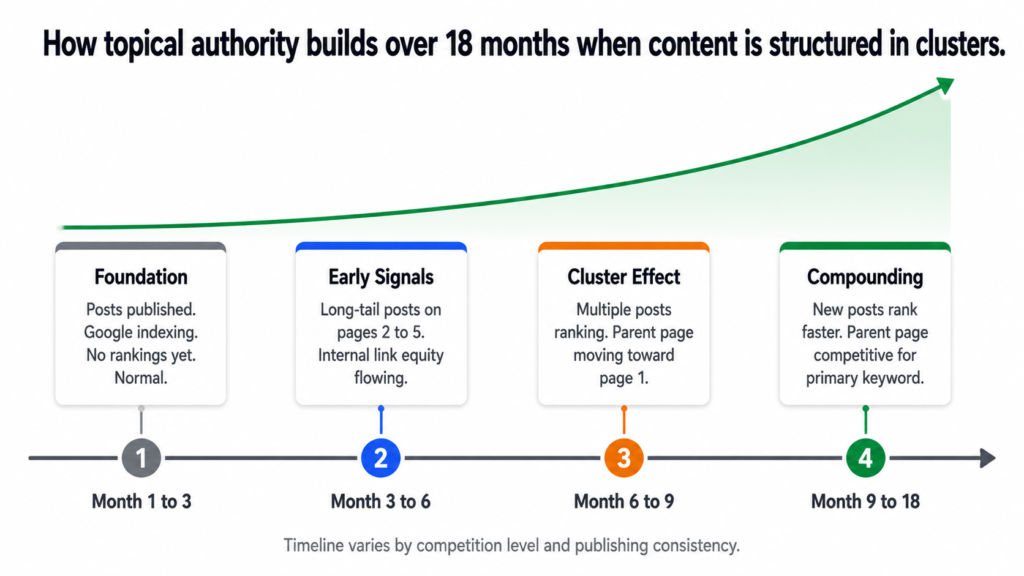
First cluster posts published.
Google crawls and indexes them.
Little to no ranking yet. Normal.
Domain is building context around the topic.Month 3 to 6: Early signals
Long-tail informational posts start appearing
on pages 2 to 5 for lower competition queries.
Internal link equity beginning to flow.
Parent page gains indirect authority.
Month 6 to 9: Cluster effect visible
Multiple posts from the same cluster ranking
for different keywords in top 20.
Parent page moving toward page 1 for primary keyword.
Google recognises topical depth.
Month 9 to 18: Compounding
Earlier posts strengthen as domain authority grows.
New posts in the cluster rank faster than early ones did.
Parent page competitive for high-volume keywords.
Cluster becomes a self-reinforcing authority signal.
This compounding effect is why the cluster approach produces better long-term returns than publishing the same number of posts on random topics. Forty posts spread across forty different subjects build forty isolated signals. Forty posts built across four clusters of ten each build four areas of genuine depth, and those four areas lift the entire domain.
How the 11 Clusters Were Decided
For Tiger Tail, the clusters were not chosen arbitrarily. Each one maps directly to either a service page or an industry page that already existed on the site. This matters because every blog post in a cluster has a clear commercial destination to link back to.
| Cluster | Parent Page | Primary Keyword | Monthly Searches |
|---|---|---|---|
| AI Audit and Strategy | /services/ai-audit-strategy | ai strategy consultant | 880 |
| Workflow Automation | /services/workflow-automation | business process automation services | 320 |
| Custom AI Development | /services/custom-ai-development | custom ai development company | 480 |
| Systems and Operations | /services/systems-operations-design | business systems consultant | 210 |
| Growth Engineering | /services/growth-engineering | ai marketing automation | 720 |
| AI Training | /services/ai-training-enablement | corporate ai training | 40 |
| Home Services | /ai-for-home-services | ai for contractors | 110 |
| Real Estate | /ai-for-real-estate | ai real estate agent | 590 |
| Legal | /ai-for-legal | ai for law firms | 1,300 |
| Healthcare | /ai-for-healthcare | healthcare workflow automation | 170 |
| Finance and Accounting | /ai-for-finance-accounting | ai for accounting firms | 70 |
Every cluster has a commercial destination. The blog posts in the legal cluster do not just exist to attract readers. They exist to attract readers who are researching AI for their law firm, build trust with them through genuinely useful content, and then point them toward a page where they can take action. The informational content and the commercial page work together rather than separately.
The Round-Robin Publishing Approach
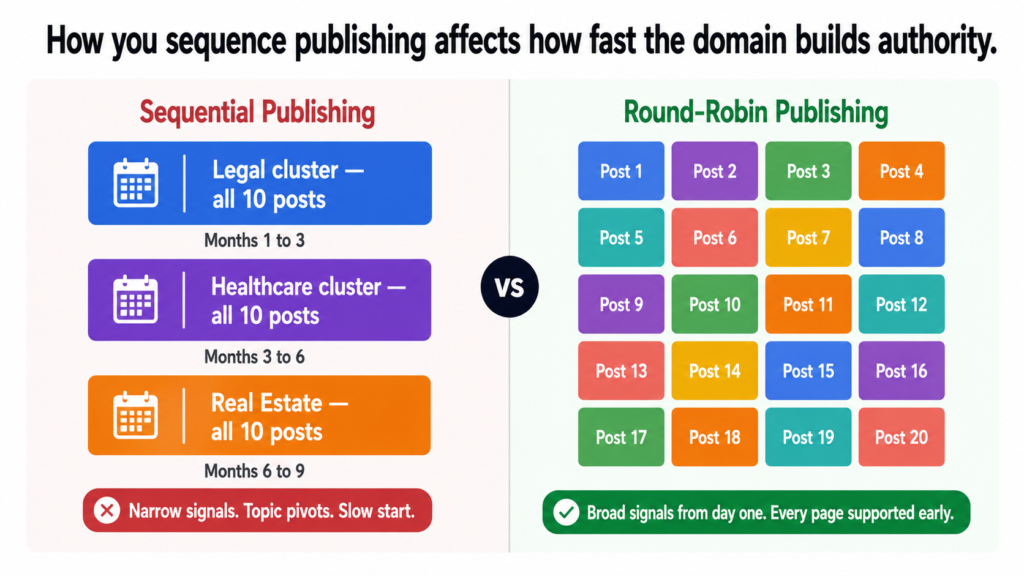
One structural decision worth explaining is that the publishing calendar does not work through one entire cluster before starting the next. It rotates across all eleven clusters from the beginning.
Months 1 to 3: Publish all 10 legal posts
Months 3 to 6: Publish all 10 healthcare posts
Months 6 to 9: Publish all 10 real estate postsProblem: Domain looks like it pivots between topics.
Google sees bursts of content then silence on a subject.
No broad topical signals in early months.
ROUND-ROBIN APPROACH (what we did)
Week 1: AI Audit and Strategy post 1
Week 2: Home Services post 1
Week 3: Workflow Automation post 1
Week 4: Legal post 1
Week 5: Real Estate post 1
… continues cycling through all 11 clusters
Result: Domain builds broad topical signals from day one.
Google sees consistent coverage across the full subject area.
Every page category gets early signals rather than delayed ones.
The round-robin approach means every cluster gets its first post in the early weeks. Every service page and industry page on the site starts receiving supporting content within the first few months. Nothing waits six months for its cluster to begin.
Publishing all content for one cluster before starting the next feels logical but it creates a domain that looks narrow early on. Google sees a site entirely focused on one topic and then suddenly pivoting. Round-robin publishing signals consistent, broad expertise from the start.
What Clusters Do That Individual Posts Cannot
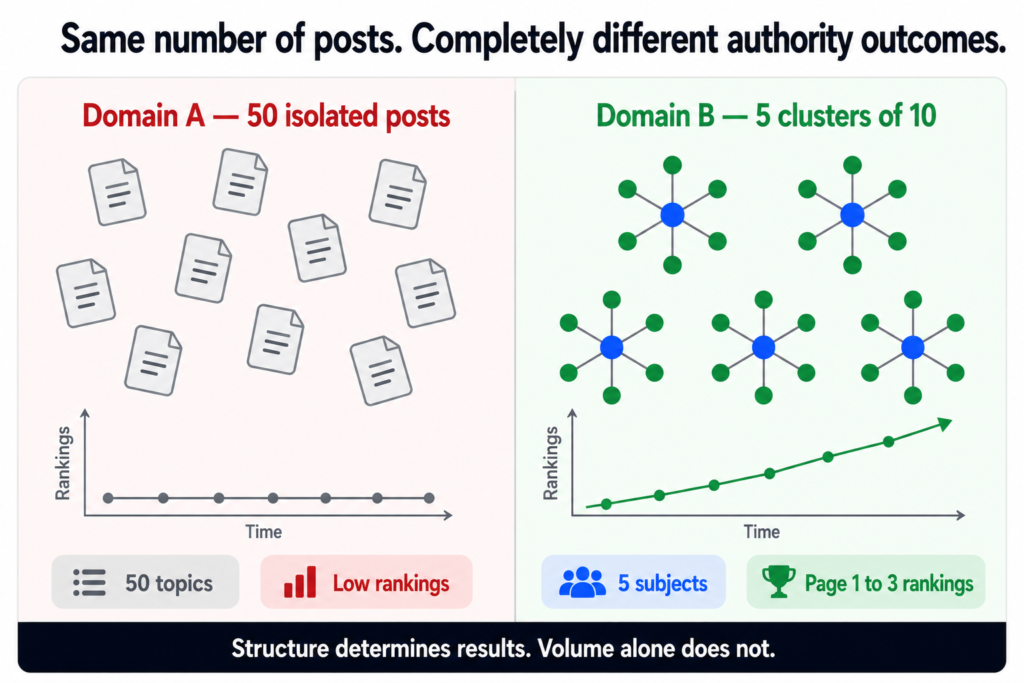
The simplest way to understand the cluster advantage is to compare two domains publishing the same total number of posts over the same time period.
Each post covers one subject with no related content nearby.
No internal linking architecture.
No commercial page to feed authority into.
Google sees breadth but no depth on any subject.
Result: Most posts on pages 4 to 10. Low traffic. Few conversions.DOMAIN B — 50 posts across 5 clusters of 10
Each cluster covers one subject from 10 different angles.
Posts interlink within clusters and to parent pages.
Commercial pages benefit from cluster authority.
Google sees consistent depth on five clear subjects.
Result: Cluster posts on pages 1 to 3. Parent pages ranking.
Organic traffic building. Leads coming in.
Both domains published fifty posts. Same effort. Very different outcomes. The difference is entirely structural.
Clusters are not a content strategy preference. They are the mechanism by which a domain with limited authority competes with established sites. Ten posts covering one subject from ten angles consistently outranks one post trying to cover everything at once.
What Comes Next
With the cluster architecture designed and the research in place, the final structural decision was how to sequence the publishing calendar to get the most out of the domain authority building process. That is what I cover in the next post: how I build a 24-month blog calendar that a client can actually follow.
If you want a content strategy built around proper cluster architecture for your own website, book a call. The structure is what most content strategies are missing and it is the first thing I look at.
See how I approach SEO strategy →
Dhruv is an SEO consultant working with business owners, founders, and agencies. If organic search is not delivering for your business, this is where to start.

Dhruv The SEO Guy
I do SEO for agencies, founders, and business owners. No fixed packages. No fluff. Just technical, revenue-focused strategies that scale your organic presence securely.
Ready to dominate search?
Stop reading about algorithms and start ranking. Book a quick 1-on-1 strategy call below.
Book a Strategy Call →