TL;DR
SEO and AEO are not competing strategies, they answer different questions. SEO asks "how do we rank on the results page," while AEO asks "how do we become part of the answer before anyone clicks." Around 60% of searches now end without a click, and Google AI Mode alone has crossed 2 billion monthly users, so being absent from AI answers means losing visibility at the research stage even if your rankings look fine. SEO remains the foundation: AI Overviews still pull mostly from top-10 organic results, so a page with no SEO foundation has little chance of being cited. The practical difference shows up in content structure. SEO favors comprehensive, long-form coverage built to rank for many variations. AEO favors content where each section opens with a direct answer that can be quoted on its own, then adds context below. Most businesses do not need to choose. They need an SEO foundation with an AEO layer on top, prioritized based on how their specific audience searches.
SEO and AEO are answering two different questions
SEO and AEO get talked about as if they are rival strategies, competing for the same budget and the same hours. In practice they are answering two different questions, and most businesses need answers to both.
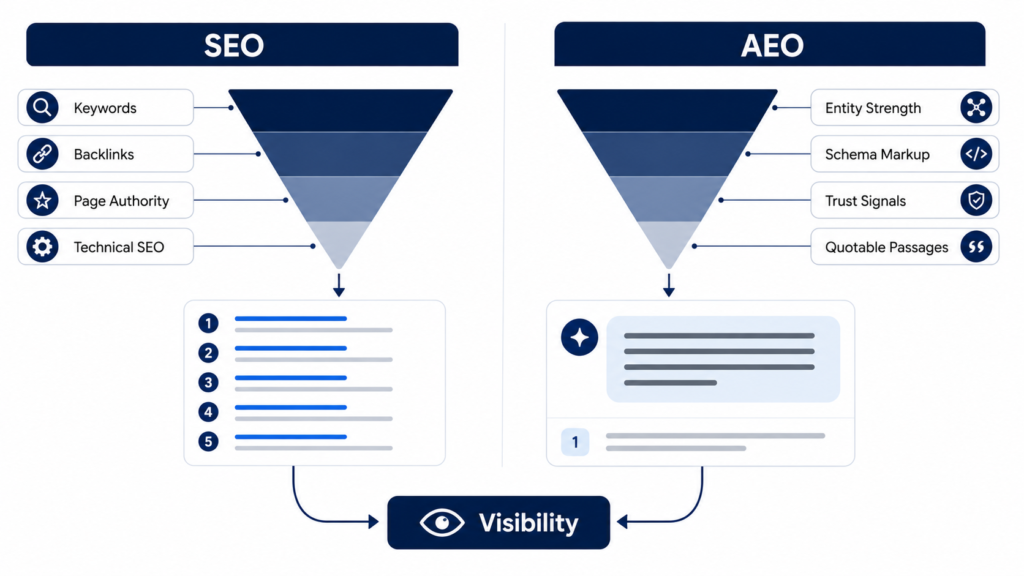
SEO asks: how do we get this page to rank high enough on Google that someone clicks on it? It is built around keywords, backlinks, technical performance, and page authority. The outcome it is optimized for is a visit to your site.
AEO asks: how do we get this brand or this piece of information included when an AI system answers a related question? It is built around structure, entity clarity, and how easily a model can extract and trust a specific fact or recommendation. The outcome it is optimized for is being part of the answer, whether or not that leads to a click.
If you have read our guide on what answer engine optimization actually is, this distinction will be familiar. This post goes one step further and looks specifically at how the two disciplines differ in practice, and how to figure out where your business should put its effort first.
Why this comparison matters now
The honest answer is that search behavior has changed enough that ignoring either one creates a real gap.
Roughly 60% of searches now end without the user clicking through to a website. People are getting their answer directly on the results page, or from a conversational AI tool, and moving on. Google AI Mode has crossed 2 billion monthly users across more than 200 countries. For a lot of queries, particularly informational ones, the AI-generated answer is now the first thing a person sees.
At the same time, AI Overviews and similar features still draw heavily from pages that are already ranking well in classic search. So the two are linked. A page with strong SEO has a real shot at being pulled into an AI answer. A page with no SEO foundation, no matter how well it is structured for AEO, is starting from a much weaker position.
This is the part that gets lost in a lot of “AEO vs SEO” framing. It is rarely a fork in the road. It is closer to a sequencing question: get the SEO foundation right, then add the structure and clarity that helps AI systems use that content.
The practical differences, side by side
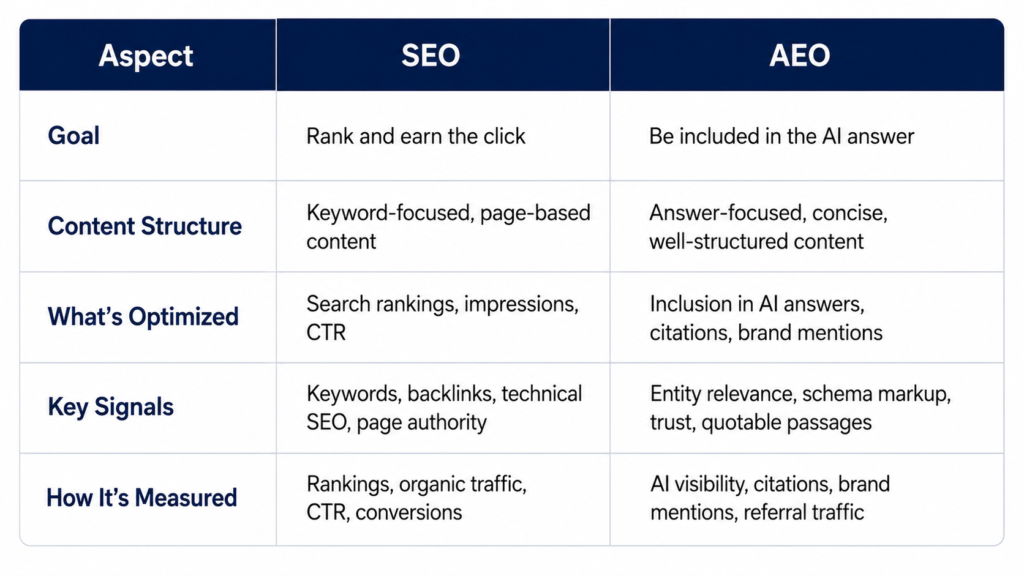
Here is where the two disciplines actually diverge in day-to-day work.
What “winning” looks like. For SEO, winning means ranking in the top positions for a keyword and earning the click. For AEO, winning means your brand, data, or explanation shows up inside an AI-generated answer, summary, or recommendation, sometimes without any click at all.
Content structure. SEO has traditionally rewarded long-form content that covers a topic from multiple angles and ranks for dozens of keyword variations. Depth and breadth are the point. AEO rewards content where each section can stand on its own. An AI system often pulls a single passage, not the whole page, so that passage needs to read sensibly even when quoted out of context. The practical approach is to lead each section with a direct answer, then add detail underneath for readers who want more.
What you’re optimizing. SEO optimizes whole pages and whole sites: site architecture, internal linking, technical performance, backlink profiles. AEO optimizes at the passage level as well as the page level. A single well-written paragraph with a clear claim and a number attached to it can become the quotable unit, even if the rest of the page is unremarkable.
Signals that matter. SEO leans on keywords, meta tags, backlinks, and page authority. AEO leans more on entity strength (is your brand a clearly defined, recognizable entity with consistent information across the web), schema markup, named authorship, and trust signals like reviews and citations from other sources.
Measurement. SEO has decades of established metrics: rankings, organic traffic, click-through rate. AEO measurement is newer and less standardized, but it generally comes down to tracking how often your brand or content appears in AI-generated answers for a defined set of queries, which is closer to a visibility percentage than a ranking position.
When SEO should be the priority
SEO carries more of the weight when your content sits closer to a transaction. Product pages, service pages, and anything where the goal is for someone to land on your site and take an action benefit most directly from SEO. AI engines still need to send the user somewhere to actually book, buy, or sign up, and that somewhere is your page. If your site has weak technical SEO, thin content, or no clear authority signals, that is the gap to close first regardless of how much attention AI search is getting, because it is also the foundation AEO depends on.
When AEO should be the priority
AEO carries more weight for informational and comparative content, the kind of queries where someone is still researching, comparing options, or trying to understand a topic before they have decided what to do. This tends to matter most for professional services, healthcare, legal, finance, and software businesses, where buyers often start by asking an AI tool to explain a topic or compare options long before they are ready to talk to anyone. If your category involves a lot of “what is,” “how does,” or “X vs Y” type questions, and you suspect your brand rarely or never comes up when those questions are asked, that is a sign AEO deserves dedicated attention.
How to figure out which one you need first
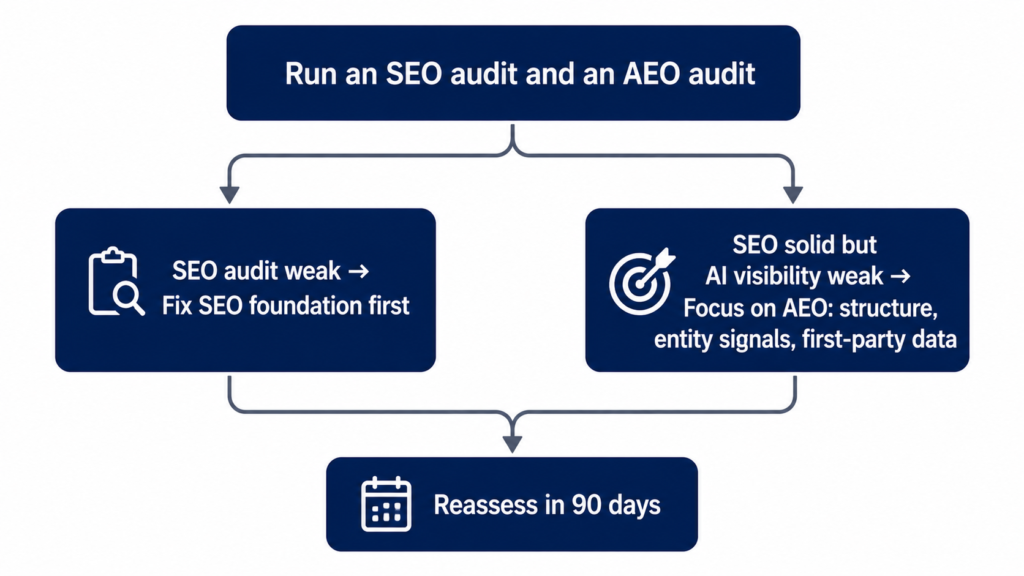
A short way to think about it: audit both, then fix whichever gap is bigger.
For SEO, the standard checks apply. Are your key pages ranking for the terms that matter? Is the technical foundation, site speed, indexing, mobile experience, in reasonable shape? Do you have a content base that covers your core topics with some depth?
For AEO, the check is different and less commonly done. Run a set of real questions your buyers would ask through ChatGPT, Perplexity, and Google AI Overviews, and see whether your brand comes up at all, and who comes up instead of you. We walked through exactly this kind of audit in our Midstream Marketing case study, where a financial services agency went from 1.9% AI visibility to 8.9% in 90 days once they knew where the gaps were.
If both audits come back weak, SEO comes first. It is the foundation AI systems lean on too. If your SEO is reasonably solid but you are invisible in AI answers, that is where AEO-specific work, restructuring content for quotable passages, strengthening entity signals, adding first-party data, will move the needle faster.
The bottom line
SEO and AEO are not a choice you make once. SEO is the operating system: site authority, technical health, and content that ranks. AEO is the layer on top that determines whether AI systems can extract, trust, and cite what you’ve built. Treating them as competitors means you end up under-investing in whichever one feels less urgent this quarter, and both tend to compound, so the gap grows the longer it’s ignored.
If you want a clearer picture of where your SEO and AI visibility actually stand right now, you can see our full range of SEO and AEO services or book a call and we’ll run through both with you.

Dhruv The SEO Guy
I do SEO for agencies, founders, and business owners. No fixed packages. No fluff. Just technical, revenue-focused strategies that scale your organic presence securely.
Ready to dominate search?
Stop reading about algorithms and start ranking. Book a quick 1-on-1 strategy call below.
Book a Strategy Call →