TL;DR
A content strategy without a publishing calendar is just a list of good intentions. This post covers how the Tiger Tail 24-month blog calendar was built, how the publishing pace was designed around a new domain's authority curve, why the cluster priority order matters as much as the content itself, and what every row in a properly built calendar should contain before a writer touches it.
This is the fifth post in the series. You can read the strategy overview, keyword mapping, research process, and cluster architecture in the earlier posts.
Why Most Content Calendars Get Abandoned
A content calendar that lives in a spreadsheet and gets ignored by week three is not a calendar. It is a guilt document.
Most content calendars fail for one of two reasons. Either they are built with titles and dates and nothing else, which means every publishing cycle starts with a blank page and a deadline. Or they are built with so much structure that maintaining the document takes more effort than writing the actual content.
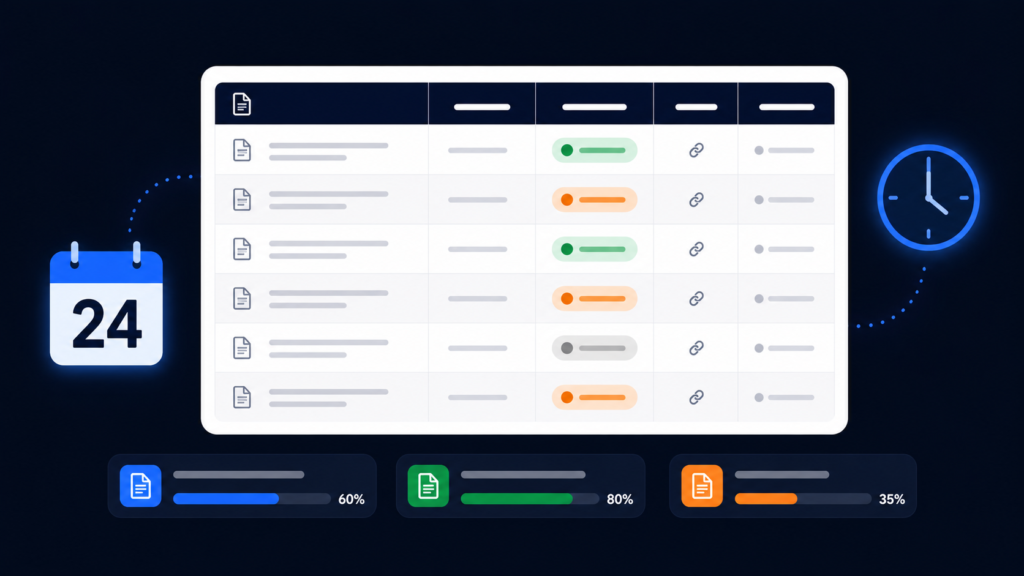
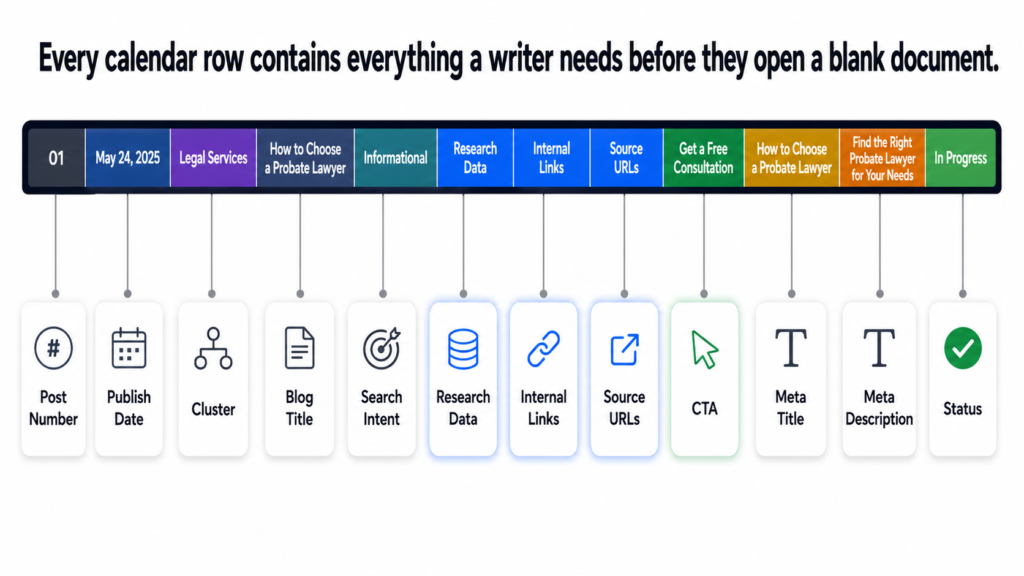
The calendar I built for Tiger Tail was designed around one principle: every row should contain everything a writer needs to start immediately with no additional briefing required. The calendar is the brief. The moment a post moves to “in progress,” the writer already has the research data, the source URLs, the internal links, the intent classification, and the CTA. Nothing is left to figure out.
A content calendar is only useful if it removes decisions, not adds them. Every decision about a post should be made when the calendar row is built, not when the writer opens a blank document.
What Every Calendar Row Contains
Here is the exact column structure used for every one of the 110 posts in the Tiger Tail calendar:
| Column | What It Contains | Why It Matters |
|---|---|---|
| Post Number | Sequential 1 to 110 | Tracks progress at a glance |
| Publish Date | Specific date from June 2026 | Removes scheduling decisions |
| Cluster | Which of the 11 clusters | Links post to parent page |
| Blog Title | Working title | Keyword-aligned, intent-matched |
| Search Intent | Informational, How-To, Comparison | Determines structure and depth |
| Research Data | Full stats from Perplexity Sonar | Writer uses this directly |
| Internal Links | Specific tigertail.co pages | No guessing where to link |
| External Links | Source URLs for every stat | Inline citations ready to use |
| CTA | One specific call to action | Placed once, where it earns its place |
| Meta Title | Under 60 characters | SEO-ready before publishing |
| Meta Description | Under 160 characters | No writing needed at publish time |
| Status | Not Started, In Progress, Written, Edited, Published | Single source of truth for progress |
Twelve columns per row. One hundred and ten rows. Every decision about every post made before the writing starts. A writer who picks up a brief from this calendar does not need to ask any questions. Everything is already there.
The Publishing Pace and Why It Was Set This Way
The publishing pace for a new domain is not just a volume decision. It is a trust-building decision. Google needs time to learn a new site. Publishing fifty posts in the first month on a brand new domain does not accelerate that process. It looks like a spam pattern to a domain with no history.
1 post per week on Mondays
Why: New domain needs consistent signals, not volume bursts.
Google indexes and evaluates early posts carefully.
Foundation being established. Quality over quantity.
8 posts published. All 11 clusters get early coverage.PHASE 2 — Week 9 onwards (July 27 2026)
2 posts per week — Mondays and Thursdays
Why: Domain has 8 weeks of consistent publishing history.
Google has begun learning the site structure.
Increasing pace signals growth, not spam.
102 remaining posts published across 51 weeks.
TOTAL DURATION
Approximately 24 months from first publish to post 110.
This is not slow. This is sustainable and compound-friendly.
The ramp from one to two posts per week was deliberately delayed until week nine. Eight weeks of consistent single-post publishing gives the domain enough history that doubling the pace looks like organic growth rather than a sudden content dump. The distinction matters to how Google interprets the signal.
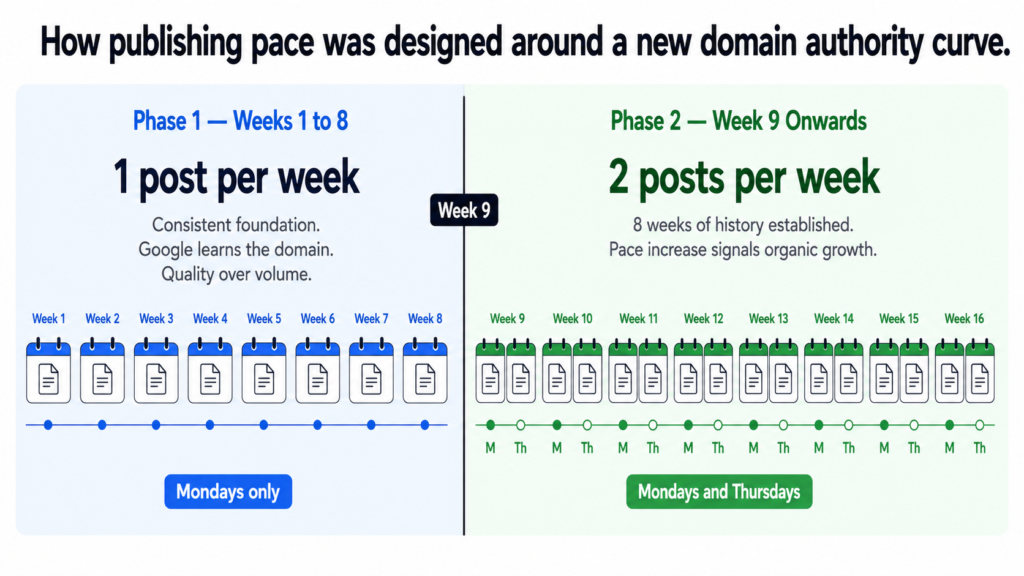
Publishing frequency on a new domain is a trust signal, not just a volume metric. Sudden spikes in publishing on a site with no history look very different to Google than a gradual ramp that mirrors how a real business grows its content operation.
The Cluster Priority Order
The order in which clusters get their first posts published was not decided alphabetically or by which felt most important to the client. It was decided by competition level and by what would give the domain the fastest path to early ranking signals.
| Priority | Cluster | Reason |
|---|---|---|
| 1st | AI Audit and Strategy | Establishes what the business does. First impression for Google. |
| 2nd | Home Services | Lower competition. Local long-tail keywords. Early wins possible. |
| 3rd | Workflow Automation | Strong long-tail demand. Less dominated by big brands. |
| 4th | Legal | Higher volume. Domain has history by now. Timing matters here. |
| 5th | Real Estate | Competitive but authority building from clusters 1 to 4. |
| 6th | Healthcare | Mid-competition. Domain credibility growing by this point. |
| 7th | Finance and Accounting | Specialist audience. Benefits from established domain trust. |
| 8th | Custom AI Development | Competitive space. Needs domain authority to compete. |
| 9th | Growth Engineering | Broad keyword competition. Later timing is strategic. |
| 10th | Systems and Operations | Niche audience. Works better once domain has full authority. |
| 11th | AI Training and Enablement | Lowest search volume. Low competition but small audience. |
The first three clusters were chosen because they give a new domain the fastest path to real ranking signals. Lower competition keywords on a new domain rank faster. Those early rankings build the domain authority that makes it possible to compete for the higher-volume keywords in clusters four through seven later in the program.
Starting with the legal cluster, which targets “ai for law firms” at 1,300 monthly searches, on a brand new domain would mean months of sitting on page ten for a keyword that Forbes, HubSpot, and established legal tech publications are already competing for. Starting there after six months of authority building from clusters one through three changes that calculation significantly.
On-Page Requirements Built Into Every Row
The calendar also carries on-page SEO requirements for every post so nothing gets published with missing elements. These are not suggestions. They are publishing gates.
Meta title under 60 characters — pre-written in calendar
Meta description under 160 characters — pre-written in calendar
At least one image with descriptive alt text
URL slug matching the primary keyword
Internal link to the parent service or industry page
2 to 3 internal links to related posts in the same cluster
CTA pointing to the relevant service page or booking link
All external stats linked inline to their source URLs
These are gates, not guidelines.
A post missing any of these does not get published.
The meta title and meta description are written when the calendar row is built, not when the post is about to go live. This matters because writing SEO metadata under deadline pressure produces generic titles that do not perform. Writing them as part of the planning process, when there is no urgency, produces titles that are actually designed to be clicked.
The Domain Authority Building Work That Runs Alongside Content
Content is the primary organic acquisition channel but it does not operate in a vacuum on a new domain. The calendar strategy included a set of parallel activities designed to accelerate the authority-building process from day one.
Clutch, G2, DesignRush, GoodFirms.
Each listing is a citation and a potential backlink.
Priority: first 30 days.
One guest post in first 3 months
One authoritative industry publication in the AI or SMB space.
A single quality backlink early on does more than
ten directory listings for domain authority signals.
Resource page outreach
Relevant AI consulting and automation resource pages.
Ask to be listed where genuinely relevant.
LinkedIn publishing
Every blog post shared on LinkedIn at publish time.
Drives early traffic signals back to new content.
Google notices traffic from social as a relevance signal.
Google Search Console setup — day one
Submit sitemap immediately. Monitor crawl coverage.
Catch indexing issues before they compound.
Google Analytics setup — day one
Track what is working from the first post published.
Data from month one informs decisions in month six.
Content without any off-page authority signals takes longer to move. These parallel activities do not replace the content work. They compress the timeline by giving Google additional trust signals while the cluster authority is still building.
What a 24-Month Calendar Actually Delivers
By the end of month 24, the Tiger Tail content program will have published 110 posts across 11 clusters, each one mapped to a commercial page, each one backed by real research and source citations, and each one part of an interconnected architecture that compounds in value every month it runs.
That is not a blog. That is an organic acquisition system that runs on a schedule, requires no paid media, and gets more valuable over time rather than less.
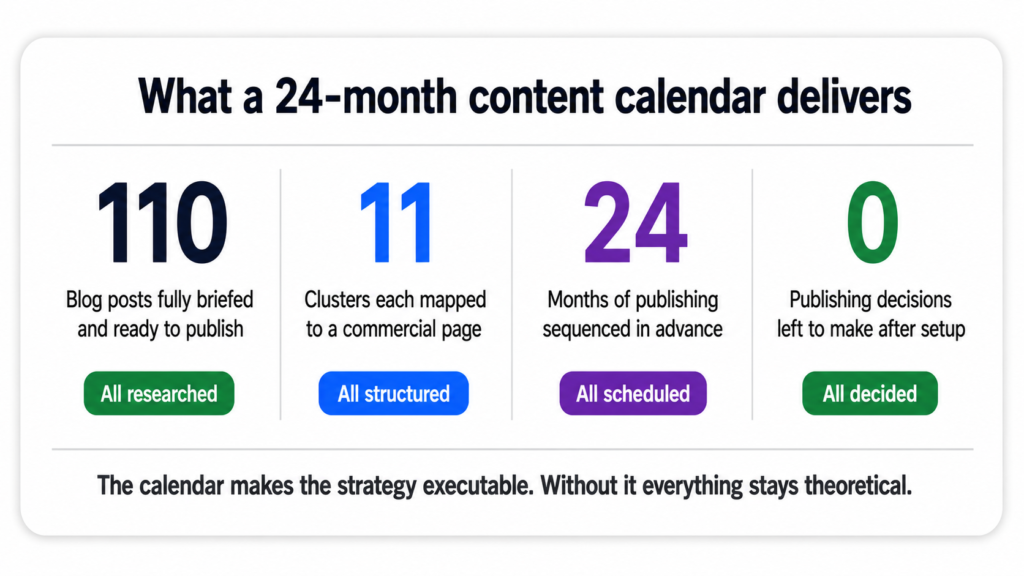
The calendar is not the strategy. It is the system that makes the strategy executable. Without it, even the best keyword research and cluster architecture stays theoretical. With it, 110 decisions are already made and every week the next post is ready to publish.
I Built This for a Client. I Can Build It for You.
A complete blog calendar built for your business — researched, structured, and ready to publish
What I built for Tiger Tail — the keyword mapping, the Perplexity Sonar research, the cluster architecture, the 110-post calendar with every row pre-loaded — is something I build for businesses and agencies. If your content is not producing organic traffic, the calendar and the structure behind it is almost always the missing piece.
Here is what you get:
- Full keyword research mapped to every page on your site
- Cluster architecture designed around your services and industries
- Research data pack for every post — real stats, named sources, citation URLs
- Complete publishing calendar with meta titles, meta descriptions, intent classification, internal links, CTAs, and status tracking — all pre-built
- Publishing pace and cluster priority order matched to your domain’s current authority level
Book a free 30-minute call
See the full SEO strategy service
The last post in this series covers how I brief AI to write industry-specific content that actually sounds like it was written by someone who knows the subject: how I brief AI to write content that does not sound generic.

Dhruv The SEO Guy
I do SEO for agencies, founders, and business owners. No fixed packages. No fluff. Just technical, revenue-focused strategies that scale your organic presence securely.
Ready to dominate search?
Stop reading about algorithms and start ranking. Book a quick 1-on-1 strategy call below.
Book a Strategy Call →