TL;DR
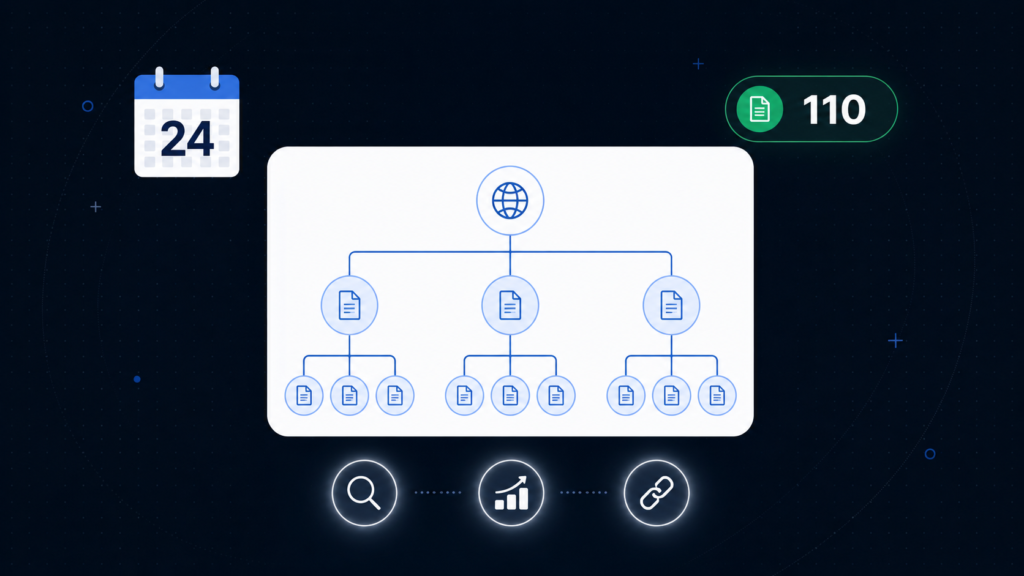
A client came to me needing a content strategy for a new AI consultancy website. What started as "we need some blog ideas" turned into a fully researched, 110-post, 24-month SEO content program built around 11 topic clusters, real keyword data, and industry-specific research for every single post. This is how I built it, what decisions went into it, and what the thinking was behind every layer of the strategy.
How This Started
The brief was not complicated. A new AI implementation consultancy — Tiger Tail, based in Montclair, NJ — had just launched their website and needed a content strategy. They serve small and mid-size businesses across industries like legal, healthcare, real estate, home services, and finance. The site had industry pages and service pages already mapped out. What it did not have was a blog that could actually build organic traffic over time.
This is a situation I see constantly. The website exists. The pages are live. But without a content layer built around what the target audience is actually searching for, those pages sit there doing nothing. Google has no reason to show the site to anyone because there is no signal of depth, authority, or relevance yet.
The goal was to build that signal. Deliberately, systematically, over 24 months.
The Starting Point: Keywords and Page Mapping
Before writing a single brief or topic idea, the first step was understanding what the site was already trying to rank for and what search volume existed behind each page.
Every industry page and service page got mapped to its primary keywords and monthly search volumes. Not as a rough estimate but with specific data points that shaped priority decisions later.
A few examples from the service pages alone:
keyword-page-mapping.txt
Service Page                          Primary Keyword                    Monthly Searches

/services/ai-audit-strategy            ai strategy consultant                      880
/services/ai-audit-strategy            ai readiness assessment                     720
/services/growth-engineering           ai marketing automation                     720
/services/custom-ai-development        ai integration services                     590
/services/ai-audit-strategy            automation consultant                       480
/services/custom-ai-development        custom ai development company               480
/ai-for-legal                          ai for law firms                          1,300
/ai-for-real-estate                    ai real estate agent                        590
This mapping does two things. First, it tells you which pages matter most from a traffic potential standpoint. Second, it tells you which blog clusters need to be built first to support those pages with topical authority before competitors lock in their positions.
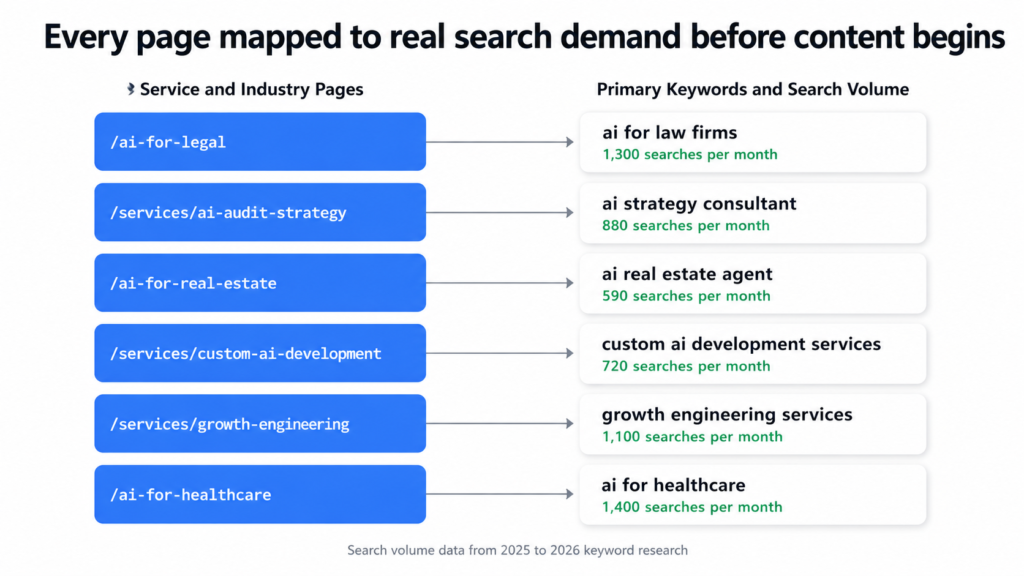
The legal page targeting “ai for law firms” at 1,300 searches per month, for example, is a page worth fighting for. But a new domain cannot rank for that keyword by just having a service page. It needs a cluster of supporting blog content that signals to Google that this site genuinely understands legal AI from multiple angles.
Building the Cluster Architecture
The core structural decision was to organise the entire blog around topical clusters rather than individual posts. Eleven clusters in total, each one mapped to either a service page or an industry page, each containing ten posts.
| Cluster | Parent Page | Posts |
|---|---|---|
| AI Audit and Strategy | /services/ai-audit-strategy | 10 |
| Workflow Automation | /services/workflow-automation | 10 |
| Custom AI Development | /services/custom-ai-development | 10 |
| Systems and Operations Design | /services/systems-operations-design | 10 |
| Growth Engineering | /services/growth-engineering | 10 |
| AI Training and Enablement | /services/ai-training-enablement | 10 |
| Home Services | /ai-for-home-services | 10 |
| Real Estate | /ai-for-real-estate | 10 |
| Legal | /ai-for-legal | 10 |
| Healthcare | /ai-for-healthcare | 10 |
| Finance and Accounting | /ai-for-finance-accounting | 10 |
110 posts total. Each cluster functions as a self-contained body of content on one subject, with every post linking back to the parent page and cross-linking to related posts within the same cluster. The effect builds over time: the more posts in a cluster, the stronger the topical authority signal, and the more likely every post in that cluster is to rank higher than it would in isolation.
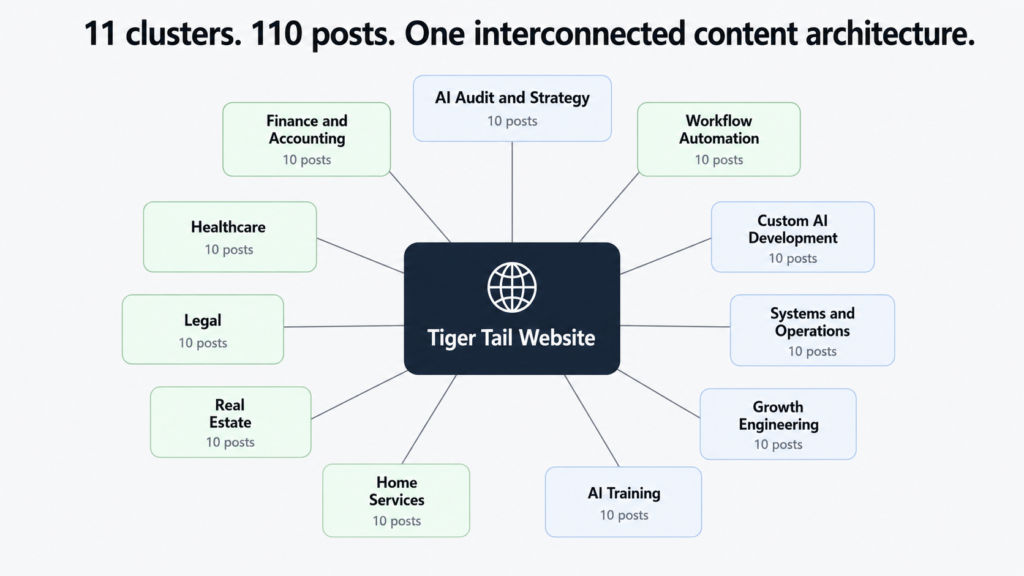
One post about AI for law firms is a blog post. Ten interconnected posts about AI for law firms, each covering a different angle and all linking back to the same service page, is a topical authority signal. Google treats these very differently.
The Research Layer: Where Most Strategies Stop Short
Topic ideas are the easy part. Every SEO agency can give you a list of blog titles. What separates a content strategy that actually performs from one that just fills up a blog page is the research behind each post.
For this project, every single post got its own research data pulled from Perplexity Sonar. Not generic AI training data. Live web research with real statistics, named sources, publication dates, and citation URLs.
The difference this makes is significant. A blog post about physician burnout that says “burnout is a growing problem in healthcare” is forgettable. A blog post that cites the AMA’s finding that 43.2 percent of physicians reported at least one symptom of burnout in 2024, down from 48.2 percent in 2023 but still far above 2011 levels, with a link to the source — that is a post that earns trust and ranks.
I cover exactly how I run the Perplexity Sonar research process in the next post in this series. The short version is that each cluster required a dedicated research prompt designed to return current statistics, pain points with quantified data, ROI benchmarks, and competitor content gaps. That research became the backbone of every brief.
The Publishing Strategy: Pace and Cluster Priority
A common mistake in content strategy is publishing randomly across topics and hoping something sticks. The publishing plan for this project was deliberately sequenced.
publishing-schedule.txt
# Publishing pace

Weeks 1 to 8    1 post per week on Mondays
Week 9 onwards  2 posts per week — Mondays and Thursdays
Total duration  approximately 24 months

# Cluster priority order (lowest to highest competition)

1.  AI Audit and Strategy       — establishes what the business does
2.  Home Services               — lower competition, local long-tail
3.  Workflow Automation         — strong long-tail, less dominated
4.  Legal                        — higher volume, domain has history by now
5.  Real Estate                  — competitive but authority building
6.  Healthcare                   — mid competition
7.  Finance and Accounting
8.  Custom AI Development
9.  Growth Engineering
10. Systems and Operations
11. AI Training and Enablement
The logic behind starting slow and ramping up is that Google needs time to learn a new domain. Publishing 20 posts in the first month on a brand new site does not accelerate that process. Publishing consistently, at a pace the site can sustain, signals stability and intent. The ramp to two posts per week after eight weeks happens once the foundation is established.
The cluster priority order follows a deliberate pattern too. Start with the clusters where competition is lowest so early posts have a realistic chance of ranking while the domain is still young. Build authority there. Then move into more competitive territory once Google has started to trust the site.
Publishing high-competition content too early on a new domain is one of the most common content strategy mistakes. The posts exist, they just sit on page eight indefinitely. Starting with winnable keywords lets early content generate signals that lift everything published later.
What the SEO Timeline Actually Looks Like
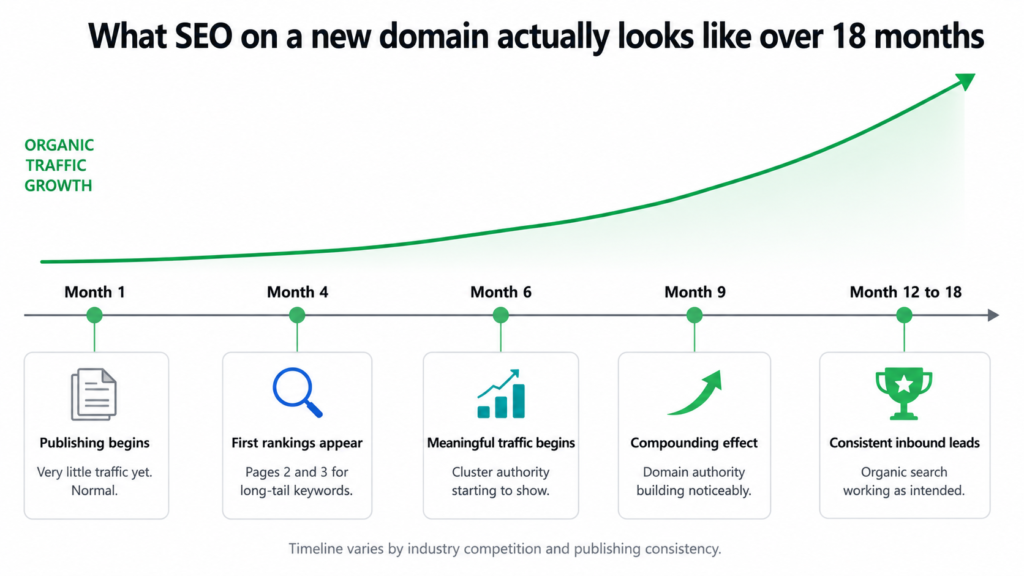
Part of building a strategy is being honest with the client about what to expect and when. Content SEO on a new domain does not produce results in the first month. Anyone who tells you otherwise is selling something.
seo-timeline-expectations.txt
Months 1 to 4
Publishing consistently. Very little organic traffic yet.
Google is learning the site. Foundation being built.

Months 4 to 6
First long-tail posts appearing on pages 2 and 3.
Some early page 1 wins on low-competition keywords.

Months 6 to 9
Meaningful organic traffic begins.
Cluster authority starts to show in rankings.

Months 9 to 12
Compounding effect begins.
Domain authority building noticeably.

Months 12 to 18
Consistent inbound leads from organic search.
Earlier posts climbing as domain strengthens.
This timeline is what I shared with the client upfront. Not because it is pessimistic but because it is accurate. Content SEO compounds. The value of every post published in month two does not peak in month two. It peaks in month ten when the domain has authority, the cluster has depth, and Google has seen consistent publishing for nearly a year.
The businesses that give up at month three are the ones that never find out what month twelve would have looked like.
The Writing Framework
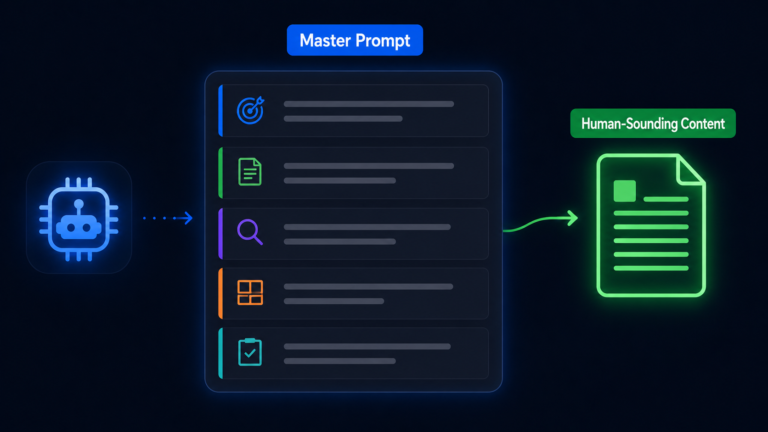
With 110 posts across 11 different industries and service areas, consistency of quality was a real challenge. The solution was a master writing prompt that every post gets written through — one that carries the brand voice, tone rules, structural requirements, and humanizer guidelines, and adapts by industry.
The prompt covers things like: never open with “In today’s digital landscape,” no em dashes anywhere, every strong claim backed by a named source with an inline link, and a specific tone shift depending on whether the post is for a home services contractor or a law firm partner. Those two audiences need to be spoken to completely differently even if the underlying AI subject is similar.
I cover the full writing framework and how to build one in the last post in this series.
What This Whole Thing Actually Delivers
At the end of this process, the client had something most businesses never build: a content system with a reason behind every decision. Every post has a cluster it belongs to. Every cluster has a parent page it supports. Every parent page has keywords worth ranking for. And every keyword was chosen because real people search for it when they have a problem the client can solve.
That is not a blog. That is a compounding organic acquisition channel built to run for two years and keep delivering after that.
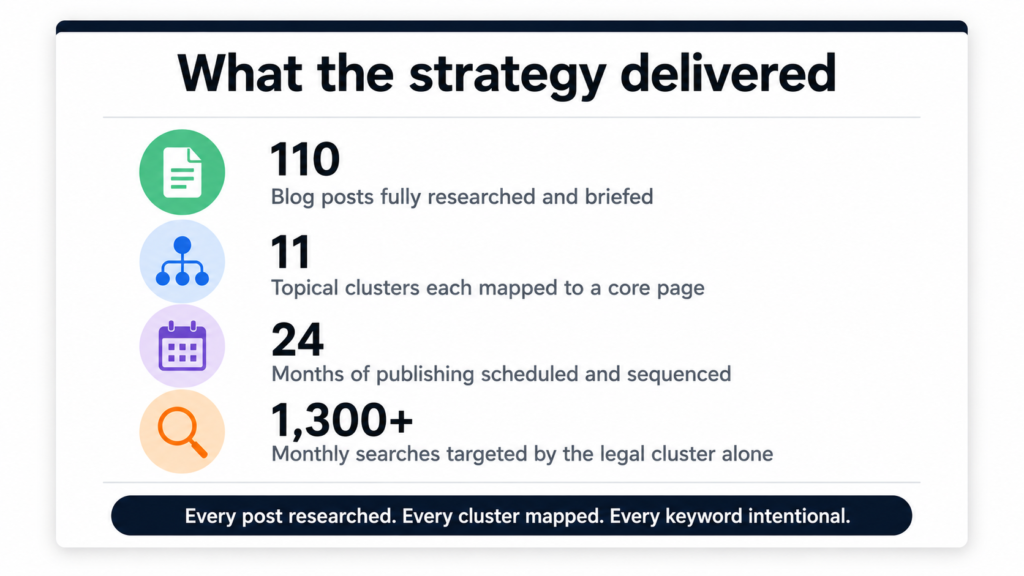
110 posts. 11 clusters. 24 months. Every post researched with real data, every cluster mapped to a page worth ranking, every keyword chosen with intent. This is what a content strategy looks like when it is built to actually work.
Want Something Like This for Your Business?
If you are running a business and your blog is either not working or not started yet, this kind of strategy is what bridges the gap between publishing and actually getting found. It is not about writing more. It is about building the right architecture before the first post goes live.
The next posts in this series go deeper into each layer of the process — keyword mapping, research with Perplexity Sonar, cluster architecture, publishing strategy, and the writing framework. If you want to talk about building this for your own business, book a call.
See how I build SEO strategy →
Dhruv is an SEO consultant working with business owners, founders, and agencies. If organic search is not delivering for your business, this is where to start.

Dhruv The SEO Guy
I do SEO for agencies, founders, and business owners. No fixed packages. No fluff. Just technical, revenue-focused strategies that scale your organic presence securely.
Ready to dominate search?
Stop reading about algorithms and start ranking. Book a quick 1-on-1 strategy call below.
Book a Strategy Call →