TL;DR
ChatGPT does not rank pages the way Google does. When it searches the web, it retrieves a handful of candidate pages, reads through them, and decides which ones are worth citing in its answer. Research on roughly 700,000 real ChatGPT conversations found that the opening question in a chat is over twice as likely to trigger a citation as a follow-up question, so the content that wins is the content that answers the very first thing someone asks. ChatGPT also rarely picks a single winner. It tends to cite several sources side by side, often pulling from Wikipedia and other high-authority references first. What pushes a page into that group: a direct answer in the first sentence or two of a section, clear heading structure, specific numbers and data instead of generalities, and content that is current rather than years old. Pages under around 500 words rarely get cited at all, not because length is the goal, but because short pages usually do not cover enough to be useful as a source.
ChatGPT is not Google, and ranking means something different here
“How do I rank in ChatGPT” is a slightly misleading question, but it is the question people actually ask, so it is worth answering directly.
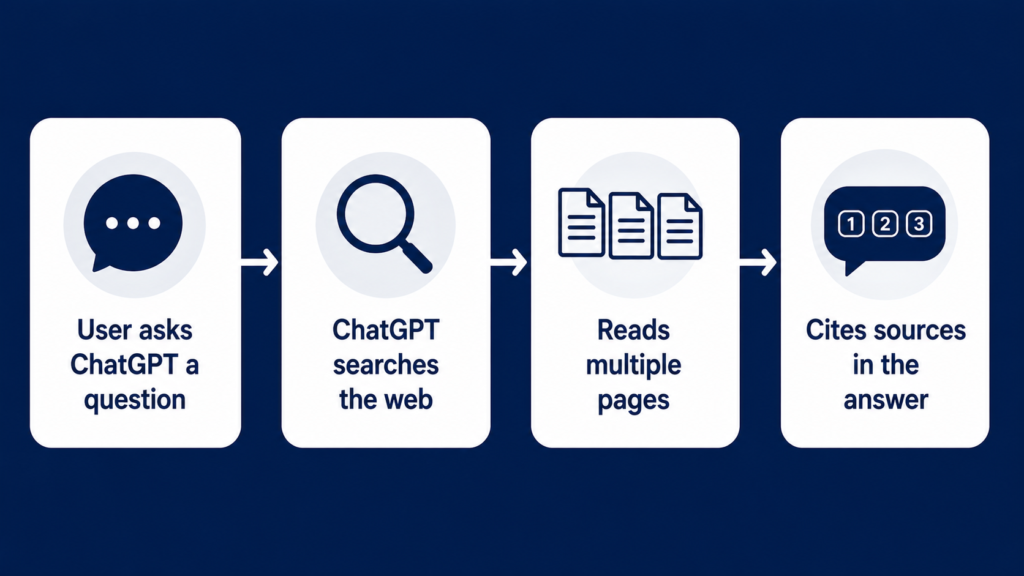
Google ranking is about position. Your page sits at number 3 or number 7 for a given keyword, and that position is fairly stable until something changes. ChatGPT does not have positions. According to OpenAI’s own documentation on ChatGPT search, when a question benefits from current information, ChatGPT searches the web, reads through the results, and returns an answer with inline citations linking to the sources it used. There is no leaderboard. There is only: did your page get pulled into this specific answer, or not.
That means “ranking in ChatGPT” really means becoming one of the sources ChatGPT reaches for when it needs to answer a question in your topic area. The rest of this post covers how that selection actually works, and what makes a page worth picking.
If you have not yet read our overview of what answer engine optimization is, this post builds directly on that. The mechanics described here are specific to ChatGPT, but the underlying goal, being a source AI systems trust enough to cite, is the same one that pillar page covers more broadly.
The first question in a conversation matters more than anything that follows
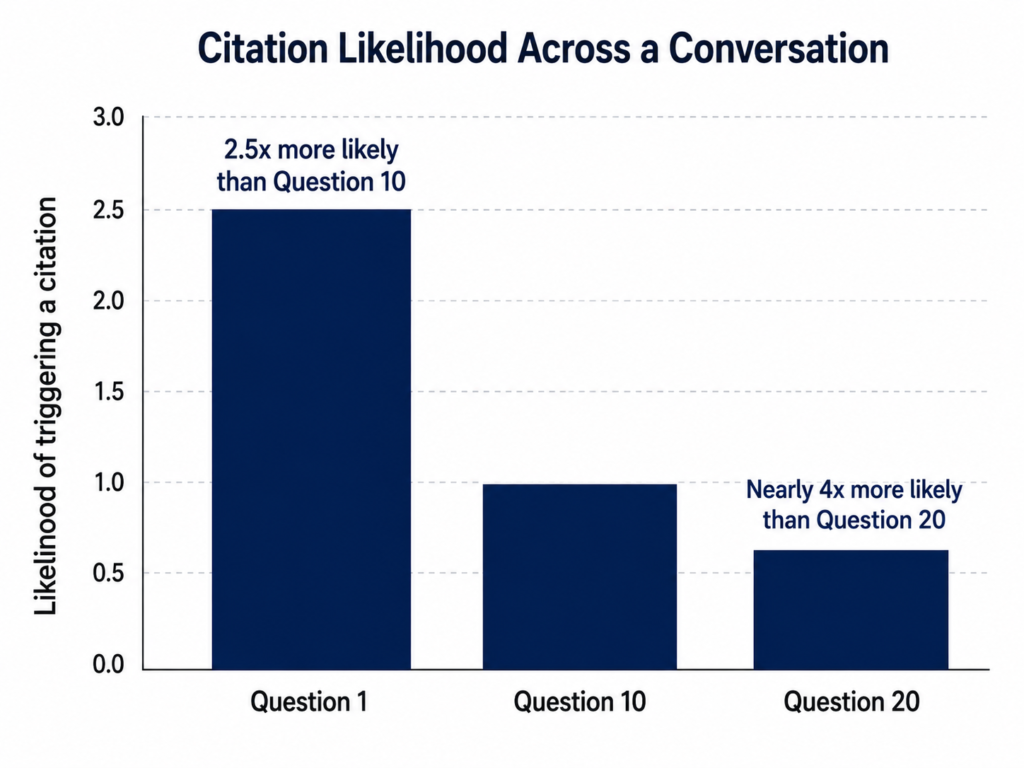
One of the more useful findings from recent research comes from an analysis of around 700,000 real ChatGPT conversations. It found that the opening question in a conversation is roughly 2.5 times more likely to trigger a citation than the tenth message, and nearly 4 times more likely than the twentieth.
In practice, this means the question someone types when they first open ChatGPT and start a new topic is the one that matters most for citations. Follow-up questions, clarifications, and “tell me more about that” style messages rarely send ChatGPT back out to search the web again. So if you are thinking about which queries to target, think about what someone would type as their very first message on a topic, not the deeper, more specific questions they might ask three messages into the conversation.
This has a practical effect on how you structure content. A page that answers the broad, opening-style question clearly near the top, and then goes into the more specific sub-questions further down, is positioned to catch that first citation opportunity while still covering the detail someone might want later.
ChatGPT rarely picks one winner
Unlike a Google results page, where ten links compete for clicks, ChatGPT tends to cite multiple sources in the same answer, often side by side. If you are cited once, that does not mean you have “won” the query the way ranking first on Google would feel like winning.
This changes what success looks like. Instead of aiming to be the only source ChatGPT mentions, a more realistic goal is to consistently be one of the few sources that show up across the range of questions in your topic area. Being present in a high percentage of relevant conversations matters more than being the sole citation in any one of them.
It is also worth knowing that ChatGPT’s citation rates vary enormously by topic and by how the underlying retrieval works. A study of over 34,000 AI responses found a roughly 46-times difference in how often brands got cited between ChatGPT and other AI platforms. So a page that performs well in Perplexity or Google AI Overviews is not guaranteed to perform the same way in ChatGPT, and the reverse is also true.
What makes a page worth citing
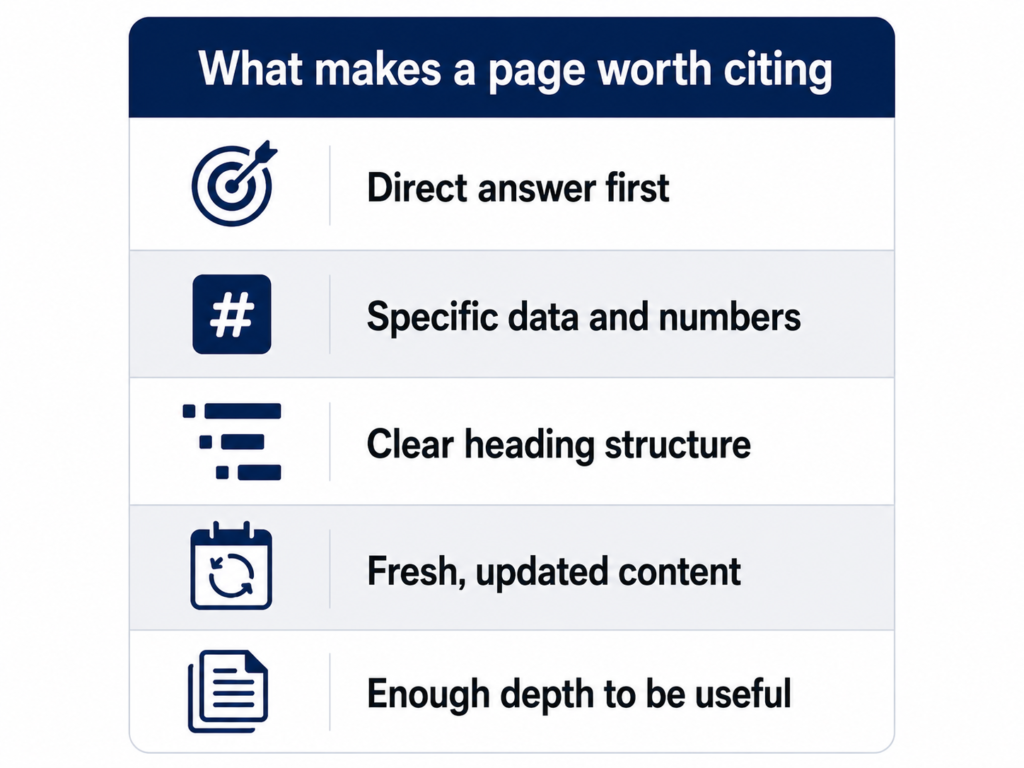
Across the research on this topic, the same handful of patterns come up again and again.
The answer comes first. ChatGPT favors content that states the answer directly near the top of a section, then explains or expands afterward. A section that opens with a few sentences of throat-clearing before getting to the point is less likely to be the one quoted, even if the actual information further down is good.
Specific numbers beat general claims. A sentence with a real figure attached to it, a percentage, a timeframe, a sample size, gives ChatGPT something concrete to extract. Vague statements like “many businesses see improvements” do not give the model anything to cite, because there is nothing specific to attribute.
Clear heading structure. Pages that use a logical hierarchy of headings, where each section covers one clearly defined sub-topic, are easier for ChatGPT to scan and match against a question. This is the same structural advice that matters for AI Overviews and Perplexity, and it is worth getting right once rather than reworking content separately for each platform.
Freshness. Content with outdated dates or references signals to both the model and the reader that it might not reflect the current situation. This does not mean every page needs constant rewrites, but pages on topics that change, pricing, tools, statistics, benefit from periodic updates.
Enough depth to actually be useful. Very short pages, often cited as being under roughly 500 words, rarely get picked as sources. This is not because there is a minimum word count requirement. It is because a page that short usually has not covered the topic thoroughly enough to be the thing ChatGPT reaches for when it needs a reference.
Where Wikipedia and high-authority sources fit in
It is worth being realistic about one part of this. A large share of ChatGPT’s citations, particularly for general knowledge and definitional questions, go to a small number of very high-authority sources, with Wikipedia accounting for a large portion on its own.
This does not mean a smaller business site cannot get cited. It means the competition for purely definitional questions, “what is X,” is steep, and the more realistic opportunity for most businesses is in the questions that sit one or two steps past the definition: how something works in practice, what it costs, how it compares to alternatives, or what a real result looked like. These are the questions where a specific business with direct experience has something a general reference source does not.
This is also where first-party data earns its keep. A page that includes a result you actually measured, like the kind of before-and-after numbers in our Midstream Marketing case study, gives ChatGPT a specific, attributable fact that no general reference source can provide, because the data only exists on your page.
A practical starting point
Rather than trying to optimize an entire site for ChatGPT citations at once, it helps to start narrow.
Pick three to five questions that represent the kind of opening question someone in your audience would type into ChatGPT when they first start researching your topic. Ask those exact questions yourself and see what comes back. Note which sources get cited, and whether your site appears anywhere in the answer or the list of links ChatGPT shows.
For the pages that did not appear, check them against the patterns above. Does the relevant section open with a direct answer, or does it take a paragraph to get there? Does it include any specific numbers, or is it written in generalities? Is the heading structure clear enough that someone scanning just the headings would understand the page?
Fixing these issues on a small number of high-value pages tends to move the needle faster than spreading the same effort across an entire site. Once you have a sense of how your existing content performs, that becomes the baseline for deciding what to fix first and what to leave alone.
If you want help running this kind of audit on your own site, you can see our AEO and SEO services or book a call and we can walk through it together.

Dhruv The SEO Guy
I do SEO for agencies, founders, and business owners. No fixed packages. No fluff. Just technical, revenue-focused strategies that scale your organic presence securely.
Ready to dominate search?
Stop reading about algorithms and start ranking. Book a quick 1-on-1 strategy call below.
Book a Strategy Call →