TL;DR
Getting AI to write industry-specific content that sounds like it was written by someone who actually knows the subject requires one thing: a master writing prompt that is specific enough to constrain the output and flexible enough to adapt by industry. This post covers the full prompt framework used across 110 blog posts for five different industries, the tone rules that make content sound human rather than generated, and the humanizer pass that catches AI writing patterns before anything gets published.
This is the final post in the series. You can read the full strategy overview, keyword mapping, Sonar research process, cluster architecture, and publishing calendar strategy in the earlier posts.
The Problem With Generic AI Content
Ask any AI to write a blog post about AI for law firms without a proper prompt and you will get something that reads like a Wikipedia summary written by a consultant who has never worked with a law firm. Every sentence is technically accurate. Nothing is specific. The tone is the same whether the audience is a solo attorney or a healthcare CFO. It sounds like every other AI blog post because it was produced the same way every other AI blog post is produced.
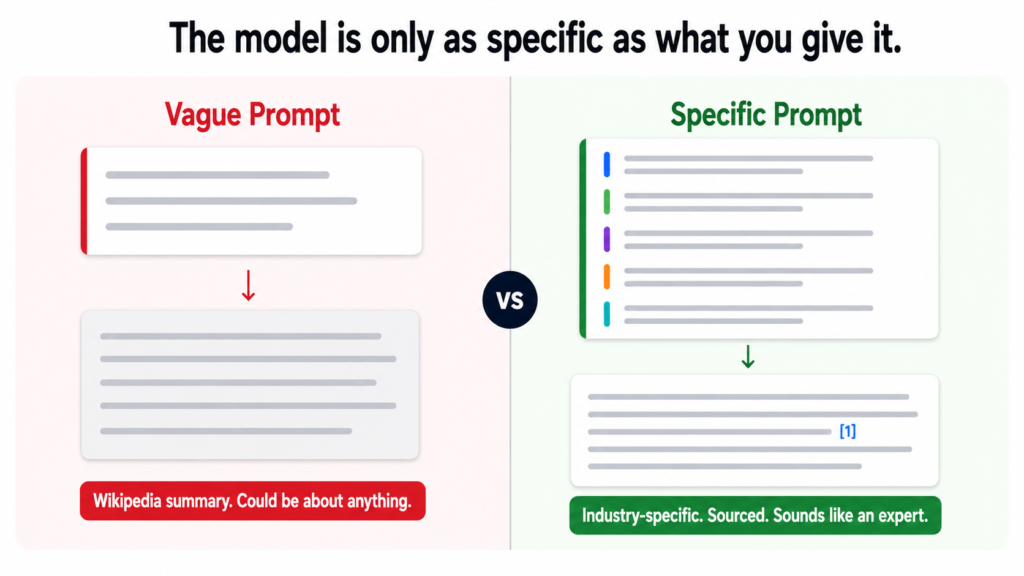
The fix is not a better AI model. It is a better input. The model is only as specific as what you give it. A vague prompt produces vague output. A highly specific prompt with clear tone rules, structural requirements, and sourced research data produces something that actually reads like it came from someone who knows the industry.
For the Tiger Tail project, 110 posts across five distinct industries needed to sound different from each other. A home services contractor does not want to read the same prose style as a law firm partner. Healthcare administrators do not respond to the same tone as accounting firm owners. The writing framework had to produce genuinely different output for genuinely different audiences from the same underlying system.
A prompt is not a topic request. It is a detailed instruction set that constrains how the model writes, what it includes, what it avoids, and how it adapts to each audience. The more specific the constraint, the more specific the output.
The Master Prompt Structure
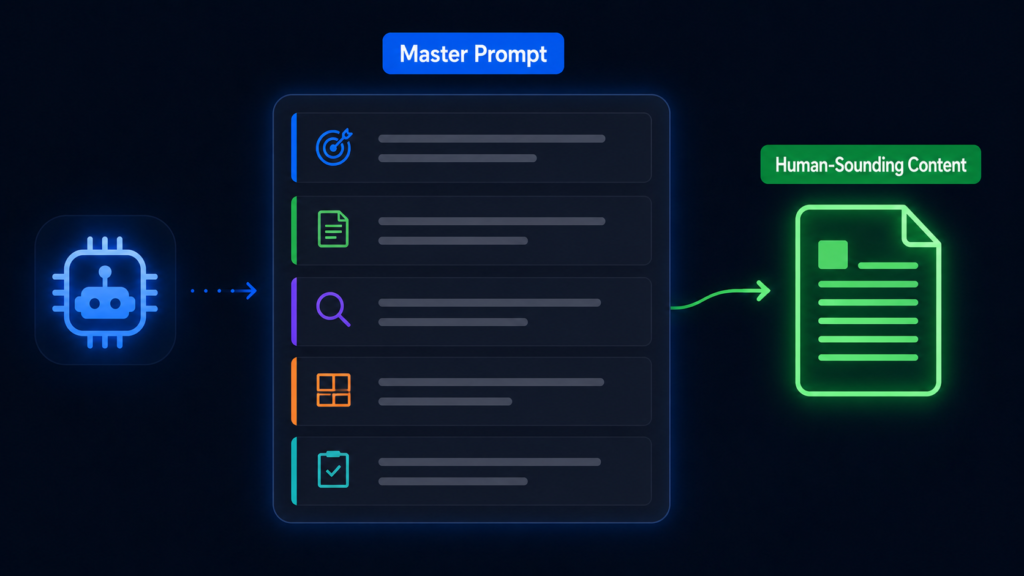
Every blog post across all 110 briefs was written through a single master prompt. The prompt has five core sections. Each one does a specific job.
Who the brand is. Who they serve. What they do.
What the reader looks like when they land on this post.
This grounds every word in a specific person reading it.Section 2 — Writing Style Rules
Be direct. Say the thing plainly. No hedging.
Short sentences. Vary the rhythm.
Never open with a filler line.
No corporate speak. No em dashes anywhere.
Data leads. Back every strong claim with a named source.
Have a point of view. React to the data, do not just report it.Section 3 — Tone by Industry
Home Services: plain and blunt. Lead with money and time.
Real Estate: practical and fast-moving. Leads and closings.
Legal: precise and careful. Acknowledge complexity and risk.
Healthcare: empathetic and accurate. Never oversell.
Finance and Accounting: numbers first. Conservative claims.
Section 4 — Structure Rules
No fixed template. Let intent guide structure.
Headers only when the content genuinely needs them.
Open with the specific problem. End with a concrete takeaway.
CTA once only, placed where it earns its place.
Section 5 — Link and Citation Rules
External links embedded inline on the stat they support.
Internal links placed naturally in body context.
No links listed at the bottom. No forced placements.
The brand and audience context section is what most prompts skip entirely. Without it, the model has no reference point for who is reading. With it, every sentence is written toward a specific person in a specific situation rather than a generic professional in a vague industry.
The Tone Rules That Make the Biggest Difference
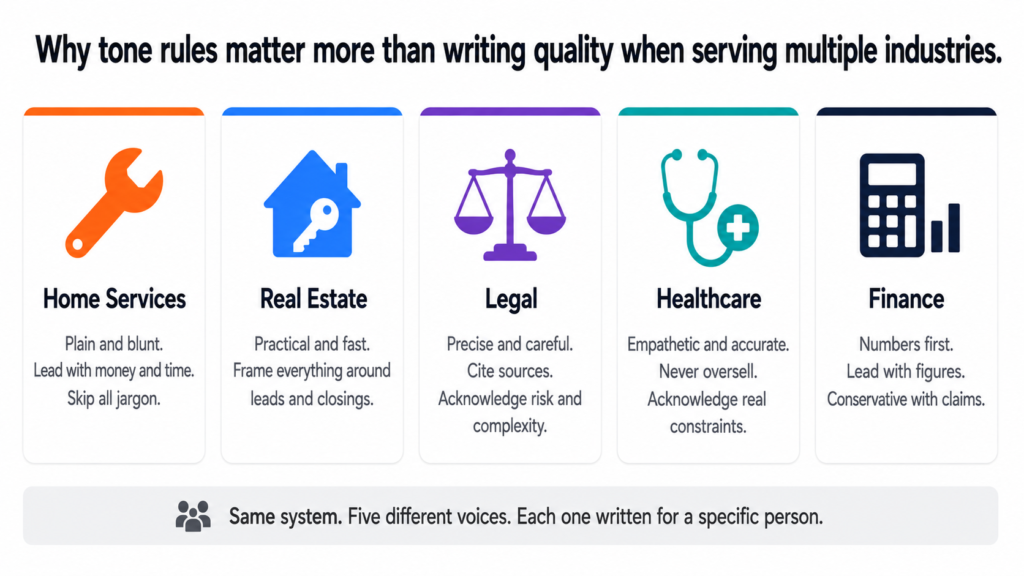
The tone-by-industry section of the prompt is what makes a legal post read differently from a home services post even though both go through the same system. Here is what each industry tone rule actually produces in practice:
| Industry | Tone Rule | What It Produces |
|---|---|---|
| Home Services | Plain and blunt. Lead with money and time. Skip jargon entirely. | A contractor reads it and thinks: this person gets how my business works. |
| Real Estate | Practical and fast-moving. Frame everything around leads, response time, and closings. | An agent reads it and immediately applies it to their pipeline. |
| Legal | Precise and careful. Cite sources properly. Acknowledge complexity and risk. | A lawyer reads it and trusts the accuracy. Does not feel oversold to. |
| Healthcare | Empathetic and accurate. Never oversell. Acknowledge real constraints. | A physician reads it and feels understood rather than marketed to. |
| Finance | Numbers first. Lead with figures. Be conservative with claims. | An accountant reads it and finds it credible enough to share with clients. |
The difference between a healthcare post and a home services post is not just vocabulary. It is the entire posture of the writing. Healthcare content that leads with money the way home services content does would feel wrong to a physician. Home services content that hedges and acknowledges complexity the way legal content does would lose a contractor in the first paragraph.
The Filler Openers List
One of the most specific sections of the prompt is a list of opening lines the model is explicitly told never to use. This matters more than it sounds. AI defaults to filler openers because they are the most statistically common way articles begin in its training data. Without a specific prohibition, the model will produce them every time.
“As businesses continue to evolve…”
“In an era of rapid technological change…”
“Whether you are a small business or a large enterprise…”
“Artificial intelligence is transforming the way…”
“It is no secret that…”
“Now more than ever…”
“In recent years, the rise of AI has…”
“Let us dive in.”
“Here is what you need to know.”INSTEAD: Open with the specific problem.
Name it plainly. No warm-up. No throat-clearing.
The reader should feel addressed by the second sentence.
Every one of those openers signals to a reader that the content was not written for them specifically. They have read that sentence a hundred times on a hundred different sites. Banning them forces the model to find a more direct entry point, which almost always produces a better opening than the default.
The Humanizer Pass
Even with a strong prompt, AI writing has patterns that accumulate across a long piece. Small habits that individually seem fine but collectively make the content feel generated rather than written. The humanizer pass catches these before anything gets published.
“Testament to”, “pivotal moment”, “underscores”,
“highlights the importance of”, “it is worth noting”.
Replace with the plain statement the inflation was hiding.Promotional language
Any word that sounds like marketing copy.
Seamless. Robust. Transformative. Game-changing.
These words mean nothing. Remove them.
Superficial -ing phrases
“Showcasing”, “reflecting”, “contributing to”,
“fostering”, “enabling”. These verbs add no meaning.
Replace with a direct statement of what actually happened.
Rule of three
Listing three synonyms when one would do.
“Efficient, productive, and streamlined.”
Pick one. The best one. Cut the other two.
Negative parallelism
“It is not just X, it is Y.” Always feels performative.
Just say Y. The contrast adds nothing.
Vague attributions
“Experts say”, “studies show”, “research indicates”.
Name the expert. Name the study. Name the year.
If you cannot, remove the claim entirely.
Generic positive conclusions
“The future is bright”, “now is the time to act”,
“the possibilities are endless”.
End with something specific or do not end with a conclusion.
The humanizer pass is not a stylistic preference. It is a quality gate. Every one of those patterns makes content feel less trustworthy to the reader, even if they cannot articulate why. Removing them is what takes a competent draft and makes it feel like something a real expert wrote.
The Final Check Before Publishing
Before any post from the Tiger Tail calendar goes live, it passes a final checklist. This is the last gate between the draft and the published URL.
No filler opener in the first paragraph
Every stat has an inline external link to its named source
Internal links appear naturally in context, not forced
CTA appears once only, where it earns its place
Tone matches the industry cluster it belongs to
Primary keyword in H1, first paragraph, and one H2
Meta title under 60 characters
Meta description under 160 characters
Image with descriptive alt text present
URL slug matches primary keyword
Humanizer pass completedAsk before publishing:
“What makes this obviously AI-generated?”
Fix those things. Then publish.
The last question in that checklist is the most important one. Not “does this read well” but “what would make a reader suspect this was generated.” That question forces a more honest review than general proofreading does because it is looking for the specific patterns that erode trust rather than just checking for errors.
What the Whole System Produces
Put together, the five layers covered across this series produce something most content strategies never achieve: a system where every post is intentional before it is written, researched before it is briefed, structured before it is published, and reviewed against the right standard before it goes live.
The keyword map tells you what to write and where it belongs. The Sonar research tells you what to say and how to back it up. The cluster architecture tells you how each post relates to everything around it. The calendar tells you when to publish it and removes every remaining decision. The writing framework and humanizer tell you how to make it sound like it was written by a person who genuinely knows what they are talking about.
None of these layers is complicated on its own. The value comes from all five working together. A calendar without research produces thin content. Research without a cluster produces isolated posts. Clusters without a framework produce inconsistent writing. The system only works when all five parts are in place.
I Built All of This. I Can Build It for Your Business.
The full content system — built for your website, your industry, your audience
Everything covered in this series is something I build for businesses and agencies. The keyword map. The Perplexity Sonar research data pack. The cluster architecture. The 24-month calendar with every row pre-loaded. The master writing prompt adapted to your brand voice and your industries. The humanizer rules built into every brief.
This is not a template. Every system I build is specific to the client. The Tiger Tail project took 11 clusters across 5 industries and produced 110 posts with full research and briefs. Yours will be built around your pages, your keywords, and your audience.
Here is what the engagement covers:
- Full keyword research and page mapping for your entire site
- Cluster architecture designed around your commercial pages
- Perplexity Sonar research data pack — real stats, named sources, citation URLs — for every post
- Complete publishing calendar with every row pre-loaded: meta titles, meta descriptions, intent, internal links, external sources, CTAs, and status tracking
- Master writing prompt built for your brand voice and adapted by industry or service area
- Humanizer checklist and final publish gate built into the workflow
- Publishing pace and cluster priority order matched to your domain’s current authority level
If you are a business owner who wants organic search working for you without paying for ads every month, or an agency that wants to deliver this kind of strategy for clients, book a call and let us talk through what it looks like for your specific situation.
Book a free 30-minute call
See the full SEO strategy service

Dhruv The SEO Guy
I do SEO for agencies, founders, and business owners. No fixed packages. No fluff. Just technical, revenue-focused strategies that scale your organic presence securely.
Ready to dominate search?
Stop reading about algorithms and start ranking. Book a quick 1-on-1 strategy call below.
Book a Strategy Call →