
TL;DR
Most business blogs get zero traffic not because the writing is bad but because there is no strategy behind the topics. Google does not reward effort. It rewards relevance. If you are picking topics based on what you feel like writing rather than what your audience is searching for, your content will stay invisible no matter how good it is. This post explains exactly why that happens and what actually works instead.
You Are Probably Doing Everything Right Except the One Thing That Actually Matters
You are publishing. You are consistent. The writing is decent and the information is real. But the traffic is not coming. A month passes. Then six. Sometimes a full year. And the blog that was supposed to bring in leads is just sitting there, invisible.
This is one of the most frustrating positions to be in because you followed the advice. Blogging is good for SEO. Content builds authority. Show up consistently and results will follow. You did all of that and got nothing back.
The problem is not your execution. The advice you followed was incomplete. Publishing consistently is necessary but it is not enough on its own. Without a strategy behind what you publish, the content has no real chance of ranking regardless of how well it is written.
The Number That Should Change How You Think About This
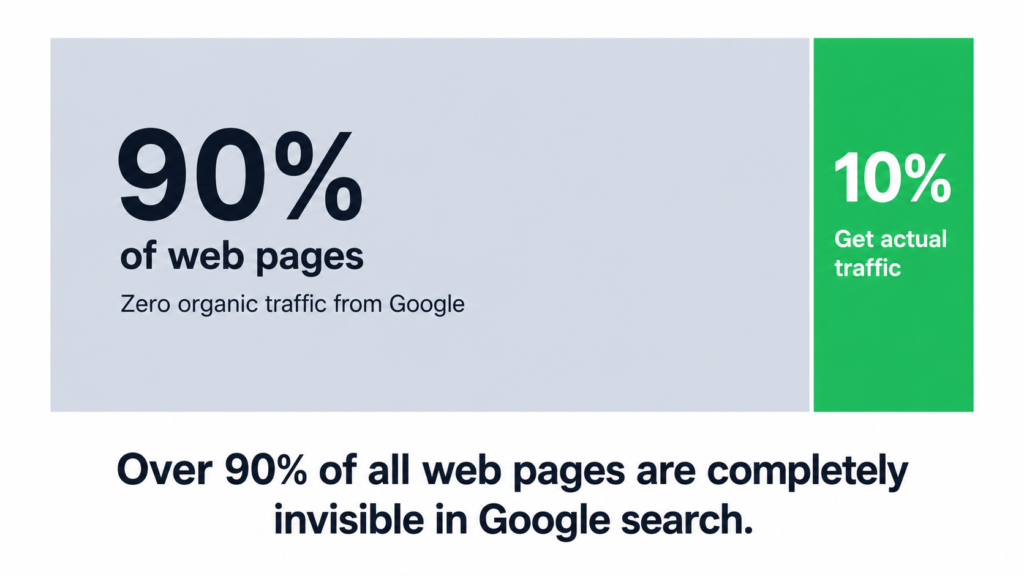
Over 90 percent of all web pages get zero organic traffic from Google. Not a small slice. Not low-quality spam sites. Over nine out of ten pages on the internet are completely invisible in search.
That is not a writing quality problem. Most of those pages are not badly written. They are pages that were published without understanding how Google decides what to show people. That is a strategy problem.
What Google Actually Cares About
Google ranks content based on two things above everything else: relevance and authority.
Relevance means the page directly matches what someone typed into the search bar. Not roughly covers the topic. Directly matches the intent behind the search. Authority means Google trusts your website enough to show it over the hundreds of other pages covering the same subject.
Most business blogs fail on relevance before authority even becomes a factor. Topics get chosen based on what the business wants to say, what feels interesting internally, or what someone suggested in a meeting. None of that has anything to do with what the target audience is actually searching for.
The result is a blog full of content nobody is looking for. Google cannot rank it for searches that do not exist. And the people who would benefit from it never find it because they are searching for something slightly different.
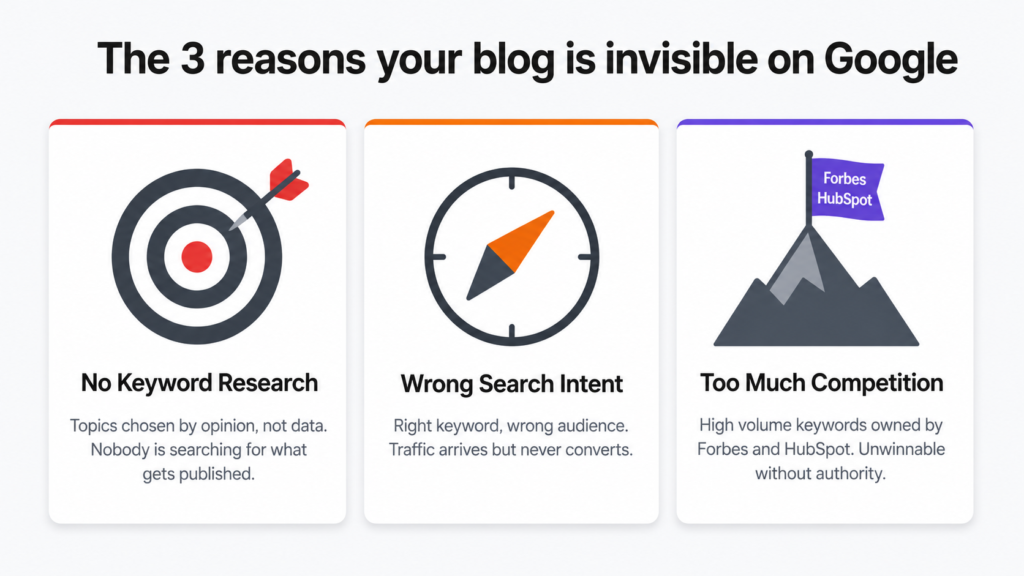
The Three Reasons Blogs Fail to Get Traffic
No keyword research. Topics are picked by gut rather than data. The content is real and useful but it was never built around phrases people actually type into Google. It ranks for nothing because it targets nothing specific.
Wrong search intent. This one is subtle and gets missed even by people who do keyword research. A keyword can have real search volume and still bring in the wrong audience. Writing a post about “what is SEO” might get traffic but the people searching that phrase are complete beginners who will never buy a service. The keyword exists. The traffic exists. The conversions do not. Matching intent means understanding not just what people search but what they are trying to do when they search it.
Too much competition. Some topics have real demand but are owned by sites with enormous authority. Forbes, HubSpot, Semrush, Moz. A new or mid-sized website competing for those keywords is not going to win no matter how thorough the content is. The goal is not to avoid popular topics entirely but to find angles and keyword variations where the competition is actually beatable.
Two blogs can cover the exact same topic. One gets 2,000 visitors a month. One gets zero. The difference is almost never writing quality. It is whether the topic was chosen with real search data or without it.
The Real Cost of Blogging Without a Strategy
The obvious cost is zero results. But the less obvious cost is opportunity. Every hour spent writing a post that will never rank is an hour that could have been spent on a post that would. Every month of inconsistent or misdirected content is a month of compounding SEO value that never built.
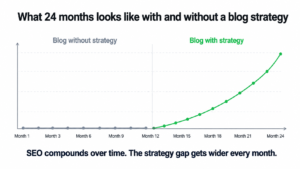
A well-targeted blog post published today can bring in traffic for two or three years without any additional investment. That is the compounding nature of SEO. A post written without a strategy brings in nothing in the first month and nothing two years later either.
The gap between those two outcomes is not talent or budget. It is whether the topic was chosen intentionally.
There Are Two Goals a Blog Can Serve — Most Businesses Pick Neither
The first goal is traffic. Publishing content that ranks for keywords your audience is actively searching for and bringing them to your website through Google. This is measurable, scalable, and builds over time.
The second goal is authority. Becoming the most trusted voice in your niche so that when your target audience thinks about your category, they think of you. This is slower to show up in analytics but it is what turns readers into buyers.
Both are legitimate goals. Both require strategy. The mistake most businesses make is not choosing between them. They just publish and hope something happens. Nothing does.
Knowing which goal you are building toward changes everything about how you pick topics, how you structure posts, and how you measure whether the blog is working.
So What Actually Works
There are two approaches that consistently produce results. Which one is right depends on the business, the industry, and what the blog is meant to do.
The first is building your content strategy around what competitors are already ranking for. If your competitors have an active blog that is getting organic traffic, they have essentially published a map of what works in your niche. You use that data to identify topics with proven demand and create better content on those same subjects. I cover this in detail in this post on using competitor research to drive organic traffic.
The second is building your content around your buyer personas. Instead of following competitor keywords, you research your ideal customers in depth — their daily frustrations, the questions they are searching for, the information they need before they make a decision — and build a full content calendar around those insights. This approach is better for niche industries, businesses that want a distinct voice, and anyone whose goal is long-term authority over short-term traffic. I walk through the full process in this post on building a blog calendar using the buyer persona approach.
Both work. The worst option is continuing to publish without either.
One Last Thing
If you have been blogging for months with nothing to show for it, that effort is not wasted. The writing skill is there. The publishing habit is there. What is missing is the strategy layer underneath. Add that and the same effort starts producing very different results.
If you want to talk through what that looks like for your specific business, I am happy to get into it on a call.
See how I approach SEO strategy →
Dhruv is an SEO consultant working with business owners, founders, and agencies. If your blog is not bringing in traffic, the strategy is the starting point.

Dhruv The SEO Guy
I do SEO for agencies, founders, and business owners. No fixed packages. No fluff. Just technical, revenue-focused strategies that scale your organic presence securely.
Ready to dominate search?
Stop reading about algorithms and start ranking. Book a quick 1-on-1 strategy call below.
Book a Strategy Call →