
TL;DR
Your competitors who are getting blog traffic have already done the hard work of proving which topics your shared audience searches for. Instead of guessing what to write about, you can use Semrush to find every blog post they are ranking for, pick the ones driving real traffic, and build better content around those same topics. This post walks through the exact process step by step.
If you are not sure why your blog is not getting traffic in the first place, start with this post first — it covers the root causes before getting into solutions.
The Answer Is Already Sitting in Front of You
Most businesses spend hours trying to figure out what to write about. Brainstorming sessions, internal discussions, content calendars built on gut instinct. The result is usually a list of topics that feel right but have no data behind them.
Here is the thing nobody points out early enough: if you have competitors who are actively blogging and getting organic traffic, they have already solved this problem for you. Every blog post they rank for is proof that someone in your shared audience searched for that topic and Google decided it was worth showing. That is not a guess. That is confirmed demand.
You do not have to start from scratch. You just have to know how to read the data that is already out there.
Why This Approach Works
When a competitor blog post ranks in Google’s top ten results for a keyword, it means Google has evaluated the content, compared it against everything else available, and decided it is relevant and trustworthy enough to show to real searchers. The demand for that topic is proven. The keyword is real. People are clicking.
If you create content on the same topic that is more thorough, more current, better structured, or simply more useful to the reader, you are competing directly for that same position. You are not experimenting with topics that might work. You are targeting searches that are already working for someone in your space.
That is a fundamentally different starting point than writing about whatever seems interesting this month.
What You Need Before You Start
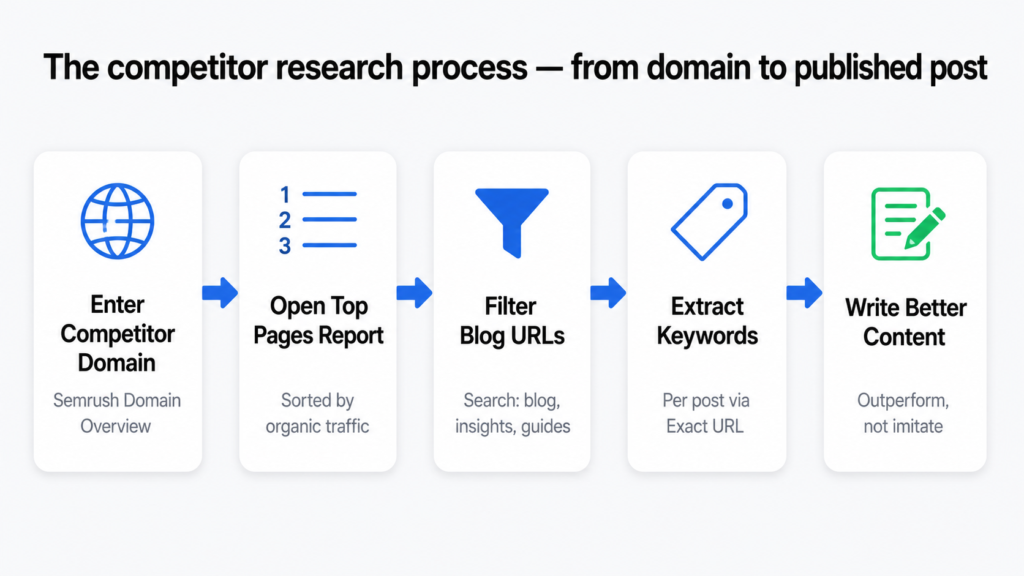
This process uses Semrush. Specifically the Domain Overview feature and the Top Pages report. These two features together give you a complete picture of what any competitor’s blog is ranking for and how much traffic each post is bringing in.
You will also need a list of two to three competitors whose blogs you want to analyse. They do not need to be your direct business competitors. They just need to be websites in your niche that are actively publishing blog content and getting search traffic from it.
If none of your direct competitors have an active blog with measurable traffic, this approach has limited value for your situation. In that case, the buyer persona strategy is a better fit. I cover that in the next post in this series.
The Full Process, Step by Step
Step 1 — Open Semrush and run a Domain Overview
Go to Semrush and open the Domain Overview tool. Type in your competitor’s domain URL. Select Root Domain from the dropdown so the analysis covers their entire website, not just one page. Set the target location to match your audience’s country. Click Search.
Step 2 — Go to the Top Pages report
In the left sidebar, click on Top Pages. This report shows every page on the competitor’s domain that is currently ranking in Google’s top 100 results, sorted by estimated monthly organic traffic from highest to lowest. This is the most valuable report in Semrush for content strategy work.
Step 3 — Filter for blog content only
Use the Filter by URL field at the top of the report. Type keywords that typically appear in blog URLs: blog, blogs, insights, resources, articles, learn, guides, news. This removes product pages, service pages, and homepage results so you are only looking at editorial content.
Step 4 — Identify posts worth targeting
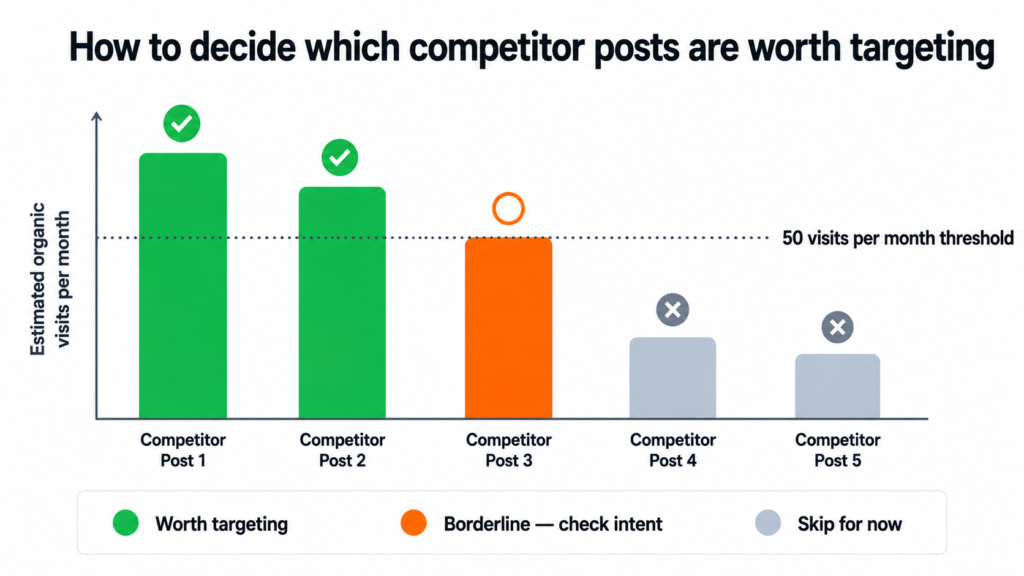
Look for blog posts generating 50 or more monthly organic visits. In niche industries with lower overall search volumes, you can lower this to 20 or 30. What matters is not the absolute number but what is high relative to that industry. A post driving 40 visits per month in a niche B2B category might be one of the most valuable topics available.
Step 5 — Export and organise the data
If the filtered list is long, export it to Excel or Google Sheets. Use a filter to show only rows where the traffic column is above your threshold. Keep the URLs and the traffic numbers. This becomes your master topic list.
Step 6 — Repeat for two to three more competitors
Run the same process on at least two other competitors in your space. The more competitor data you collect, the stronger and more comprehensive your topic list becomes. When multiple competitors are all getting traffic from the same topic, that is a strong signal the topic is worth prioritising.
Step 7 — Drill into the keywords behind each post
Take each blog URL from your list and go back to Semrush Domain Overview. Paste the specific URL into the search bar and select Exact URL from the dropdown. This shows you the organic keywords that particular post is ranking for and the traffic each keyword contributes. From that keyword list, pick 15 to 20 informational keywords that are relevant to your business. These are the keywords your own blog post will target.
Step 8 — Write a better version of the same content
With the topic confirmed and the keywords identified, write a blog post on that subject that outperforms the competitor’s version. More in-depth. More current. Better structured. More useful to the reader at that stage of their search. Use the keywords naturally throughout the content without forcing them.
You are not copying competitor content. You are identifying that demand exists, then creating the best available resource on that topic. The goal is to outperform, not imitate.
What to Realistically Expect
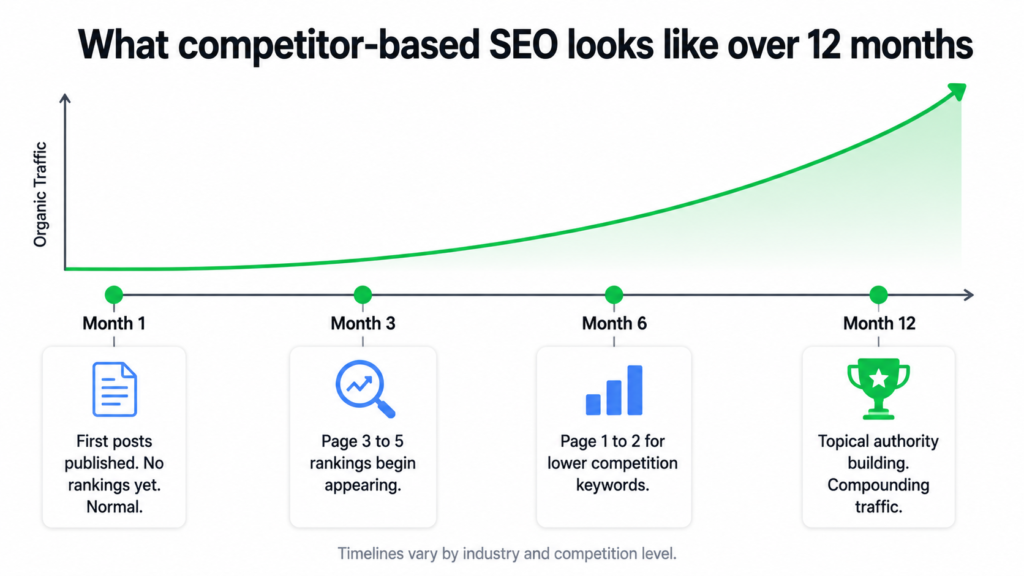
Organic rankings do not appear overnight. New content typically takes three to six months to develop meaningful rankings, sometimes longer in more competitive industries. That timeline is normal and not a sign that the approach is not working.
Not every post will land on page one. But even page two and page three rankings contribute to something important: topical authority. The more blog posts you publish within a specific subject area, the more Google recognises your site as a relevant and trustworthy source on that topic. Rankings that start on page three in month four often move to page one by month ten as that authority builds.
The audience this strategy brings in is worth thinking about too. These are people who found you through Google because they were actively looking for information. They are in research mode. That is the audience most likely to become leads over time because they arrived with intent, not by accident.
SEO from content is a compounding activity. A blog post that ranks today keeps bringing in traffic next year without any additional spend. The value builds the longer the strategy runs.
When This Strategy Has Limits
This approach works best when competitors already have blogs that are generating measurable traffic. If you are in an industry where nobody is blogging with any real results, the data is thin and the strategy loses its foundation.
It also has limits if you want to build a genuinely distinct voice rather than a content strategy shaped by what others are already doing. Following competitor keywords means following competitor topics. That produces traffic but it does not automatically build authority as the definitive source in your niche.
For those situations, a buyer persona-driven approach produces stronger results. Instead of starting with what competitors rank for, you start with a deep understanding of your ideal customer and build content around their specific questions, frustrations, and decisions. I cover the full process for that in the next post: how to build a blog calendar using the buyer persona approach.
The Simplest Way to Think About This
Your competitors are not your enemies in content strategy. They are your research department. Every post they have ranking in Google is a data point that tells you what your shared audience cares about enough to search for.
Use that data. Build better content. Show up where the searches are already happening.
If you want help building this kind of content strategy for your business, or if you want to talk through what the right approach looks like for your specific industry, book a call.
See how I approach SEO strategy →
Dhruv is an SEO consultant working with business owners, founders, and agencies. If organic search is not delivering for your business, this is where to start.

Dhruv The SEO Guy
I do SEO for agencies, founders, and business owners. No fixed packages. No fluff. Just technical, revenue-focused strategies that scale your organic presence securely.
Ready to dominate search?
Stop reading about algorithms and start ranking. Book a quick 1-on-1 strategy call below.
Book a Strategy Call →