
TL;DR
Keyword research without page mapping is just a list of words. Before writing a single blog post for a client, I map every keyword to the specific page it belongs on, check the search intent behind it, and confirm the monthly volume justifies the effort. This post walks through exactly how that process works using a real client project as the example.
This is the second post in a series about building a 110-post SEO content strategy from scratch. If you missed the first one, start here for the full overview.
The Problem With Keyword Research Done in Isolation
Most businesses approach keyword research the same way. They find a tool, type in their industry, get a list of terms with search volumes, pick the ones that look promising, and hand them to a writer. The writer produces content. The content gets published. Nothing ranks.
The missing step is not better keywords. It is understanding which page on the website each keyword belongs to and why. A keyword does not exist in a vacuum. It needs a home. And that home needs to be the right type of page for the intent behind the search.
Without that mapping, you end up in one of two bad situations. Either you create blog posts competing against your own service pages for the same keywords, or you create service pages targeting keywords that should be blog content. Both confuse Google and split your ranking potential instead of concentrating it.
The Two Types of Pages That Need Keywords
For the Tiger Tail project, the website had two distinct types of pages before a single blog post was written. Service pages and industry pages. Each type needs its own keyword logic.
Service pages target keywords where the searcher is looking for a solution or a provider. Someone searching “ai strategy consultant” or “workflow automation services” has commercial intent. They are not looking for an explanation. They are looking for someone to hire. These keywords belong on service pages, not blogs.
Industry pages target keywords where the searcher is a specific type of business looking for AI solutions relevant to their sector. Someone searching “ai for law firms” or “ai for real estate agents” has commercial intent too, but with an industry-specific lens. These keywords belong on the industry pages, not the blog either.
Blog posts serve a different purpose. They capture informational searches from people who are not ready to buy yet but are researching the problem. The blog content feeds authority to the service and industry pages. The pages convert. The blog attracts.
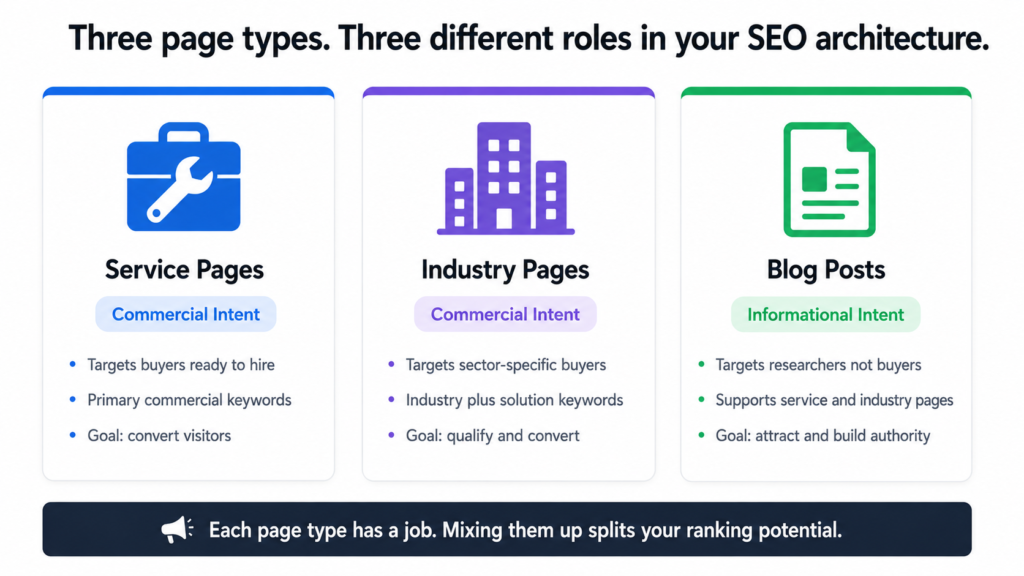
Service pages and industry pages target buyers. Blog posts target researchers. Mixing them up is one of the most common and most damaging SEO mistakes a business can make.
The Actual Mapping: Real Data From the Project
Here is what the keyword-to-page mapping looked like for the Tiger Tail service pages. Every page got its primary keywords and monthly search volumes confirmed before any content was briefed.
service-page-keyword-map.txt
Page URL                              Primary Keyword                    Monthly Searches

/services/ai-audit-strategy            ai strategy consultant                      880
/services/ai-audit-strategy            ai readiness assessment                     720
/services/ai-audit-strategy            ai implementation consultant                390
/services/ai-audit-strategy            automation consultant                       480
/services/workflow-automation          business process automation services        320
/services/custom-ai-development        custom ai development company               480
/services/custom-ai-development        ai integration services                     590
/services/growth-engineering           ai marketing automation                     720
/services/growth-engineering           ai lead generation agency                   110
/services/ai-training-enablement       corporate ai training                        40
And here is the same mapping for the industry pages:
industry-page-keyword-map.txt
Page URL                              Primary Keyword                    Monthly Searches

/ai-for-legal                          ai for law firms                          1,300
/ai-for-real-estate                    ai real estate agent                        590
/ai-for-real-estate                    ai for real estate agents                   480
/ai-for-healthcare                     healthcare workflow automation              170
/ai-for-finance-accounting             ai for accounting firms                      70
/ai-for-home-services                  ai for contractors                          110
/ai-for-legal                          legal document automation                   170
/ai-for-healthcare                     ai for medical billing                       90
Looking at this data together, the legal page stands out immediately. “Ai for law firms” at 1,300 searches per month is the single highest-volume keyword across all pages on the site. That tells you the legal cluster needs serious depth in the blog to give that page the authority it needs to compete.
The corporate AI training page, on the other hand, targets “corporate ai training” at just 40 searches per month. That is a low-volume keyword but the commercial intent behind it is very high. Someone searching that phrase is almost certainly a business ready to spend money on training. Low volume does not mean low value.
How Search Volume Shapes Priority, Not Just Selection
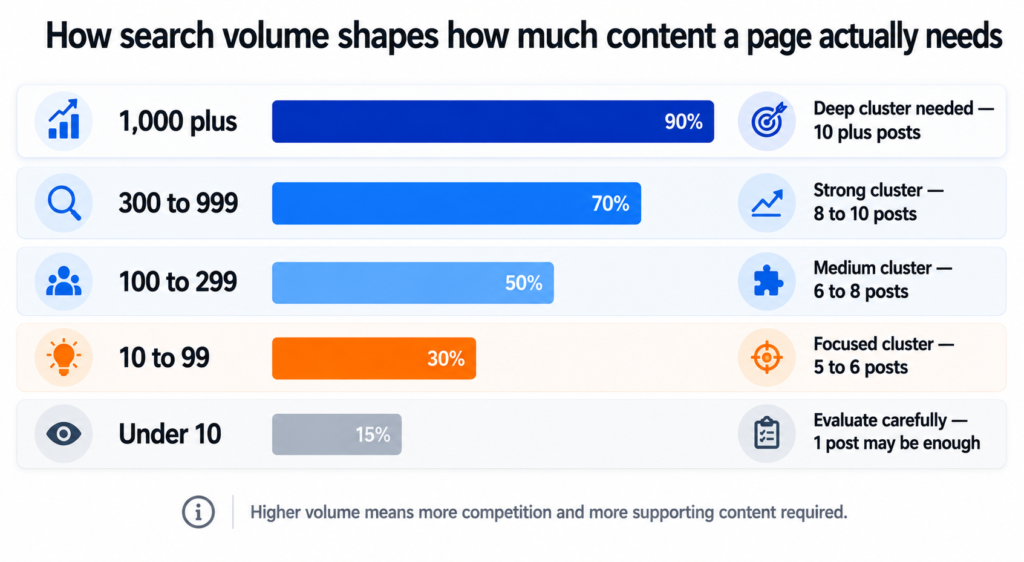
This is the part most keyword guides miss. Search volume is not just a filter for deciding which keywords to target. It is an input for prioritising which content to build first and how much of it you need.
A page targeting a keyword with 1,300 monthly searches needs more supporting blog content around it than a page targeting 40 monthly searches. Not because the second page matters less, but because Google needs to see more topical depth before it will trust a new domain with a high-volume, competitive keyword.
volume-to-priority-logic.txt
Volume Range      What It Means                          Content Priority

1,000+            High demand. High competition.             Deep cluster needed.
                  Big brands likely dominating page 1.       10+ supporting posts.
                  New domain needs time and authority.

300 to 999        Solid demand. Beatable competition         Strong cluster needed.
                  with quality content and good structure.   8 to 10 supporting posts.

100 to 299        Moderate demand. Often less competitive.   Medium cluster.
                  Good early target for a new domain.        6 to 8 supporting posts.

10 to 99          Low volume. Often high commercial intent.  Focused cluster.
                  Worth targeting if buyer intent is clear.  5 to 6 supporting posts.

Under 10          Very niche. May still be worth it          Evaluate carefully.
                  if the buyer value per conversion is high. Single post may be enough.
This framework shaped the entire cluster structure for the project. The legal cluster targeting 1,300 searches got ten posts. The AI training cluster targeting 40 searches also got ten posts, but those posts are written differently. More specific, more technical, more conversion-oriented, because the person reading them is further along in their decision.
Intent Is More Important Than Volume
Search volume tells you how many people are searching. Search intent tells you why. Getting the intent wrong is worse than targeting a low-volume keyword because it means you are attracting the wrong people even when you do rank.
Every keyword in the Tiger Tail mapping got an intent classification before it was assigned to a page. The classification is simple but it matters every time.
search-intent-classification.txt
Intent Type       What the Searcher Wants                 Right Page Type

Informational     Learning about a topic.                     Blog post.
                  Not ready to buy yet.
                  Example: "what is ai readiness assessment"

How-To            Looking for a process or steps.             Blog post or guide.
                  Example: "how to automate workflow"

Commercial        Researching providers or solutions.         Service or industry page.
                  Getting close to a decision.
                  Example: "ai strategy consultant"

Comparison        Evaluating options.                         Blog post or landing page.
                  Example: "make vs zapier vs custom automation"

Transactional     Ready to buy or contact.                    Service page with clear CTA.
                  Example: "hire ai implementation consultant"
A keyword like “what is an ai readiness assessment” is informational. It belongs in the blog as a post that educates the reader and links to the service page at the end. A keyword like “ai readiness assessment” with no qualifier is commercial. Someone typing that is likely comparing providers. It belongs on the service page itself.
Those two keywords look similar. They would land on completely different pages in a well-structured site. Getting that distinction right is what separates a site that converts from one that attracts traffic that never does anything.
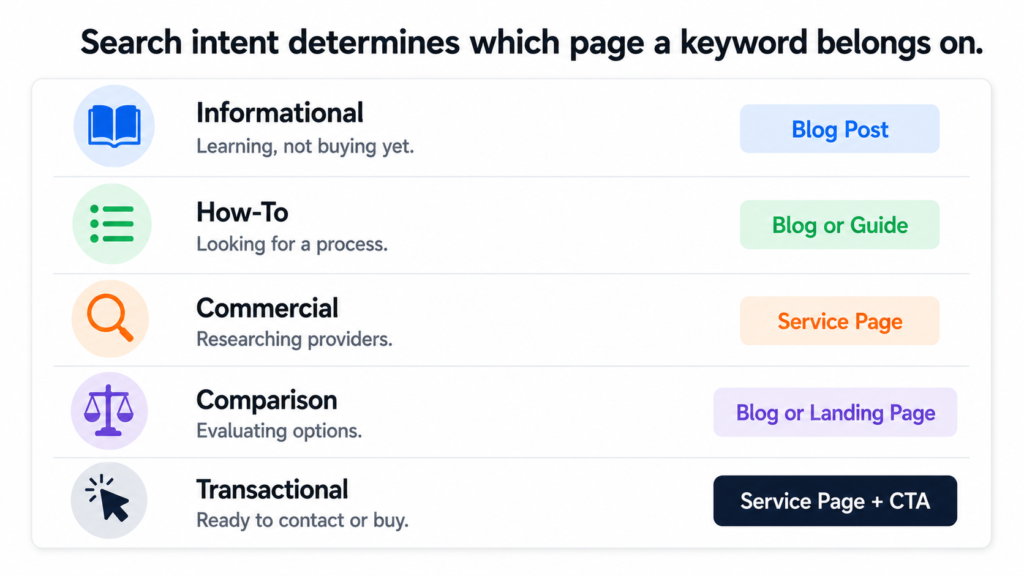
Putting commercial intent keywords on blog posts and informational keywords on service pages is one of the most common ways content strategies fail quietly. The traffic numbers look fine. The conversions never come.
The Before and After of Keyword Mapping
Here is what the approach looks like without mapping versus with it:
before-vs-after-mapping.txt
WITHOUT KEYWORD MAPPING

"Let's write a blog about AI for law firms."
"Let's write about what an AI consultant does."
"Let's cover AI pricing."

Result: Random posts. No page authority built.
        Service pages get no support.
        Blog competes with its own pages.
        Nothing ranks for anything meaningful.


WITH KEYWORD MAPPING

"ai for law firms" (1,300/mo, commercial) → /ai-for-legal service page
"how small law firms use ai" (informational) → blog post in legal cluster
"ai contract review" (informational/how-to) → blog post in legal cluster
"legal document automation" (170/mo, commercial) → /ai-for-legal page
"ai and billing ethics law firms" (informational) → blog post in legal cluster

Result: Service page targets commercial keywords.
        Blog cluster builds topical authority around it.
        Every post links back to the parent page.
        Google sees depth and relevance. Rankings follow.
The difference is not subtle. In the first approach, a business is just publishing. In the second, every piece of content has a specific job to do and a specific place in the architecture.
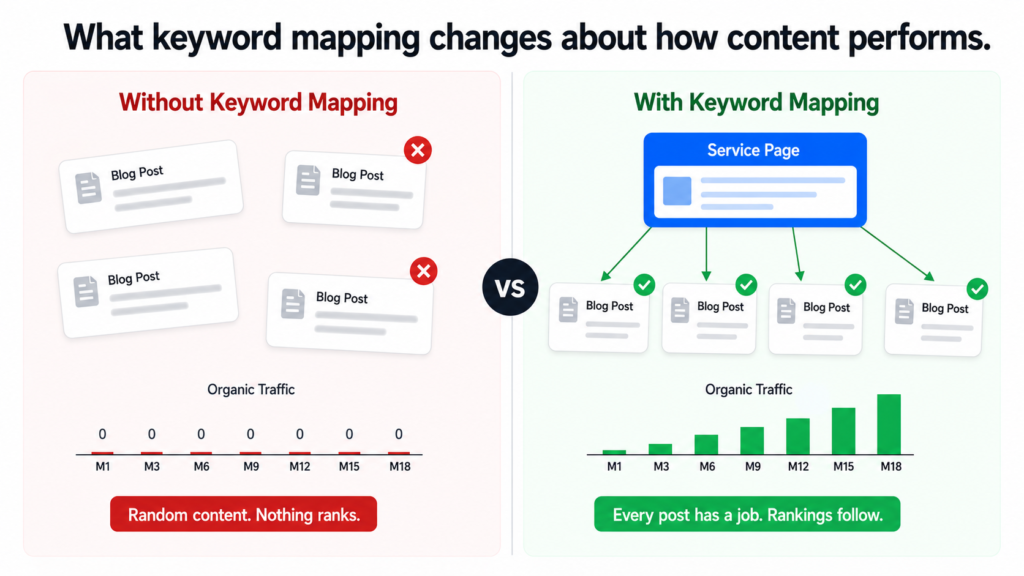
What Good Keyword Mapping Produces
By the time the keyword mapping was done for the Tiger Tail project, every page on the site had a clear primary keyword, a confirmed search volume, an intent classification, and a list of supporting blog topics that would feed it authority over time.
That groundwork meant every brief written after it had a reason to exist. Not just “here is a topic someone might find interesting” but “here is a keyword a real person searches for, here is the page it supports, here is how it fits into the cluster that will eventually rank the parent page.”
Keyword mapping is not a research exercise. It is a structural decision. It determines what gets built, where it lives, and what it is supposed to accomplish. Every hour spent on it saves ten hours of rewriting content that landed in the wrong place.
What Comes Next
With the keyword map in place, the next step was research. Not the generic kind where you read a few articles and summarise them. Proper data-backed research using Perplexity Sonar that produced real statistics, named sources, and proof points for every single post across all 110 briefs.
That process is what I cover in the next post: how I use Perplexity Sonar to research blog topics with real data.
If you want to talk through what keyword mapping would look like for your own website, book a call. I can usually tell within the first conversation whether a site’s content architecture is working for it or against it.
See how I approach SEO strategy →
Dhruv is an SEO consultant working with business owners, founders, and agencies. If organic search is not delivering for your business, this is where to start.

Dhruv The SEO Guy
I do SEO for agencies, founders, and business owners. No fixed packages. No fluff. Just technical, revenue-focused strategies that scale your organic presence securely.
Ready to dominate search?
Stop reading about algorithms and start ranking. Book a quick 1-on-1 strategy call below.
Book a Strategy Call →