
How to Rank in ChatGPT: How Citations Work and What Makes a Website Worth Mentioning
ChatGPT is not Google, and ranking means something different here
“How do I rank in ChatGPT” is a slightly misleading question, but it is the question people actually ask, so it is worth answering directly.
Google ranking is about position. Your page sits at number 3 or number 7 for a given keyword, and that position is fairly stable until something changes. ChatGPT does not have positions. According to OpenAI’s own documentation on ChatGPT search, when a question benefits from current information, ChatGPT searches the web, reads through the results, and returns an answer with inline citations linking to the sources it used. There is no leaderboard. There is only: did your page get pulled into this specific answer, or not.
That means “ranking in ChatGPT” really means becoming one of the sources ChatGPT reaches for when it needs to answer a question in your topic area. The rest of this post covers how that selection actually works, and what makes a page worth picking.
If you have not yet read our overview of what answer engine optimization is, this post builds directly on that. The mechanics described here are specific to ChatGPT, but the underlying goal, being a source AI systems trust enough to cite, is the same one that pillar page covers more broadly.
The first question in a conversation matters more than anything that follows
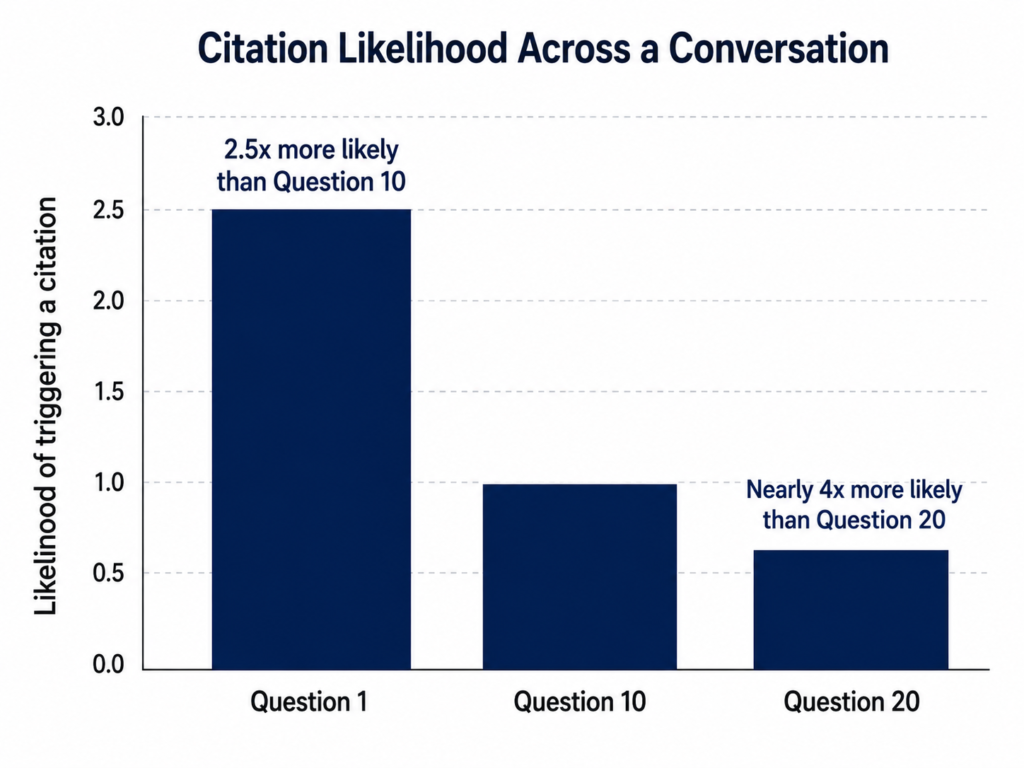
One of the more useful findings from recent research comes from an analysis of around 700,000 real ChatGPT conversations. It found that the opening question in a conversation is roughly 2.5 times more likely to trigger a citation than the tenth message, and nearly 4 times more likely than the twentieth.
In practice, this means the question someone types when they first open ChatGPT and start a new topic is the one that matters most for citations. Follow-up questions, clarifications, and “tell me more about that” style messages rarely send ChatGPT back out to search the web again. So if you are thinking about which queries to target, think about what someone would type as their very first message on a topic, not the deeper, more specific questions they might ask three messages into the conversation.
This has a practical effect on how you structure content. A page that answers the broad, opening-style question clearly near the top, and then goes into the more specific sub-questions further down, is positioned to catch that first citation opportunity while still covering the detail someone might want later.
ChatGPT rarely picks one winner
Unlike a Google results page, where ten links compete for clicks, ChatGPT tends to cite multiple sources in the same answer, often side by side. If you are cited once, that does not mean you have “won” the query the way ranking first on Google would feel like winning.
This changes what success looks like. Instead of aiming to be the only source ChatGPT mentions, a more realistic goal is to consistently be one of the few sources that show up across the range of questions in your topic area. Being present in a high percentage of relevant conversations matters more than being the sole citation in any one of them.
It is also worth knowing that ChatGPT’s citation rates vary enormously by topic and by how the underlying retrieval works. A study of over 34,000 AI responses found a roughly 46-times difference in how often brands got cited between ChatGPT and other AI platforms. So a page that performs well in Perplexity or Google AI Overviews is not guaranteed to perform the same way in ChatGPT, and the reverse is also true.
What makes a page worth citing
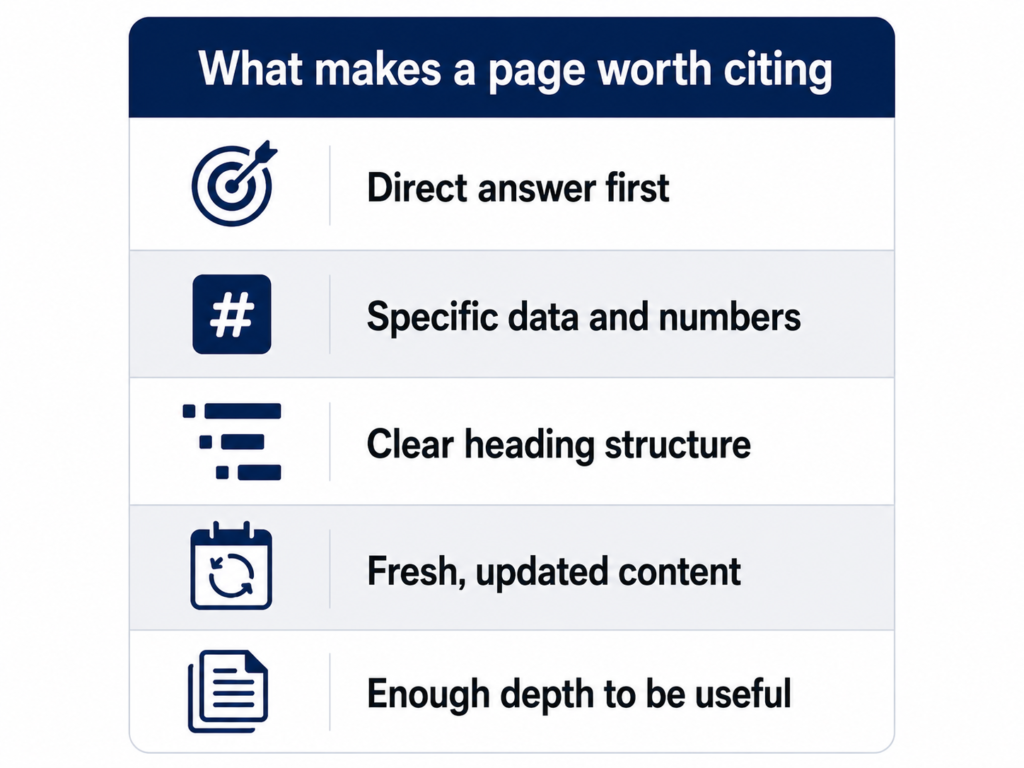
Across the research on this topic, the same handful of patterns come up again and again.
The answer comes first. ChatGPT favors content that states the answer directly near the top of a section, then explains or expands afterward. A section that opens with a few sentences of throat-clearing before getting to the point is less likely to be the one quoted, even if the actual information further down is good.
Specific numbers beat general claims. A sentence with a real figure attached to it, a percentage, a timeframe, a sample size, gives ChatGPT something concrete to extract. Vague statements like “many businesses see improvements” do not give the model anything to cite, because there is nothing specific to attribute.
Clear heading structure. Pages that use a logical hierarchy of headings, where each section covers one clearly defined sub-topic, are easier for ChatGPT to scan and match against a question. This is the same structural advice that matters for AI Overviews and Perplexity, and it is worth getting right once rather than reworking content separately for each platform.
Freshness. Content with outdated dates or references signals to both the model and the reader that it might not reflect the current situation. This does not mean every page needs constant rewrites, but pages on topics that change, pricing, tools, statistics, benefit from periodic updates.
Enough depth to actually be useful. Very short pages, often cited as being under roughly 500 words, rarely get picked as sources. This is not because there is a minimum word count requirement. It is because a page that short usually has not covered the topic thoroughly enough to be the thing ChatGPT reaches for when it needs a reference.
Where Wikipedia and high-authority sources fit in
It is worth being realistic about one part of this. A large share of ChatGPT’s citations, particularly for general knowledge and definitional questions, go to a small number of very high-authority sources, with Wikipedia accounting for a large portion on its own.
This does not mean a smaller business site cannot get cited. It means the competition for purely definitional questions, “what is X,” is steep, and the more realistic opportunity for most businesses is in the questions that sit one or two steps past the definition: how something works in practice, what it costs, how it compares to alternatives, or what a real result looked like. These are the questions where a specific business with direct experience has something a general reference source does not.
This is also where first-party data earns its keep. A page that includes a result you actually measured, like the kind of before-and-after numbers in our Midstream Marketing case study, gives ChatGPT a specific, attributable fact that no general reference source can provide, because the data only exists on your page.
A practical starting point
Rather than trying to optimize an entire site for ChatGPT citations at once, it helps to start narrow.
Pick three to five questions that represent the kind of opening question someone in your audience would type into ChatGPT when they first start researching your topic. Ask those exact questions yourself and see what comes back. Note which sources get cited, and whether your site appears anywhere in the answer or the list of links ChatGPT shows.
For the pages that did not appear, check them against the patterns above. Does the relevant section open with a direct answer, or does it take a paragraph to get there? Does it include any specific numbers, or is it written in generalities? Is the heading structure clear enough that someone scanning just the headings would understand the page?
Fixing these issues on a small number of high-value pages tends to move the needle faster than spreading the same effort across an entire site. Once you have a sense of how your existing content performs, that becomes the baseline for deciding what to fix first and what to leave alone.
If you want help running this kind of audit on your own site, you can see our AEO and SEO services or book a call and we can walk through it together.
This is the final post in the series. You can read the full strategy overview, keyword mapping, Sonar research process, cluster architecture, and publishing calendar strategy in the earlier posts.
The Problem With Generic AI Content
Ask any AI to write a blog post about AI for law firms without a proper prompt and you will get something that reads like a Wikipedia summary written by a consultant who has never worked with a law firm. Every sentence is technically accurate. Nothing is specific. The tone is the same whether the audience is a solo attorney or a healthcare CFO. It sounds like every other AI blog post because it was produced the same way every other AI blog post is produced.
The fix is not a better AI model. It is a better input. The model is only as specific as what you give it. A vague prompt produces vague output. A highly specific prompt with clear tone rules, structural requirements, and sourced research data produces something that actually reads like it came from someone who knows the industry.
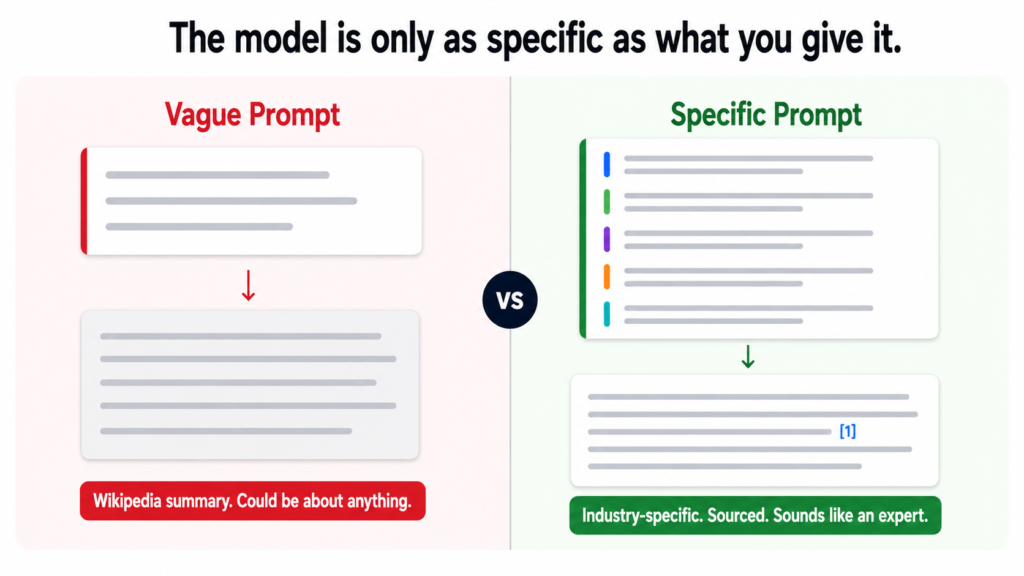
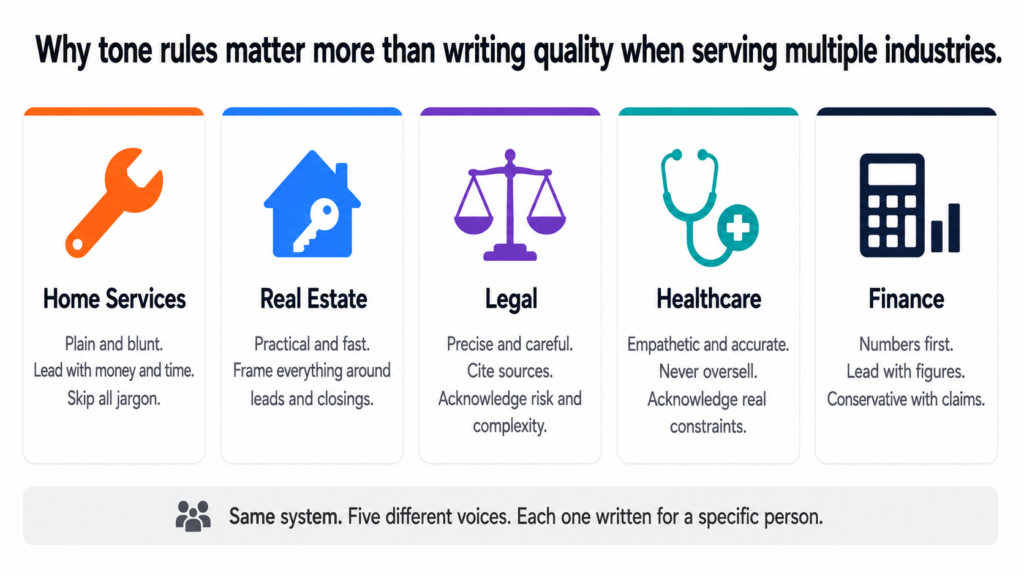
For the Tiger Tail project, 110 posts across five distinct industries needed to sound different from each other. A home services contractor does not want to read the same prose style as a law firm partner. Healthcare administrators do not respond to the same tone as accounting firm owners. The writing framework had to produce genuinely different output for genuinely different audiences from the same underlying system.
A prompt is not a topic request. It is a detailed instruction set that constrains how the model writes, what it includes, what it avoids, and how it adapts to each audience. The more specific the constraint, the more specific the output.
The Master Prompt Structure
Every blog post across all 110 briefs was written through a single master prompt. The prompt has five core sections. Each one does a specific job.
Who the brand is. Who they serve. What they do.
What the reader looks like when they land on this post.
This grounds every word in a specific person reading it.Section 2 — Writing Style Rules
Be direct. Say the thing plainly. No hedging.
Short sentences. Vary the rhythm.
Never open with a filler line.
No corporate speak. No em dashes anywhere.
Data leads. Back every strong claim with a named source.
Have a point of view. React to the data, do not just report it.Section 3 — Tone by Industry
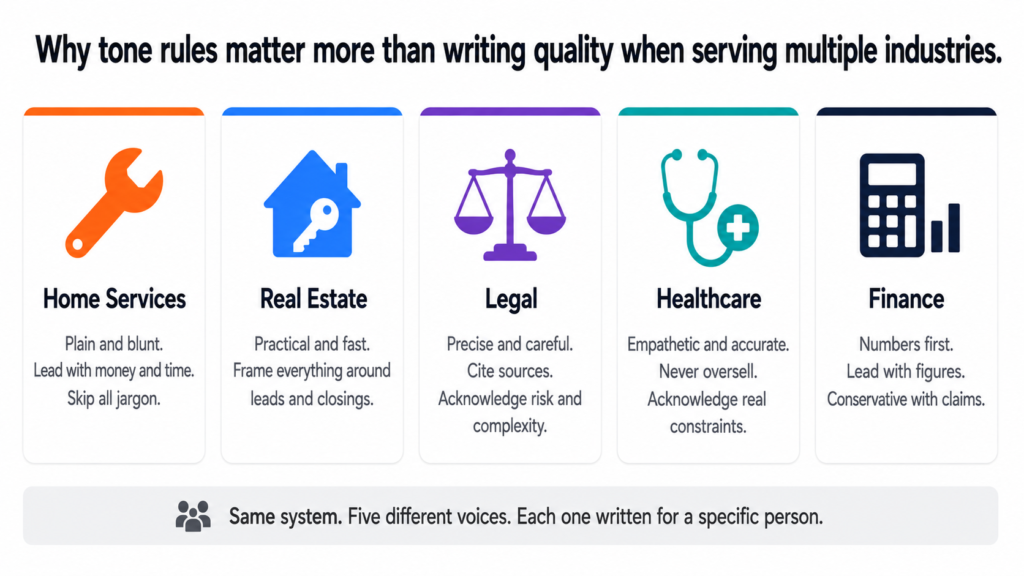
Home Services: plain and blunt. Lead with money and time.
Real Estate: practical and fast-moving. Leads and closings.
Legal: precise and careful. Acknowledge complexity and risk.
Healthcare: empathetic and accurate. Never oversell.
Finance and Accounting: numbers first. Conservative claims.
Section 4 — Structure Rules
No fixed template. Let intent guide structure.
Headers only when the content genuinely needs them.
Open with the specific problem. End with a concrete takeaway.
CTA once only, placed where it earns its place.
Section 5 — Link and Citation Rules
External links embedded inline on the stat they support.
Internal links placed naturally in body context.
No links listed at the bottom. No forced placements.
The brand and audience context section is what most prompts skip entirely. Without it, the model has no reference point for who is reading. With it, every sentence is written toward a specific person in a specific situation rather than a generic professional in a vague industry.
The Tone Rules That Make the Biggest Difference
The tone-by-industry section of the prompt is what makes a legal post read differently from a home services post even though both go through the same system. Here is what each industry tone rule actually produces in practice:
| Industry | Tone Rule | What It Produces |
|---|---|---|
| Home Services | Plain and blunt. Lead with money and time. Skip jargon entirely. | A contractor reads it and thinks: this person gets how my business works. |
| Real Estate | Practical and fast-moving. Frame everything around leads, response time, and closings. | An agent reads it and immediately applies it to their pipeline. |
| Legal | Precise and careful. Cite sources properly. Acknowledge complexity and risk. | A lawyer reads it and trusts the accuracy. Does not feel oversold to. |
| Healthcare | Empathetic and accurate. Never oversell. Acknowledge real constraints. | A physician reads it and feels understood rather than marketed to. |
| Finance | Numbers first. Lead with figures. Be conservative with claims. | An accountant reads it and finds it credible enough to share with clients. |
The difference between a healthcare post and a home services post is not just vocabulary. It is the entire posture of the writing. Healthcare content that leads with money the way home services content does would feel wrong to a physician. Home services content that hedges and acknowledges complexity the way legal content does would lose a contractor in the first paragraph.
The Filler Openers List
One of the most specific sections of the prompt is a list of opening lines the model is explicitly told never to use. This matters more than it sounds. AI defaults to filler openers because they are the most statistically common way articles begin in its training data. Without a specific prohibition, the model will produce them every time.
“As businesses continue to evolve…”
“In an era of rapid technological change…”
“Whether you are a small business or a large enterprise…”
“Artificial intelligence is transforming the way…”
“It is no secret that…”
“Now more than ever…”
“In recent years, the rise of AI has…”
“Let us dive in.”
“Here is what you need to know.”INSTEAD: Open with the specific problem.
Name it plainly. No warm-up. No throat-clearing.
The reader should feel addressed by the second sentence.
Every one of those openers signals to a reader that the content was not written for them specifically. They have read that sentence a hundred times on a hundred different sites. Banning them forces the model to find a more direct entry point, which almost always produces a better opening than the default.
The Humanizer Pass
Even with a strong prompt, AI writing has patterns that accumulate across a long piece. Small habits that individually seem fine but collectively make the content feel generated rather than written. The humanizer pass catches these before anything gets published.
“Testament to”, “pivotal moment”, “underscores”,
“highlights the importance of”, “it is worth noting”.
Replace with the plain statement the inflation was hiding.Promotional language
Any word that sounds like marketing copy.
Seamless. Robust. Transformative. Game-changing.
These words mean nothing. Remove them.
Superficial -ing phrases
“Showcasing”, “reflecting”, “contributing to”,
“fostering”, “enabling”. These verbs add no meaning.
Replace with a direct statement of what actually happened.
Rule of three
Listing three synonyms when one would do.
“Efficient, productive, and streamlined.”
Pick one. The best one. Cut the other two.
Negative parallelism
“It is not just X, it is Y.” Always feels performative.
Just say Y. The contrast adds nothing.
Vague attributions
“Experts say”, “studies show”, “research indicates”.
Name the expert. Name the study. Name the year.
If you cannot, remove the claim entirely.
Generic positive conclusions
“The future is bright”, “now is the time to act”,
“the possibilities are endless”.
End with something specific or do not end with a conclusion.
The humanizer pass is not a stylistic preference. It is a quality gate. Every one of those patterns makes content feel less trustworthy to the reader, even if they cannot articulate why. Removing them is what takes a competent draft and makes it feel like something a real expert wrote.
The Final Check Before Publishing
Before any post from the Tiger Tail calendar goes live, it passes a final checklist. This is the last gate between the draft and the published URL.
No filler opener in the first paragraph
Every stat has an inline external link to its named source
Internal links appear naturally in context, not forced
CTA appears once only, where it earns its place
Tone matches the industry cluster it belongs to
Primary keyword in H1, first paragraph, and one H2
Meta title under 60 characters
Meta description under 160 characters
Image with descriptive alt text present
URL slug matches primary keyword
Humanizer pass completedAsk before publishing:
“What makes this obviously AI-generated?”
Fix those things. Then publish.
The last question in that checklist is the most important one. Not “does this read well” but “what would make a reader suspect this was generated.” That question forces a more honest review than general proofreading does because it is looking for the specific patterns that erode trust rather than just checking for errors.
What the Whole System Produces
Put together, the five layers covered across this series produce something most content strategies never achieve: a system where every post is intentional before it is written, researched before it is briefed, structured before it is published, and reviewed against the right standard before it goes live.
The keyword map tells you what to write and where it belongs. The Sonar research tells you what to say and how to back it up. The cluster architecture tells you how each post relates to everything around it. The calendar tells you when to publish it and removes every remaining decision. The writing framework and humanizer tell you how to make it sound like it was written by a person who genuinely knows what they are talking about.
None of these layers is complicated on its own. The value comes from all five working together. A calendar without research produces thin content. Research without a cluster produces isolated posts. Clusters without a framework produce inconsistent writing. The system only works when all five parts are in place.
I Built All of This. I Can Build It for Your Business.
The full content system — built for your website, your industry, your audience
Everything covered in this series is something I build for businesses and agencies. The keyword map. The Perplexity Sonar research data pack. The cluster architecture. The 24-month calendar with every row pre-loaded. The master writing prompt adapted to your brand voice and your industries. The humanizer rules built into every brief.
This is not a template. Every system I build is specific to the client. The Tiger Tail project took 11 clusters across 5 industries and produced 110 posts with full research and briefs. Yours will be built around your pages, your keywords, and your audience.
Here is what the engagement covers:
- Full keyword research and page mapping for your entire site
- Cluster architecture designed around your commercial pages
- Perplexity Sonar research data pack — real stats, named sources, citation URLs — for every post
- Complete publishing calendar with every row pre-loaded: meta titles, meta descriptions, intent, internal links, external sources, CTAs, and status tracking
- Master writing prompt built for your brand voice and adapted by industry or service area
- Humanizer checklist and final publish gate built into the workflow
- Publishing pace and cluster priority order matched to your domain’s current authority level
If you are a business owner who wants organic search working for you without paying for ads every month, or an agency that wants to deliver this kind of strategy for clients, book a call and let us talk through what it looks like for your specific situation.
Book a free 30-minute call
See the full SEO strategy service
This is the fifth post in the series. You can read the strategy overview, keyword mapping, research process, and cluster architecture in the earlier posts.
Why Most Content Calendars Get Abandoned
A content calendar that lives in a spreadsheet and gets ignored by week three is not a calendar. It is a guilt document.
Most content calendars fail for one of two reasons. Either they are built with titles and dates and nothing else, which means every publishing cycle starts with a blank page and a deadline. Or they are built with so much structure that maintaining the document takes more effort than writing the actual content.
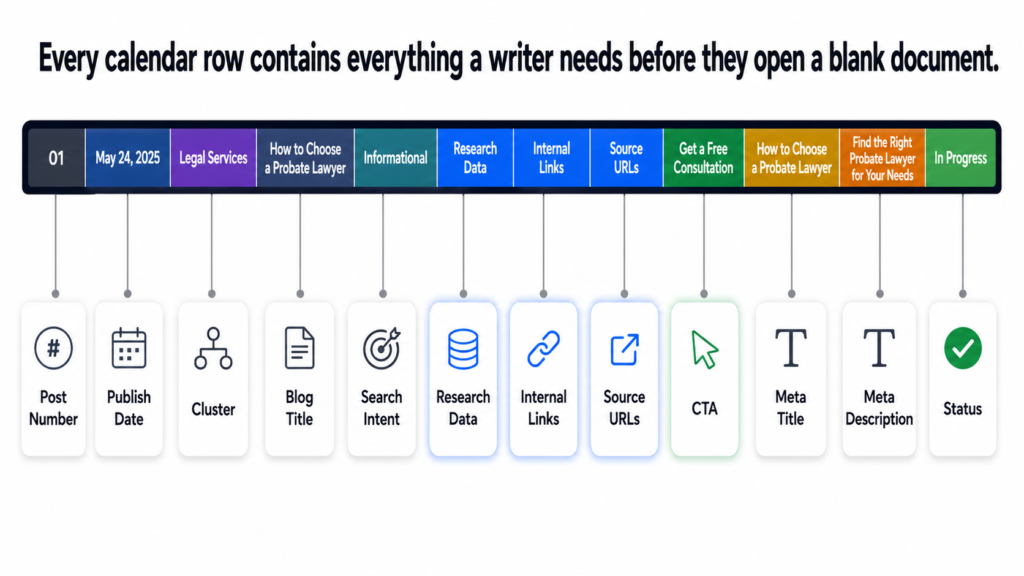
The calendar I built for Tiger Tail was designed around one principle: every row should contain everything a writer needs to start immediately with no additional briefing required. The calendar is the brief. The moment a post moves to “in progress,” the writer already has the research data, the source URLs, the internal links, the intent classification, and the CTA. Nothing is left to figure out.
A content calendar is only useful if it removes decisions, not adds them. Every decision about a post should be made when the calendar row is built, not when the writer opens a blank document.
What Every Calendar Row Contains
Here is the exact column structure used for every one of the 110 posts in the Tiger Tail calendar:
| Column | What It Contains | Why It Matters |
|---|---|---|
| Post Number | Sequential 1 to 110 | Tracks progress at a glance |
| Publish Date | Specific date from June 2026 | Removes scheduling decisions |
| Cluster | Which of the 11 clusters | Links post to parent page |
| Blog Title | Working title | Keyword-aligned, intent-matched |
| Search Intent | Informational, How-To, Comparison | Determines structure and depth |
| Research Data | Full stats from Perplexity Sonar | Writer uses this directly |
| Internal Links | Specific tigertail.co pages | No guessing where to link |
| External Links | Source URLs for every stat | Inline citations ready to use |
| CTA | One specific call to action | Placed once, where it earns its place |
| Meta Title | Under 60 characters | SEO-ready before publishing |
| Meta Description | Under 160 characters | No writing needed at publish time |
| Status | Not Started, In Progress, Written, Edited, Published | Single source of truth for progress |
Twelve columns per row. One hundred and ten rows. Every decision about every post made before the writing starts. A writer who picks up a brief from this calendar does not need to ask any questions. Everything is already there.
The Publishing Pace and Why It Was Set This Way
The publishing pace for a new domain is not just a volume decision. It is a trust-building decision. Google needs time to learn a new site. Publishing fifty posts in the first month on a brand new domain does not accelerate that process. It looks like a spam pattern to a domain with no history.
1 post per week on Mondays
Why: New domain needs consistent signals, not volume bursts.
Google indexes and evaluates early posts carefully.
Foundation being established. Quality over quantity.
8 posts published. All 11 clusters get early coverage.PHASE 2 — Week 9 onwards (July 27 2026)
2 posts per week — Mondays and Thursdays
Why: Domain has 8 weeks of consistent publishing history.
Google has begun learning the site structure.
Increasing pace signals growth, not spam.
102 remaining posts published across 51 weeks.
TOTAL DURATION
Approximately 24 months from first publish to post 110.
This is not slow. This is sustainable and compound-friendly.
The ramp from one to two posts per week was deliberately delayed until week nine. Eight weeks of consistent single-post publishing gives the domain enough history that doubling the pace looks like organic growth rather than a sudden content dump. The distinction matters to how Google interprets the signal.
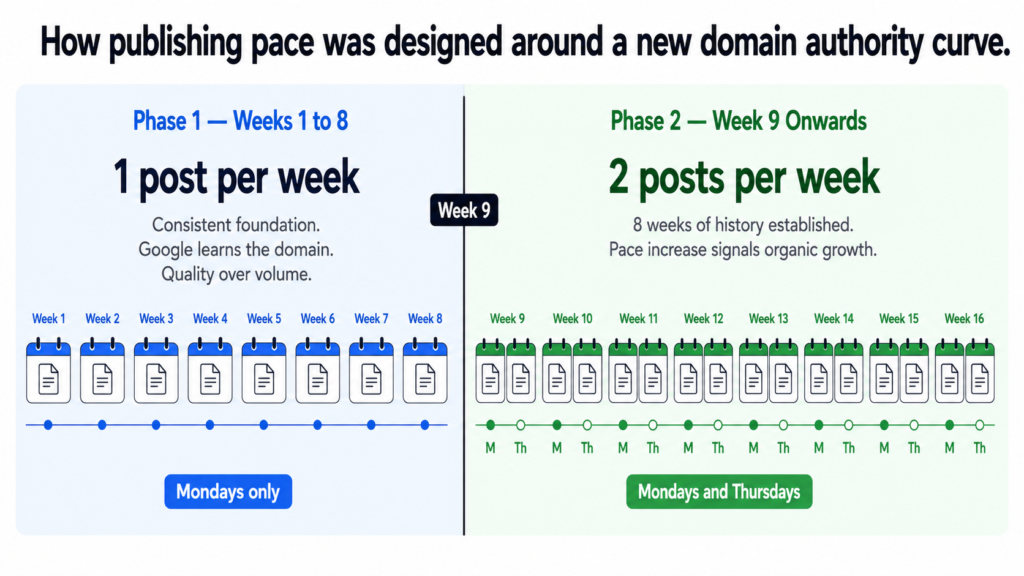
Publishing frequency on a new domain is a trust signal, not just a volume metric. Sudden spikes in publishing on a site with no history look very different to Google than a gradual ramp that mirrors how a real business grows its content operation.
The Cluster Priority Order
The order in which clusters get their first posts published was not decided alphabetically or by which felt most important to the client. It was decided by competition level and by what would give the domain the fastest path to early ranking signals.
| Priority | Cluster | Reason |
|---|---|---|
| 1st | AI Audit and Strategy | Establishes what the business does. First impression for Google. |
| 2nd | Home Services | Lower competition. Local long-tail keywords. Early wins possible. |
| 3rd | Workflow Automation | Strong long-tail demand. Less dominated by big brands. |
| 4th | Legal | Higher volume. Domain has history by now. Timing matters here. |
| 5th | Real Estate | Competitive but authority building from clusters 1 to 4. |
| 6th | Healthcare | Mid-competition. Domain credibility growing by this point. |
| 7th | Finance and Accounting | Specialist audience. Benefits from established domain trust. |
| 8th | Custom AI Development | Competitive space. Needs domain authority to compete. |
| 9th | Growth Engineering | Broad keyword competition. Later timing is strategic. |
| 10th | Systems and Operations | Niche audience. Works better once domain has full authority. |
| 11th | AI Training and Enablement | Lowest search volume. Low competition but small audience. |
The first three clusters were chosen because they give a new domain the fastest path to real ranking signals. Lower competition keywords on a new domain rank faster. Those early rankings build the domain authority that makes it possible to compete for the higher-volume keywords in clusters four through seven later in the program.
Starting with the legal cluster, which targets “ai for law firms” at 1,300 monthly searches, on a brand new domain would mean months of sitting on page ten for a keyword that Forbes, HubSpot, and established legal tech publications are already competing for. Starting there after six months of authority building from clusters one through three changes that calculation significantly.
On-Page Requirements Built Into Every Row
The calendar also carries on-page SEO requirements for every post so nothing gets published with missing elements. These are not suggestions. They are publishing gates.
Meta title under 60 characters — pre-written in calendar
Meta description under 160 characters — pre-written in calendar
At least one image with descriptive alt text
URL slug matching the primary keyword
Internal link to the parent service or industry page
2 to 3 internal links to related posts in the same cluster
CTA pointing to the relevant service page or booking link
All external stats linked inline to their source URLs
These are gates, not guidelines.
A post missing any of these does not get published.
The meta title and meta description are written when the calendar row is built, not when the post is about to go live. This matters because writing SEO metadata under deadline pressure produces generic titles that do not perform. Writing them as part of the planning process, when there is no urgency, produces titles that are actually designed to be clicked.
The Domain Authority Building Work That Runs Alongside Content
Content is the primary organic acquisition channel but it does not operate in a vacuum on a new domain. The calendar strategy included a set of parallel activities designed to accelerate the authority-building process from day one.
Clutch, G2, DesignRush, GoodFirms.
Each listing is a citation and a potential backlink.
Priority: first 30 days.
One guest post in first 3 months
One authoritative industry publication in the AI or SMB space.
A single quality backlink early on does more than
ten directory listings for domain authority signals.
Resource page outreach
Relevant AI consulting and automation resource pages.
Ask to be listed where genuinely relevant.
LinkedIn publishing
Every blog post shared on LinkedIn at publish time.
Drives early traffic signals back to new content.
Google notices traffic from social as a relevance signal.
Google Search Console setup — day one
Submit sitemap immediately. Monitor crawl coverage.
Catch indexing issues before they compound.
Google Analytics setup — day one
Track what is working from the first post published.
Data from month one informs decisions in month six.
Content without any off-page authority signals takes longer to move. These parallel activities do not replace the content work. They compress the timeline by giving Google additional trust signals while the cluster authority is still building.
What a 24-Month Calendar Actually Delivers
By the end of month 24, the Tiger Tail content program will have published 110 posts across 11 clusters, each one mapped to a commercial page, each one backed by real research and source citations, and each one part of an interconnected architecture that compounds in value every month it runs.
That is not a blog. That is an organic acquisition system that runs on a schedule, requires no paid media, and gets more valuable over time rather than less.
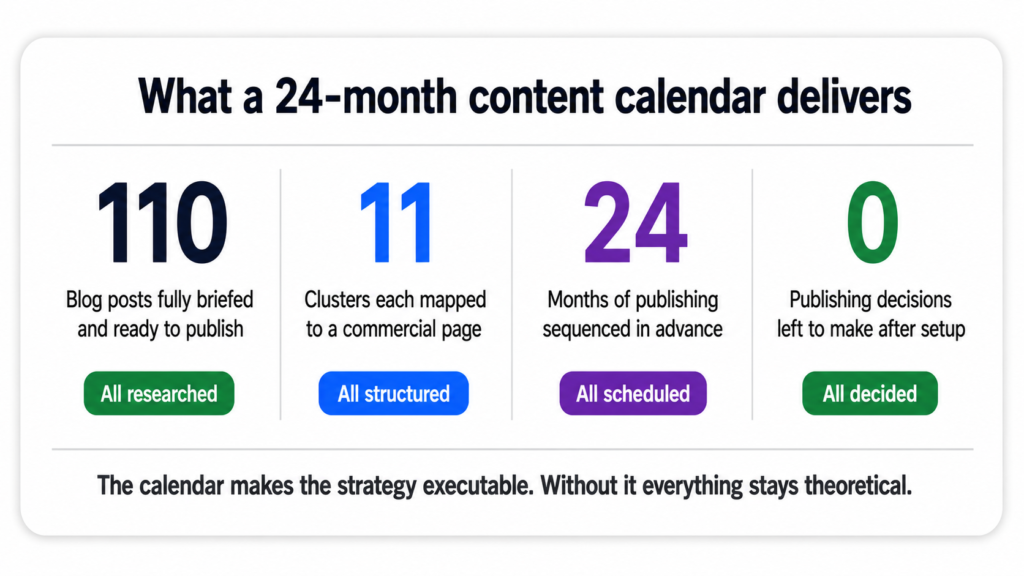
The calendar is not the strategy. It is the system that makes the strategy executable. Without it, even the best keyword research and cluster architecture stays theoretical. With it, 110 decisions are already made and every week the next post is ready to publish.
I Built This for a Client. I Can Build It for You.
A complete blog calendar built for your business — researched, structured, and ready to publish
What I built for Tiger Tail — the keyword mapping, the Perplexity Sonar research, the cluster architecture, the 110-post calendar with every row pre-loaded — is something I build for businesses and agencies. If your content is not producing organic traffic, the calendar and the structure behind it is almost always the missing piece.
Here is what you get:
- Full keyword research mapped to every page on your site
- Cluster architecture designed around your services and industries
- Research data pack for every post — real stats, named sources, citation URLs
- Complete publishing calendar with meta titles, meta descriptions, intent classification, internal links, CTAs, and status tracking — all pre-built
- Publishing pace and cluster priority order matched to your domain’s current authority level
Book a free 30-minute call
See the full SEO strategy service
The last post in this series covers how I brief AI to write industry-specific content that actually sounds like it was written by someone who knows the subject: how I brief AI to write content that does not sound generic.
SEO and AEO are answering two different questions
SEO and AEO get talked about as if they are rival strategies, competing for the same budget and the same hours. In practice they are answering two different questions, and most businesses need answers to both.
SEO asks: how do we get this page to rank high enough on Google that someone clicks on it? It is built around keywords, backlinks, technical performance, and page authority. The outcome it is optimized for is a visit to your site.
AEO asks: how do we get this brand or this piece of information included when an AI system answers a related question? It is built around structure, entity clarity, and how easily a model can extract and trust a specific fact or recommendation. The outcome it is optimized for is being part of the answer, whether or not that leads to a click.
If you have read our guide on what answer engine optimization actually is, this distinction will be familiar. This post goes one step further and looks specifically at how the two disciplines differ in practice, and how to figure out where your business should put its effort first.
Why this comparison matters now
The honest answer is that search behavior has changed enough that ignoring either one creates a real gap.
Roughly 60% of searches now end without the user clicking through to a website. People are getting their answer directly on the results page, or from a conversational AI tool, and moving on. Google AI Mode has crossed 2 billion monthly users across more than 200 countries. For a lot of queries, particularly informational ones, the AI-generated answer is now the first thing a person sees.
At the same time, AI Overviews and similar features still draw heavily from pages that are already ranking well in classic search. So the two are linked. A page with strong SEO has a real shot at being pulled into an AI answer. A page with no SEO foundation, no matter how well it is structured for AEO, is starting from a much weaker position.
This is the part that gets lost in a lot of “AEO vs SEO” framing. It is rarely a fork in the road. It is closer to a sequencing question: get the SEO foundation right, then add the structure and clarity that helps AI systems use that content.
The practical differences, side by side
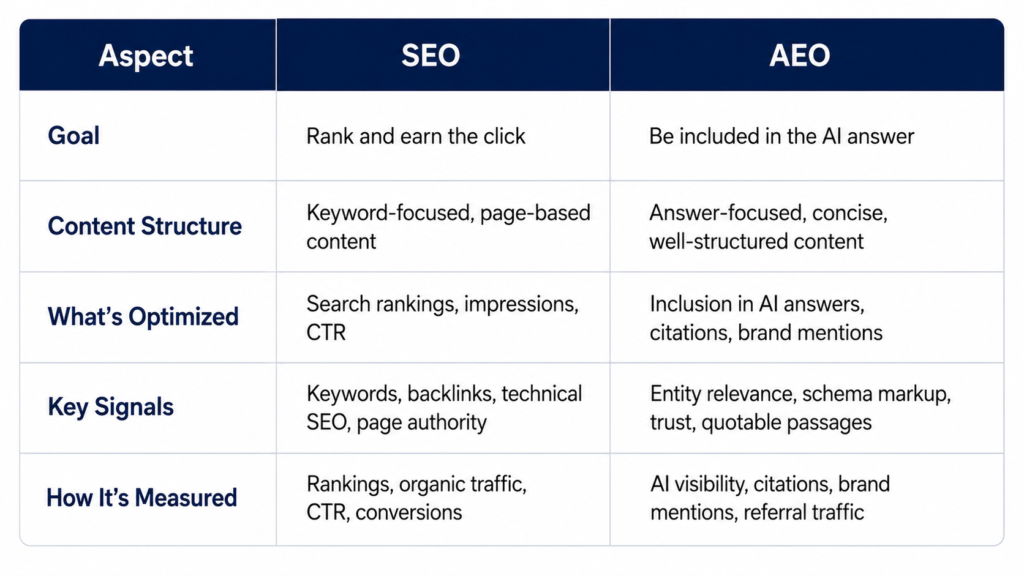
Here is where the two disciplines actually diverge in day-to-day work.
What “winning” looks like. For SEO, winning means ranking in the top positions for a keyword and earning the click. For AEO, winning means your brand, data, or explanation shows up inside an AI-generated answer, summary, or recommendation, sometimes without any click at all.
Content structure. SEO has traditionally rewarded long-form content that covers a topic from multiple angles and ranks for dozens of keyword variations. Depth and breadth are the point. AEO rewards content where each section can stand on its own. An AI system often pulls a single passage, not the whole page, so that passage needs to read sensibly even when quoted out of context. The practical approach is to lead each section with a direct answer, then add detail underneath for readers who want more.
What you’re optimizing. SEO optimizes whole pages and whole sites: site architecture, internal linking, technical performance, backlink profiles. AEO optimizes at the passage level as well as the page level. A single well-written paragraph with a clear claim and a number attached to it can become the quotable unit, even if the rest of the page is unremarkable.
Signals that matter. SEO leans on keywords, meta tags, backlinks, and page authority. AEO leans more on entity strength (is your brand a clearly defined, recognizable entity with consistent information across the web), schema markup, named authorship, and trust signals like reviews and citations from other sources.
Measurement. SEO has decades of established metrics: rankings, organic traffic, click-through rate. AEO measurement is newer and less standardized, but it generally comes down to tracking how often your brand or content appears in AI-generated answers for a defined set of queries, which is closer to a visibility percentage than a ranking position.
When SEO should be the priority
SEO carries more of the weight when your content sits closer to a transaction. Product pages, service pages, and anything where the goal is for someone to land on your site and take an action benefit most directly from SEO. AI engines still need to send the user somewhere to actually book, buy, or sign up, and that somewhere is your page. If your site has weak technical SEO, thin content, or no clear authority signals, that is the gap to close first regardless of how much attention AI search is getting, because it is also the foundation AEO depends on.
When AEO should be the priority
AEO carries more weight for informational and comparative content, the kind of queries where someone is still researching, comparing options, or trying to understand a topic before they have decided what to do. This tends to matter most for professional services, healthcare, legal, finance, and software businesses, where buyers often start by asking an AI tool to explain a topic or compare options long before they are ready to talk to anyone. If your category involves a lot of “what is,” “how does,” or “X vs Y” type questions, and you suspect your brand rarely or never comes up when those questions are asked, that is a sign AEO deserves dedicated attention.
How to figure out which one you need first
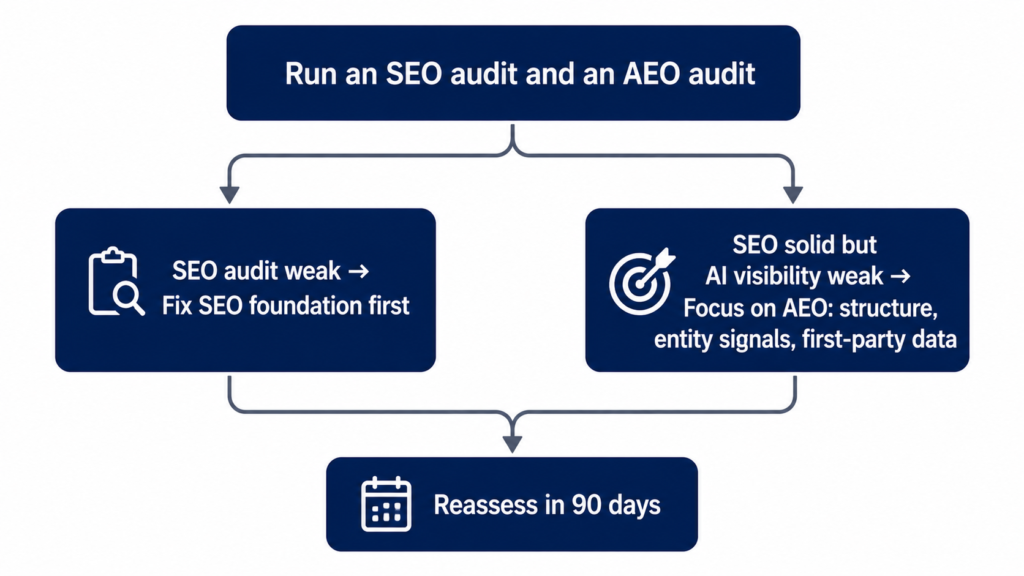
A short way to think about it: audit both, then fix whichever gap is bigger.
For SEO, the standard checks apply. Are your key pages ranking for the terms that matter? Is the technical foundation, site speed, indexing, mobile experience, in reasonable shape? Do you have a content base that covers your core topics with some depth?
For AEO, the check is different and less commonly done. Run a set of real questions your buyers would ask through ChatGPT, Perplexity, and Google AI Overviews, and see whether your brand comes up at all, and who comes up instead of you. We walked through exactly this kind of audit in our Midstream Marketing case study, where a financial services agency went from 1.9% AI visibility to 8.9% in 90 days once they knew where the gaps were.
If both audits come back weak, SEO comes first. It is the foundation AI systems lean on too. If your SEO is reasonably solid but you are invisible in AI answers, that is where AEO-specific work, restructuring content for quotable passages, strengthening entity signals, adding first-party data, will move the needle faster.
The bottom line
SEO and AEO are not a choice you make once. SEO is the operating system: site authority, technical health, and content that ranks. AEO is the layer on top that determines whether AI systems can extract, trust, and cite what you’ve built. Treating them as competitors means you end up under-investing in whichever one feels less urgent this quarter, and both tend to compound, so the gap grows the longer it’s ignored.
If you want a clearer picture of where your SEO and AI visibility actually stand right now, you can see our full range of SEO and AEO services or book a call and we’ll run through both with you.
This is the fourth post in a series about building a 110-post SEO content strategy from scratch. You can read the full strategy overview here, the keyword mapping post here, and the research process post here.
Why One Post Is Almost Never Enough
Here is a situation most business owners recognise. You write a detailed, well-researched blog post on a subject you genuinely know. You publish it. You wait. Three months later it is sitting on page four of Google and bringing in almost no traffic. The content is good. The keyword is real. Nothing happened.
The most common diagnosis for this is that the post needs more backlinks, or better on-page SEO, or a longer word count. Sometimes those things help. But the more fundamental issue is often that a single post on a new or mid-authority domain does not give Google enough to go on.
Google does not just evaluate individual pages. It evaluates patterns across a domain. A website that has published one post about AI for law firms is a website that mentioned the topic once. A website that has published ten interconnected posts about AI for law firms, each covering a different aspect and all linking to the same parent page, is a website that demonstrably understands the subject. Those two situations produce very different ranking outcomes.
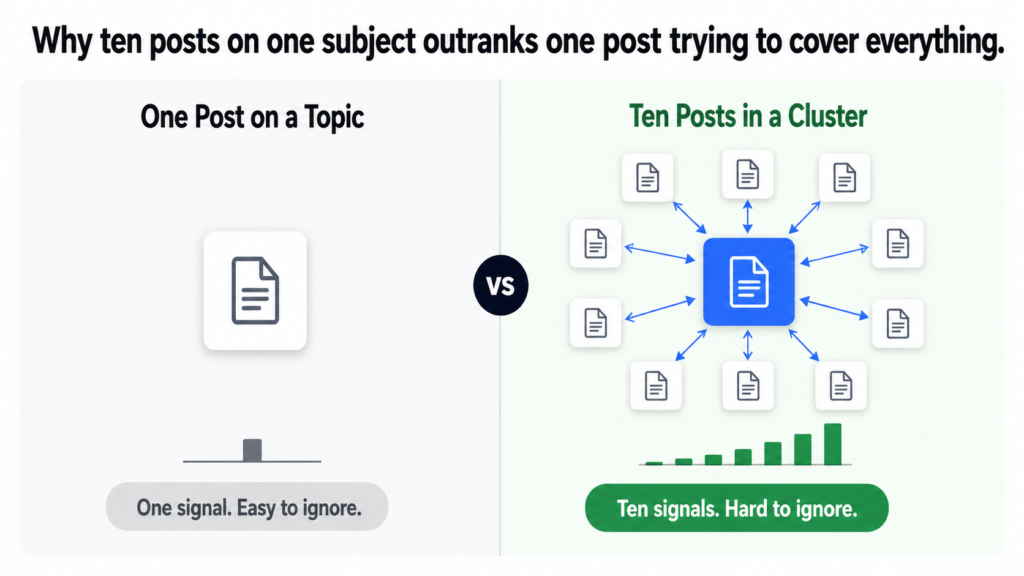
Topical authority is not about depth on one page. It is about breadth across multiple pages that together cover a subject more completely than any single competitor page can.
What a Content Cluster Actually Is
A content cluster is a group of related blog posts that all cover different aspects of the same subject, linked together and to a central parent page. The parent page targets a commercial keyword. The cluster posts target informational keywords around the same subject. Together they create a web of relevance that Google can follow in every direction and find consistent, substantive content.
The structure looks like this for the Tiger Tail legal cluster:
tigertail.co/ai-for-legal
Targets: “ai for law firms” — 1,300 monthly searches
Purpose: Convert visitors into leadsCLUSTER POSTS — all link back to parent page
Post 1: How Small and Mid-Size Law Firms Are Using AI in 2026
Post 2: How Much Time Are Your Lawyers Actually Spending on Billable Work?
Post 3: Legal Document Automation: How to Draft Faster Without Sacrificing Quality
Post 4: AI Contract Review: How to Cut Review Time From Hours to Minutes
Post 5: Client Intake Automation for Law Firms: Never Drop a Lead Again
Post 6: AI and Billing Ethics: What Every Lawyer Needs to Know About ABA Opinion 512
Post 7: How Law Firms Are Using AI to Win More Clients Without More Marketing Spend
Post 8: Matter Management Automation: How to Keep Every Case Moving
Post 9: Data Security and Confidentiality When Using AI at a Law Firm
Post 10: Solo and Small Firm AI: How Lawyers With Limited Budgets Can Compete
INTERNAL LINKING PATTERN
Every post links back to /ai-for-legal (parent page)
Every post links to 2-3 related posts within the cluster
Parent page links to the most relevant posts in the cluster
Ten posts. One parent page. Every post covers a different question a law firm partner might search for when researching AI. Together they build a complete picture of what the website knows about AI in legal. Individually, most of them would struggle to rank. As a cluster, each post lifts the others.
How Clusters Create Compounding Authority
The mechanism behind why clusters work is worth understanding properly because it changes how you think about content investment.
When Google crawls a new blog post, it evaluates that page partly on its own merits and partly on the context of the domain it sits on. A post published on a domain that already has nine related posts on the same subject starts with more context than a post published in isolation. Google can see that the domain consistently covers this topic. The new post is not a one-off mention. It is part of a pattern.
As the cluster grows, internal links pass authority between posts. A post that earns a backlink from an external source does not just benefit itself. Through internal linking, it passes some of that authority to every other post in the cluster and to the parent page. The whole cluster benefits when any one post performs well.
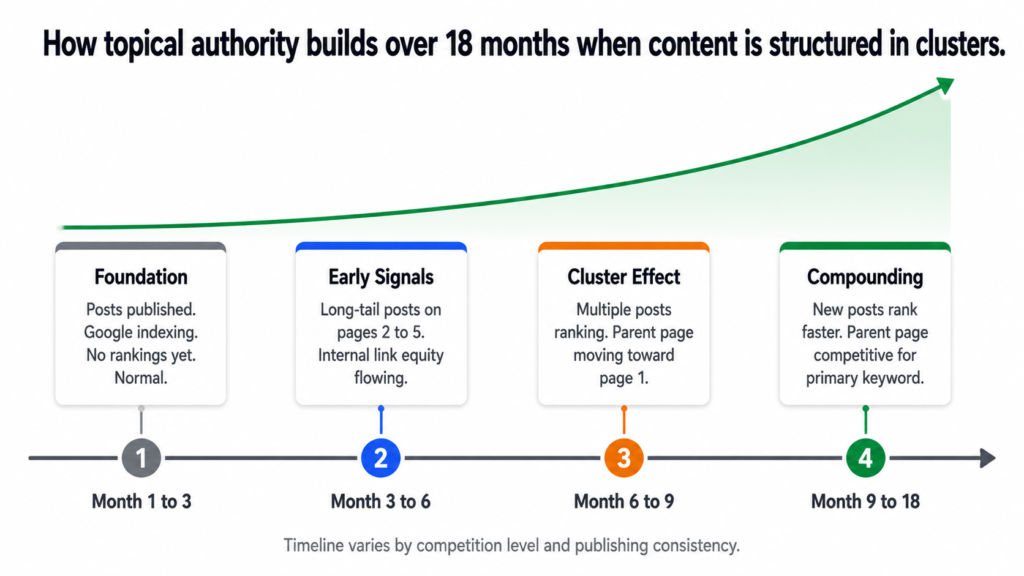
First cluster posts published.
Google crawls and indexes them.
Little to no ranking yet. Normal.
Domain is building context around the topic.Month 3 to 6: Early signals
Long-tail informational posts start appearing
on pages 2 to 5 for lower competition queries.
Internal link equity beginning to flow.
Parent page gains indirect authority.
Month 6 to 9: Cluster effect visible
Multiple posts from the same cluster ranking
for different keywords in top 20.
Parent page moving toward page 1 for primary keyword.
Google recognises topical depth.
Month 9 to 18: Compounding
Earlier posts strengthen as domain authority grows.
New posts in the cluster rank faster than early ones did.
Parent page competitive for high-volume keywords.
Cluster becomes a self-reinforcing authority signal.
This compounding effect is why the cluster approach produces better long-term returns than publishing the same number of posts on random topics. Forty posts spread across forty different subjects build forty isolated signals. Forty posts built across four clusters of ten each build four areas of genuine depth, and those four areas lift the entire domain.
How the 11 Clusters Were Decided
For Tiger Tail, the clusters were not chosen arbitrarily. Each one maps directly to either a service page or an industry page that already existed on the site. This matters because every blog post in a cluster has a clear commercial destination to link back to.
| Cluster | Parent Page | Primary Keyword | Monthly Searches |
|---|---|---|---|
| AI Audit and Strategy | /services/ai-audit-strategy | ai strategy consultant | 880 |
| Workflow Automation | /services/workflow-automation | business process automation services | 320 |
| Custom AI Development | /services/custom-ai-development | custom ai development company | 480 |
| Systems and Operations | /services/systems-operations-design | business systems consultant | 210 |
| Growth Engineering | /services/growth-engineering | ai marketing automation | 720 |
| AI Training | /services/ai-training-enablement | corporate ai training | 40 |
| Home Services | /ai-for-home-services | ai for contractors | 110 |
| Real Estate | /ai-for-real-estate | ai real estate agent | 590 |
| Legal | /ai-for-legal | ai for law firms | 1,300 |
| Healthcare | /ai-for-healthcare | healthcare workflow automation | 170 |
| Finance and Accounting | /ai-for-finance-accounting | ai for accounting firms | 70 |
Every cluster has a commercial destination. The blog posts in the legal cluster do not just exist to attract readers. They exist to attract readers who are researching AI for their law firm, build trust with them through genuinely useful content, and then point them toward a page where they can take action. The informational content and the commercial page work together rather than separately.
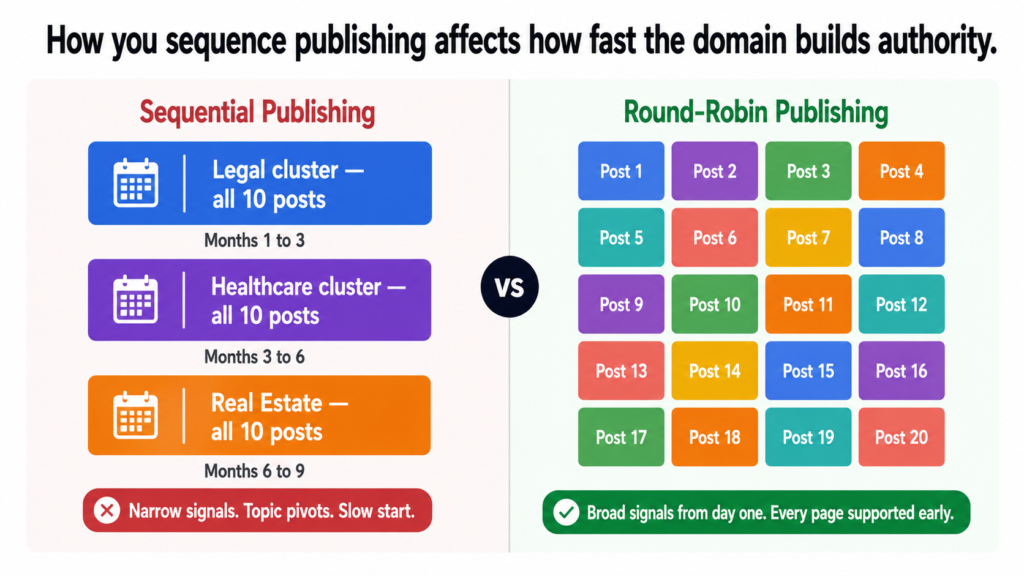
The Round-Robin Publishing Approach
One structural decision worth explaining is that the publishing calendar does not work through one entire cluster before starting the next. It rotates across all eleven clusters from the beginning.
Months 1 to 3: Publish all 10 legal posts
Months 3 to 6: Publish all 10 healthcare posts
Months 6 to 9: Publish all 10 real estate postsProblem: Domain looks like it pivots between topics.
Google sees bursts of content then silence on a subject.
No broad topical signals in early months.
ROUND-ROBIN APPROACH (what we did)
Week 1: AI Audit and Strategy post 1
Week 2: Home Services post 1
Week 3: Workflow Automation post 1
Week 4: Legal post 1
Week 5: Real Estate post 1
… continues cycling through all 11 clusters
Result: Domain builds broad topical signals from day one.
Google sees consistent coverage across the full subject area.
Every page category gets early signals rather than delayed ones.
The round-robin approach means every cluster gets its first post in the early weeks. Every service page and industry page on the site starts receiving supporting content within the first few months. Nothing waits six months for its cluster to begin.
Publishing all content for one cluster before starting the next feels logical but it creates a domain that looks narrow early on. Google sees a site entirely focused on one topic and then suddenly pivoting. Round-robin publishing signals consistent, broad expertise from the start.
What Clusters Do That Individual Posts Cannot
The simplest way to understand the cluster advantage is to compare two domains publishing the same total number of posts over the same time period.
Each post covers one subject with no related content nearby.
No internal linking architecture.
No commercial page to feed authority into.
Google sees breadth but no depth on any subject.
Result: Most posts on pages 4 to 10. Low traffic. Few conversions.DOMAIN B — 50 posts across 5 clusters of 10
Each cluster covers one subject from 10 different angles.
Posts interlink within clusters and to parent pages.
Commercial pages benefit from cluster authority.
Google sees consistent depth on five clear subjects.
Result: Cluster posts on pages 1 to 3. Parent pages ranking.
Organic traffic building. Leads coming in.
Both domains published fifty posts. Same effort. Very different outcomes. The difference is entirely structural.
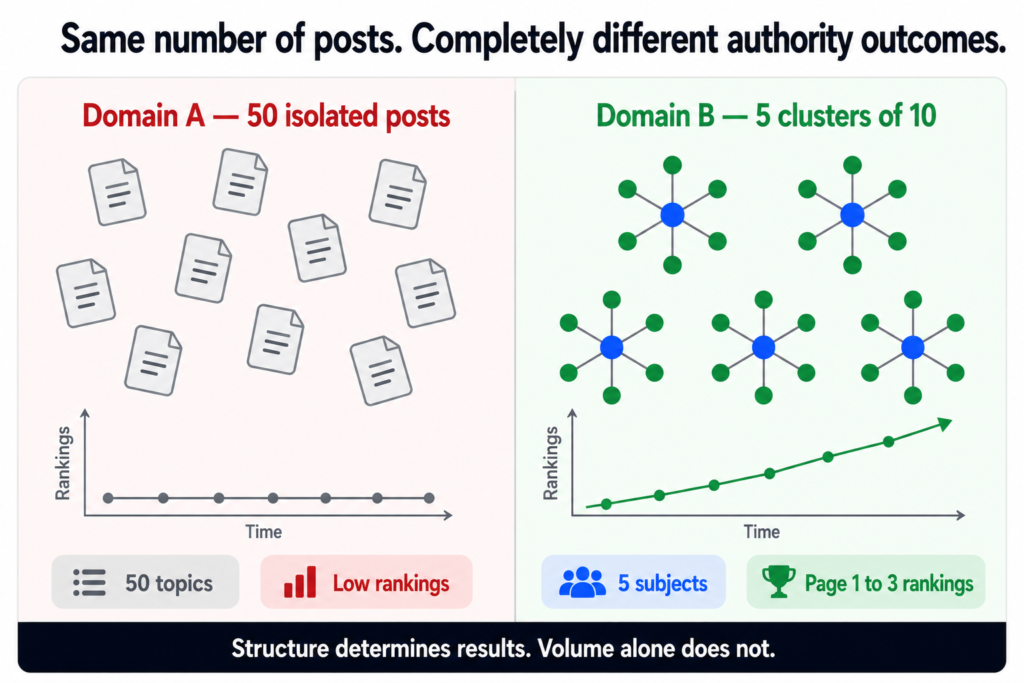
Clusters are not a content strategy preference. They are the mechanism by which a domain with limited authority competes with established sites. Ten posts covering one subject from ten angles consistently outranks one post trying to cover everything at once.
What Comes Next
With the cluster architecture designed and the research in place, the final structural decision was how to sequence the publishing calendar to get the most out of the domain authority building process. That is what I cover in the next post: how I build a 24-month blog calendar that a client can actually follow.
If you want a content strategy built around proper cluster architecture for your own website, book a call. The structure is what most content strategies are missing and it is the first thing I look at.
See how I approach SEO strategy →
Dhruv is an SEO consultant working with business owners, founders, and agencies. If organic search is not delivering for your business, this is where to start.
What is answer engine optimization?
Answer engine optimization, or AEO, is the practice of structuring your content so that AI tools like ChatGPT, Google AI Overviews, Perplexity, and Gemini can pull it out, understand it, and use it as the source for an answer.
For years, SEO meant one thing: get your page to rank high enough in Google that someone clicks on it. AEO is a different goal. The aim is to get your brand, your data, or your point of view mentioned inside the answer itself, even if the person never clicks through to your site.
This is not a replacement for SEO. It is closer to a second layer on top of it. Good AEO still depends on the basics that have always mattered: a real domain with some authority, content that is structured clearly, and information that is accurate and current. What changes is the target. You are no longer writing only for a person scanning a results page. You are also writing for a model that needs to extract a fact, a definition, or a recommendation and decide whether your source is trustworthy enough to cite.
This guide covers what answer engine optimization means in practice, why it matters now, how the major AI platforms differ in what they cite, and how to build an AEO strategy you can actually execute, with a real example of what it looks like when it works.
Why this matters right now
The numbers on this shift are hard to ignore. Gartner has projected that organic search volume could drop by around 25% by 2026 as more people get answers directly from AI chatbots and assistants instead of clicking through to websites. At the same time, AI-referred traffic to websites has grown sharply, and research from AirOps found that AI search visitors convert at roughly 4.4 times the rate of traditional organic visitors.
So the picture is not “AI search is killing traffic.” It is closer to “fewer people are clicking, but the ones who do click are much further along in their decision.” If your brand is not part of the answer at all, you are invisible to a growing share of buyers during the exact moment they are forming an opinion about who to trust.
This is the gap most businesses do not realize they have. Traditional SEO tools will tell you where you rank on Google. They will not tell you whether ChatGPT has ever heard of you, or whether Perplexity cites your competitor every time someone asks about your category.
How AEO is different from traditional SEO
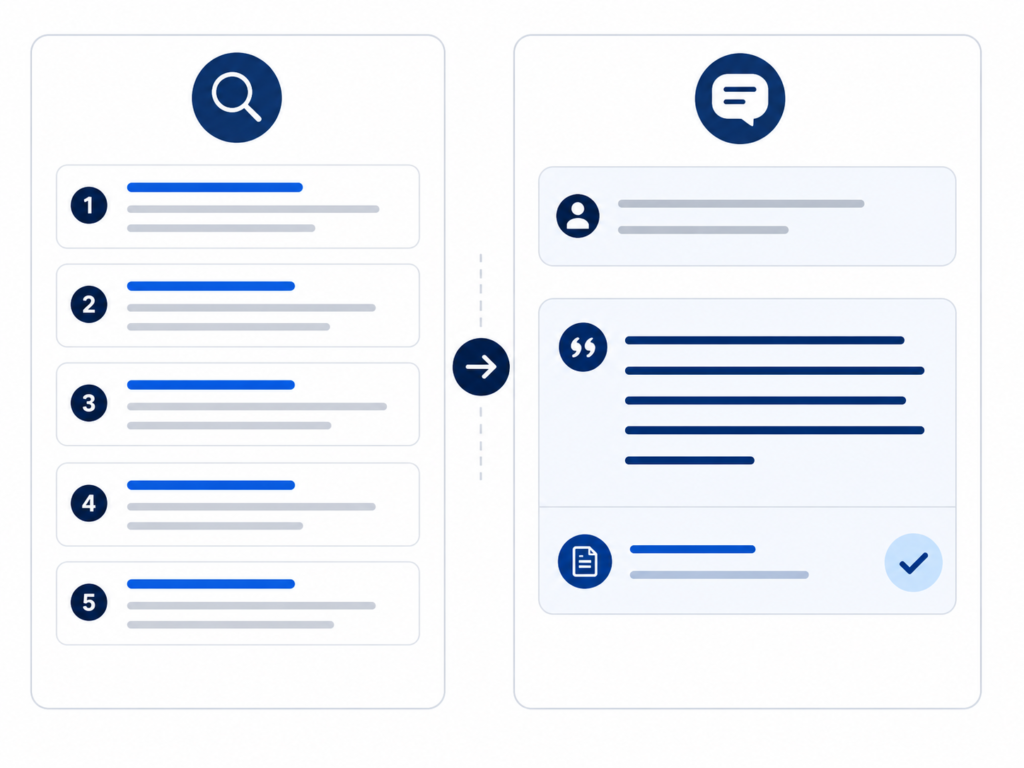
The two disciplines overlap more than people expect, but the priorities shift in a few specific ways.
Traditional SEO is built around keywords, backlinks, and ranking positions. The win condition is a click. AEO is built around structure, freshness, and citation-worthy facts. The win condition is being the source an AI model pulls from, whether or not that leads to an immediate visit.
AEO also spreads across more platforms than SEO ever had to. SEO was largely a Google game. AEO means thinking about how several different AI systems each pull and weight sources, because they do not all behave the same way.
None of this means abandoning what already works. It means adding a layer of structure and proof on top of content that was already doing reasonably well in search.
How the major AI platforms source their answers
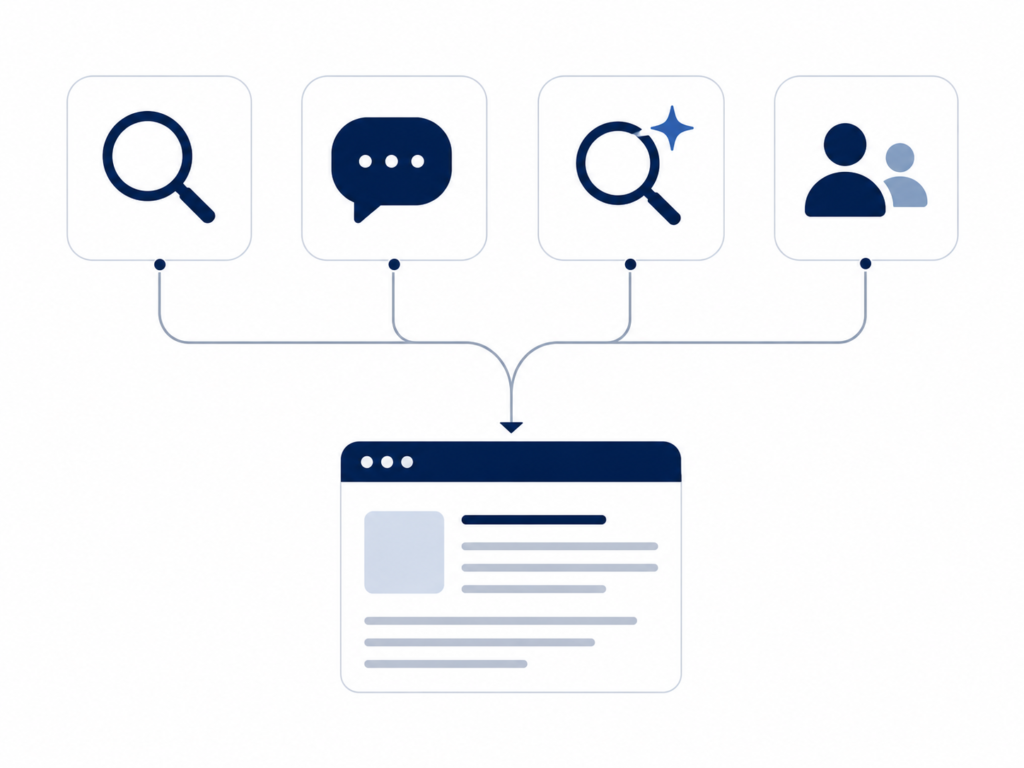
One thing that makes AEO harder than traditional SEO is that there is no single algorithm to study. Each platform has its own habits, and they shift as the models get updated. Here is what current research shows about the main ones.
Google AI Overviews still pull mostly from pages that are already ranking in the top 10 organic results for a query. If your page is not visible in classic Google search, it has very little chance of being cited in an AI Overview for the same query. This is the clearest overlap between SEO and AEO. AI Overviews now appear in roughly half of all Google searches, so this single platform carries a lot of weight.
ChatGPT leans heavily on a smaller set of high-authority reference sources. Industry analysis of ChatGPT citations has found that a huge share, close to half, come from Wikipedia. After that, established publications, official documentation, and primary sources for tools and products tend to dominate. Getting cited directly on ChatGPT often depends more on broader brand mentions and being referenced by the sources ChatGPT already trusts than on any single page you publish.
Perplexity behaves differently again. It rewards freshness and source diversity more than the others, and it pulls more heavily from forums, video platforms, and recently published content. If your audience uses Perplexity, recency and active publishing matter more than they would for, say, ChatGPT.
Microsoft Copilot leans on LinkedIn for business and B2B queries more than any other platform. If you are targeting a professional audience, a content strategy that ignores LinkedIn entirely is leaving a real gap in Copilot visibility.
The takeaway is not that you need a different strategy for every platform. It is that you should know which one or two platforms your buyers actually use, and weight your effort accordingly instead of spreading it evenly across all of them.
What actually makes content AEO-friendly
A few patterns show up consistently in research on what gets cited by AI models versus what gets skipped.
Clear, sequential heading structure matters more than people think. AirOps’ 2026 State of AI Search Report found that pages with logically ordered headings were significantly more likely to be cited, because the model can map the structure of the page to the structure of the question being asked.
Freshness matters, especially for anything commercial. The same report found that 83% of AI citations for commercial and evaluation-stage queries came from pages updated within the past 12 months, and more than 60% came from pages refreshed within the last six months. A page that has not been touched in two years is competing at a real disadvantage, even if the information in it is still technically correct.
Specificity beats generic advice. A Princeton study on Generative Engine Optimization found that adding expert quotes, statistics, and citations to a page measurably increased how often it got pulled into AI-generated answers, with statistics alone boosting visibility by around 30%. This lines up with what we have seen in practice. First-party data, things like your own case study numbers or a benchmark you measured yourself, tends to earn citations that a generic best-practices paragraph never will, because the AI model has nowhere else to get that exact number.
What we did for one client, and what happened
We worked with Midstream Marketing, an agency serving financial advisors, on exactly this problem. Going in, their AI visibility across major models sat at 1.9%. In plain terms, if you ran a hundred relevant AI conversations about their category, their brand showed up in fewer than two of them.
We ran 214 simulated conversations across seven AI model families using 31 prompts mapped to their actual buyer personas. That gave us a map of where they were already showing up, where competitors were dominating, and which topics had the most room to move.
From there the work focused on three things: prioritizing the topics where Midstream had a genuine edge, like outsourced CMO services for financial advisors, building up the sources that AI models were already citing in that space so Midstream’s domain got pulled into more of them, and aligning content to the specific questions their two core buyer types were actually asking.
After 90 days, overall AI visibility went from 1.9% to 8.9%, a 368% increase. Their strongest topic, outsourced CMO services, went from 11% to 24% visibility. Domain citations across AI platforms rose from 13 to 26. You can read the full breakdown in our Midstream Marketing AEO case study.
The point of sharing this is not the percentages themselves. It is that visibility in AI search is measurable, and it moves faster than most people expect once you know which gaps to close.
Building an AEO strategy step by step
An AEO strategy does not need to be complicated to be effective. The work breaks down into a few stages, and most of the early gains come from getting the first two right.
Step 1: Establish your baseline. Before changing anything, find out where you actually stand. Run a set of realistic questions your buyers would ask through ChatGPT, Perplexity, and Google AI Overviews, and note whether your brand comes up, and who comes up instead of you. This baseline is the single most useful thing you can have, because it tells you which topics and which platforms are worth prioritizing.
Step 2: Audit and refresh your highest-value pages. Go back through the pages that already get the most traffic or already rank reasonably well, and check when they were last meaningfully updated. Given how strongly freshness correlates with citation rates, a page from a couple of years ago that still gets traffic is often a better investment to update than a new page from scratch.
Step 3: Add real numbers wherever you can. Look for places where you can include a result you measured, a benchmark from your own work, or a before-and-after from a client. These are the details that give an AI model a reason to cite you specifically instead of a competitor saying roughly the same thing in vaguer terms.
Step 4: Fix your heading structure. Headings should read like a logical breakdown of the topic on their own, the way a table of contents would. If someone only read your H2s and H3s, would they understand the shape of the answer? If not, restructure before writing more content.
Step 5: Build topical depth around two or three areas. Pick the topics where you have a genuine point of view or track record, not just generic competence, and go deep on those first. Trying to be cited for everything at once spreads your authority too thin to move the needle anywhere. This is also where supporting content comes in: a strong pillar page on a topic, backed by several focused posts that each go deeper on one piece of it, tends to build authority faster than the same number of standalone, unrelated posts.
Step 6: Track citations alongside rankings. Rankings tell you how you are doing in classic search. Citation tracking tells you how you are doing in AI search. Treat them as two separate metrics that both need attention, since a page can rank well and still never get cited, or vice versa.
Common mistakes to avoid
A few patterns come up often enough to be worth calling out directly.
Treating AEO as a one-time project rather than an ongoing practice. Given how much weight freshness carries in citation rates, a page optimized once and never revisited will lose ground over time, even if nothing about the underlying information has changed.
Chasing every platform at once instead of the one or two your audience actually uses. A B2B brand whose buyers live on LinkedIn gets more out of strengthening Copilot visibility than spending equal effort on Perplexity.
Publishing generic advice with no first-party data. This is the content that is easiest to write and hardest to get cited, because an AI model has dozens of other sources saying the same thing in roughly the same words.
Ignoring the connection between classic SEO rankings and AI citations. Google AI Overviews in particular still draw heavily from top-10 organic results, so neglecting fundamentals in favor of “AI-specific” tactics tends to backfire.
Where this fits with everything else
AEO is not a separate track from your content strategy. It is a lens you apply to the content you are already planning to write. If you have read our pieces on building a blog strategy and keeping it consistent, the same foundation applies here: a clear plan, real data, and content built around what your audience is actually asking. AEO just adds one more question to ask before you hit publish: if an AI model needed to answer this exact question, would it have a reason to pull from this page?
If you want a clearer picture of where your brand currently stands in AI search and what an AEO strategy would look like for your specific category, you can see our full range of SEO and AEO services or book a call and we can run a quick visibility check together.
This is the third post in a series about building a 110-post SEO content strategy from scratch. Start with the overview here or read about keyword mapping here if you missed the earlier posts.
Why Most AI-Generated Content Feels Empty
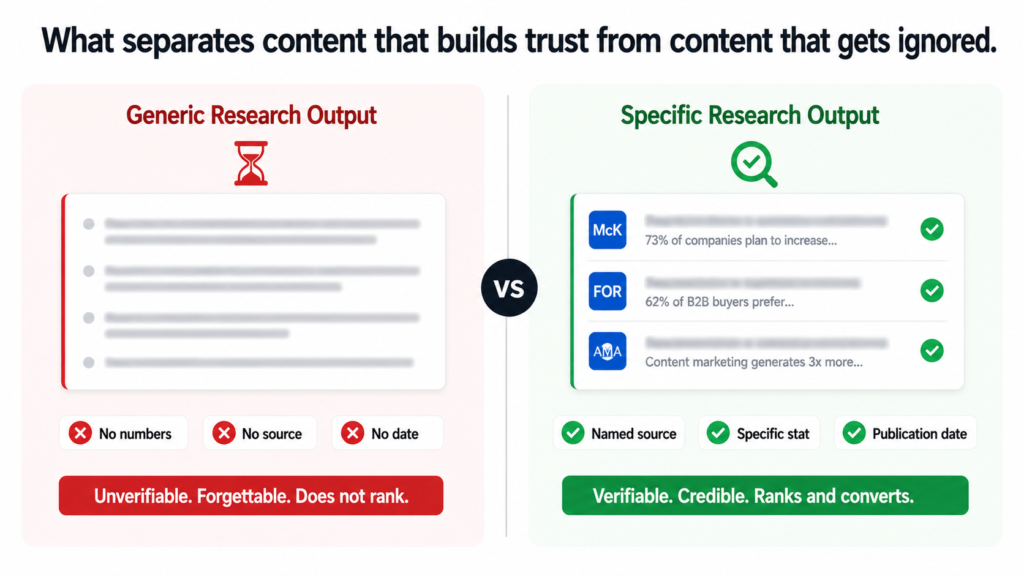
There is a specific feeling you get when you read AI-generated content that was not properly researched. It is technically accurate. It covers the topic. But it says nothing you could not have guessed without reading it. No numbers. No named sources. No dates. Just confident-sounding sentences that gesture at the subject without actually saying anything specific about it.
That content does not rank well because Google has seen millions of pages that say the same thing in slightly different words. It does not convert well because readers who are evaluating whether to hire someone do not trust vague claims. And it does not build authority because there is nothing in it that a competitor could not produce in three minutes.
The fix is not better writing. It is better research input before the writing starts.
What Perplexity Sonar Actually Does
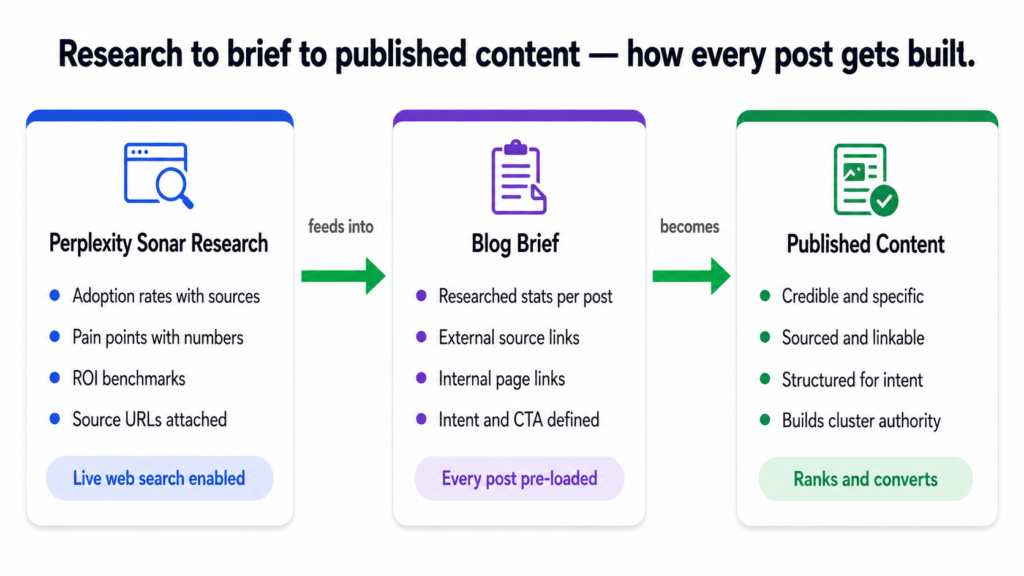
Perplexity Sonar is the API version of Perplexity AI with live web search enabled. Unlike standard language models that draw only on training data, Sonar actively searches the web in real time and returns answers with cited sources.
For content research, this matters for one specific reason. Training data gets stale. A model trained on data from 2023 does not know what the AMA published in 2024 about physician burnout rates or what McKinsey’s 2025 State of AI survey found about how many organisations are actually scaling AI versus still experimenting. Sonar pulls that data live with the source URLs attached.
The goal of research is not to fill a brief with statistics. It is to find the specific numbers that make a claim undeniable. One well-sourced stat from a named publication does more for credibility than ten vague assertions about industry trends.
The Research Prompt Structure
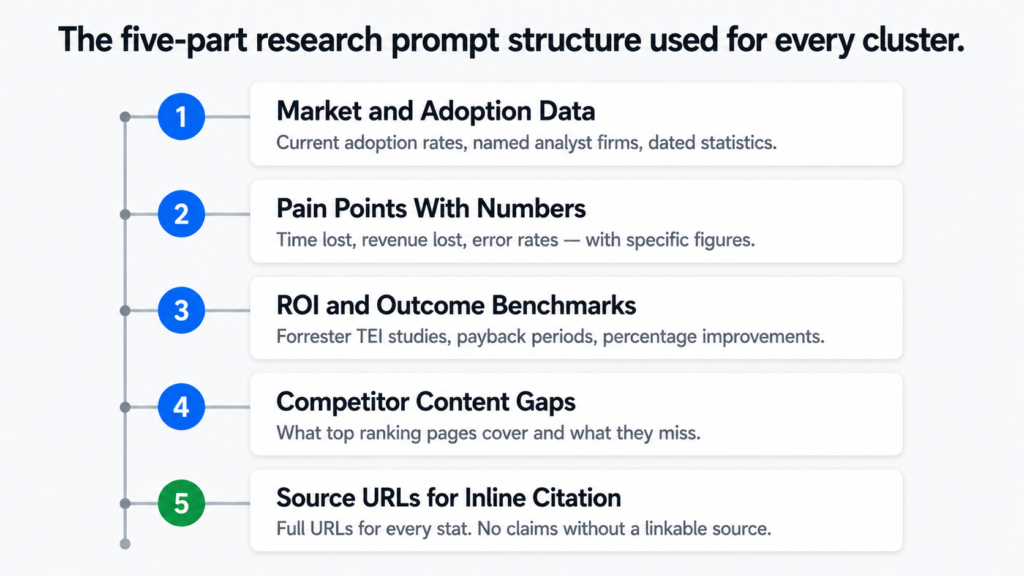
Every cluster in the Tiger Tail project got its own dedicated research prompt. Not a generic “tell me about AI in healthcare” request. A structured prompt designed to return exactly the categories of data the blog posts needed to be useful.
Here is the core structure I use for every cluster research prompt:
Current adoption rates with source and publication date.
How many businesses in this sector are using AI or automation.
Growth projections with named analyst firms.
2. Pain points with quantified data
Specific problems the audience faces, backed by survey data.
Time lost, revenue lost, errors caused — with numbers.
Named studies or reports, not vague attributions.
3. ROI and outcome benchmarks
What results do businesses actually see after implementation.
Forrester TEI studies, McKinsey surveys, industry reports.
Payback periods, percentage improvements, cost savings.
4. Competitor content gaps
Top 5 ranking pages for the primary keywords.
What they cover and what they miss.
Angles that are underserved in existing content.
5. Source URLs for inline citation
Full URLs for every stat returned.
Publication name, author where available, and date.
No stats used without a linkable source.
That structure applies to every cluster. What changes is the industry context and the specific questions asked within each category. A healthcare cluster research prompt asks about physician burnout rates and prior authorisation time. A legal cluster prompt asks about billable hour utilisation and contract review time. Same framework, different inputs.
What Good Research Output Looks Like
Here is an example of the difference between weak research output and strong research output for the same topic. Both are about physician burnout. Both are technically accurate. Only one is usable.
research-output-comparison.txt
——————————————————————————————————————
“Physician burnout is a serious and growing problem
in the healthcare industry. Many doctors report
feeling overwhelmed by administrative tasks and
documentation requirements. Studies show that
burnout rates have increased in recent years.”No numbers. No source. No date. No named study.
A reader cannot verify it. Google has seen it
a million times. Nobody finds it convincing.
STRONG RESEARCH OUTPUT
——————————————————————————————————————
“The AMA’s national physician burnout survey shows
that 43.2 percent of physicians reported at least
one symptom of burnout in 2024, down from 48.2
percent in 2023 but still far above 2011 levels.
AMA time-use data show physicians worked 57.8 hours
per week on average, spending 13 hours on indirect
patient care and 7.3 hours on administrative tasks.”
Source: AMA national physician burnout survey, 2024.
URL: ama-assn.org/[full path]
Specific percentage. Named organisation. Year.
Comparison data. Time breakdown. Linkable source.
A reader can verify it. Google can trust it.
The second version took the same amount of writing effort. The difference is entirely in the research input. Sonar returned the specific AMA data with the source URL. The writer used it. The post is now citing a real study from a named authority rather than making a vague claim that sounds like every other article on the subject.
How the Research Feeds the Brief
For the Tiger Tail project, every blog post brief was built around a structured data pack pulled from Sonar. Each brief included the following categories of research:
Full stats, proof points, and findings from Perplexity Sonar.
Sourced from 2024 to 2026 publications only.
Each stat matched to the specific post it would support.
External Links
Full source URLs for every statistic.
Only authoritative domains: AMA, McKinsey, Forrester,
Clio, Gartner, Deloitte, ABA, NAR, IBM, Zapier.
No aggregator sites. No low-authority citations.
Internal Links
Specific pages on tigertail.co to link to naturally.
Parent service or industry page for the cluster.
Related posts within the same cluster.
Search Intent
Informational, How-To, Comparison, or Commercial.
Determines structure, depth, and CTA placement.
CTA
One call to action per post, placed where it earns its place.
Not forced. Not repeated. One clear next step.
With that research in the brief, a writer does not need to go looking for statistics. They do not need to guess what sounds credible. Every claim they make is backed by something real before they write the first sentence.
Why Source Quality Matters as Much as the Stat Itself
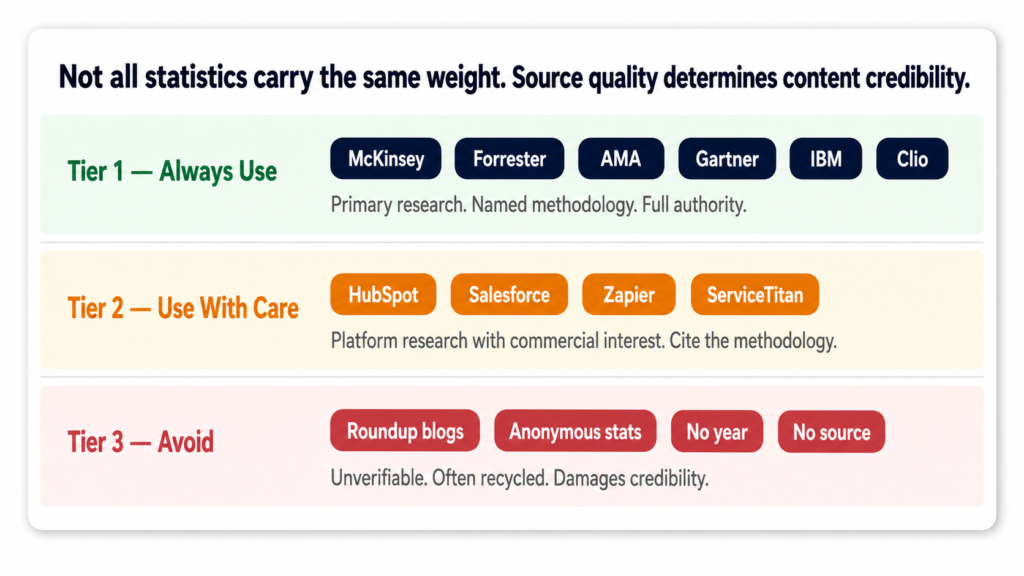
Not all statistics are equal. A stat from a Forrester Total Economic Impact study carries more weight than the same number repeated on a marketing blog. A figure from the AMA national physician survey is more credible than “experts say burnout is rising.”
For every cluster, the research was filtered to authoritative sources only. That meant primary research from named analyst firms, government or professional associations, peer-reviewed publications, and major industry platforms with named methodology. Anything that could not be traced back to a primary source did not make it into a brief.
McKinsey, Forrester, Gartner, Deloitte, BCG
AMA, ABA, NAR, AICPA, HIMSS, Clio Legal Trends
IBM Cost of Data Breach, Zapier State of Automation
Harvard Business Review, JAMA, NEJM
Government data: BLS, CMS, HHSUSE WITH CARE — Tier 2 Sources
Platform research from major SaaS companies
with named methodology and sample size.
Examples: HubSpot, Salesforce, ServiceTitan surveys.
Cite but note the source has a commercial interest.
AVOID — Tier 3 Sources
Anonymous blog posts repeating stats without sourcing.
Roundup articles that cite other roundup articles.
“According to experts” with no named expert.
Statistics without a year or methodology attached.
This filtering step is what protects the content long term. A blog post built on Tier 1 sources stays credible for years. A blog post built on recycled statistics from aggregator sites can be undermined the moment someone checks the original source and finds it does not say what the article claims.
The Real Reason This Step Cannot Be Skipped
It is tempting to move straight from keyword mapping to writing. Research feels like overhead. It adds time to the brief. It requires a tool and a process rather than just opening a document and starting.
But the research step is what separates content that builds genuine authority from content that just exists. Google can identify thin content. Readers can feel it. And in competitive niches like AI consulting, legal technology, or healthcare automation, you are competing against content backed by real data from serious publications. Vague claims do not compete with that.
Every post in the Tiger Tail project started with a research data pack. Every stat in every post has a source URL attached. That is not a quality-control step. It is the foundation the entire content strategy is built on.
What Comes Next
With keyword mapping done and research packed into every brief, the next decision was how to organise all 110 posts into a structure that builds compounding authority rather than just accumulating content. That is what cluster architecture is about and it is what I cover in the next post: why I build content in clusters, not one-off posts.
If you want a content strategy built this way for your own business, including the keyword mapping, Sonar research, and full brief pack, book a call and we can talk through what that looks like for your specific site.
See how I approach SEO strategy →
Learn about AEO and answer engine optimisation →
Dhruv is an SEO consultant working with business owners, founders, and agencies. If organic search is not delivering for your business, this is where to start.
This is the second post in a series about building a 110-post SEO content strategy from scratch. If you missed the first one, start here for the full overview.
The Problem With Keyword Research Done in Isolation
Most businesses approach keyword research the same way. They find a tool, type in their industry, get a list of terms with search volumes, pick the ones that look promising, and hand them to a writer. The writer produces content. The content gets published. Nothing ranks.
The missing step is not better keywords. It is understanding which page on the website each keyword belongs to and why. A keyword does not exist in a vacuum. It needs a home. And that home needs to be the right type of page for the intent behind the search.
Without that mapping, you end up in one of two bad situations. Either you create blog posts competing against your own service pages for the same keywords, or you create service pages targeting keywords that should be blog content. Both confuse Google and split your ranking potential instead of concentrating it.
The Two Types of Pages That Need Keywords
For the Tiger Tail project, the website had two distinct types of pages before a single blog post was written. Service pages and industry pages. Each type needs its own keyword logic.
Service pages target keywords where the searcher is looking for a solution or a provider. Someone searching “ai strategy consultant” or “workflow automation services” has commercial intent. They are not looking for an explanation. They are looking for someone to hire. These keywords belong on service pages, not blogs.
Industry pages target keywords where the searcher is a specific type of business looking for AI solutions relevant to their sector. Someone searching “ai for law firms” or “ai for real estate agents” has commercial intent too, but with an industry-specific lens. These keywords belong on the industry pages, not the blog either.
Blog posts serve a different purpose. They capture informational searches from people who are not ready to buy yet but are researching the problem. The blog content feeds authority to the service and industry pages. The pages convert. The blog attracts.
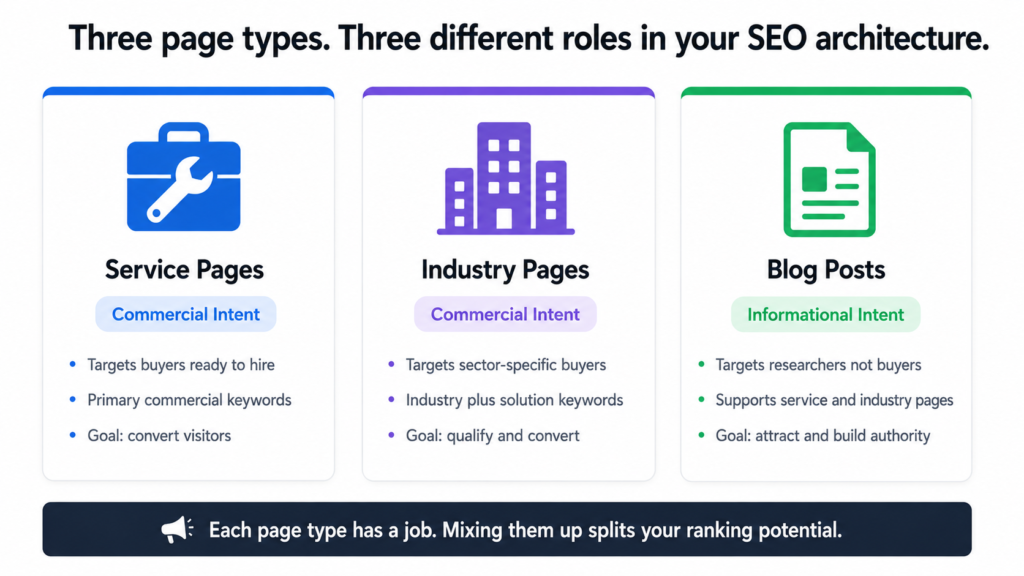
Service pages and industry pages target buyers. Blog posts target researchers. Mixing them up is one of the most common and most damaging SEO mistakes a business can make.
The Actual Mapping: Real Data From the Project
Here is what the keyword-to-page mapping looked like for the Tiger Tail service pages. Every page got its primary keywords and monthly search volumes confirmed before any content was briefed.
service-page-keyword-map.txt
Page URL                              Primary Keyword                    Monthly Searches

/services/ai-audit-strategy            ai strategy consultant                      880
/services/ai-audit-strategy            ai readiness assessment                     720
/services/ai-audit-strategy            ai implementation consultant                390
/services/ai-audit-strategy            automation consultant                       480
/services/workflow-automation          business process automation services        320
/services/custom-ai-development        custom ai development company               480
/services/custom-ai-development        ai integration services                     590
/services/growth-engineering           ai marketing automation                     720
/services/growth-engineering           ai lead generation agency                   110
/services/ai-training-enablement       corporate ai training                        40
And here is the same mapping for the industry pages:
industry-page-keyword-map.txt
Page URL                              Primary Keyword                    Monthly Searches

/ai-for-legal                          ai for law firms                          1,300
/ai-for-real-estate                    ai real estate agent                        590
/ai-for-real-estate                    ai for real estate agents                   480
/ai-for-healthcare                     healthcare workflow automation              170
/ai-for-finance-accounting             ai for accounting firms                      70
/ai-for-home-services                  ai for contractors                          110
/ai-for-legal                          legal document automation                   170
/ai-for-healthcare                     ai for medical billing                       90
Looking at this data together, the legal page stands out immediately. “Ai for law firms” at 1,300 searches per month is the single highest-volume keyword across all pages on the site. That tells you the legal cluster needs serious depth in the blog to give that page the authority it needs to compete.
The corporate AI training page, on the other hand, targets “corporate ai training” at just 40 searches per month. That is a low-volume keyword but the commercial intent behind it is very high. Someone searching that phrase is almost certainly a business ready to spend money on training. Low volume does not mean low value.
How Search Volume Shapes Priority, Not Just Selection
This is the part most keyword guides miss. Search volume is not just a filter for deciding which keywords to target. It is an input for prioritising which content to build first and how much of it you need.
A page targeting a keyword with 1,300 monthly searches needs more supporting blog content around it than a page targeting 40 monthly searches. Not because the second page matters less, but because Google needs to see more topical depth before it will trust a new domain with a high-volume, competitive keyword.
volume-to-priority-logic.txt
Volume Range      What It Means                          Content Priority

1,000+            High demand. High competition.             Deep cluster needed.
                  Big brands likely dominating page 1.       10+ supporting posts.
                  New domain needs time and authority.

300 to 999        Solid demand. Beatable competition         Strong cluster needed.
                  with quality content and good structure.   8 to 10 supporting posts.

100 to 299        Moderate demand. Often less competitive.   Medium cluster.
                  Good early target for a new domain.        6 to 8 supporting posts.

10 to 99          Low volume. Often high commercial intent.  Focused cluster.
                  Worth targeting if buyer intent is clear.  5 to 6 supporting posts.

Under 10          Very niche. May still be worth it          Evaluate carefully.
                  if the buyer value per conversion is high. Single post may be enough.
This framework shaped the entire cluster structure for the project. The legal cluster targeting 1,300 searches got ten posts. The AI training cluster targeting 40 searches also got ten posts, but those posts are written differently. More specific, more technical, more conversion-oriented, because the person reading them is further along in their decision.
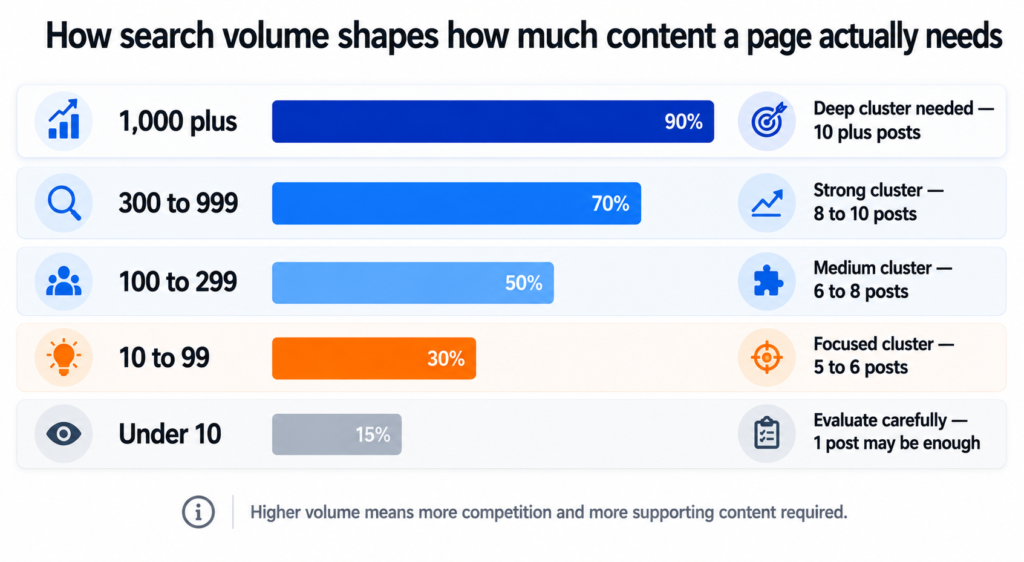
Intent Is More Important Than Volume
Search volume tells you how many people are searching. Search intent tells you why. Getting the intent wrong is worse than targeting a low-volume keyword because it means you are attracting the wrong people even when you do rank.
Every keyword in the Tiger Tail mapping got an intent classification before it was assigned to a page. The classification is simple but it matters every time.
search-intent-classification.txt
Intent Type       What the Searcher Wants                 Right Page Type

Informational     Learning about a topic.                     Blog post.
                  Not ready to buy yet.
                  Example: "what is ai readiness assessment"

How-To            Looking for a process or steps.             Blog post or guide.
                  Example: "how to automate workflow"

Commercial        Researching providers or solutions.         Service or industry page.
                  Getting close to a decision.
                  Example: "ai strategy consultant"

Comparison        Evaluating options.                         Blog post or landing page.
                  Example: "make vs zapier vs custom automation"

Transactional     Ready to buy or contact.                    Service page with clear CTA.
                  Example: "hire ai implementation consultant"
A keyword like “what is an ai readiness assessment” is informational. It belongs in the blog as a post that educates the reader and links to the service page at the end. A keyword like “ai readiness assessment” with no qualifier is commercial. Someone typing that is likely comparing providers. It belongs on the service page itself.
Those two keywords look similar. They would land on completely different pages in a well-structured site. Getting that distinction right is what separates a site that converts from one that attracts traffic that never does anything.
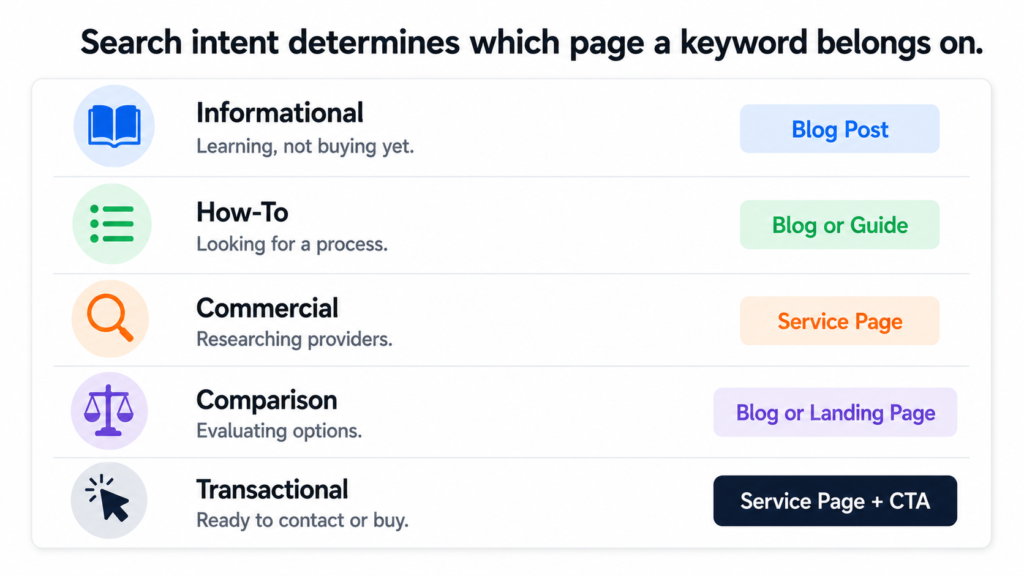
Putting commercial intent keywords on blog posts and informational keywords on service pages is one of the most common ways content strategies fail quietly. The traffic numbers look fine. The conversions never come.
The Before and After of Keyword Mapping
Here is what the approach looks like without mapping versus with it:
before-vs-after-mapping.txt
WITHOUT KEYWORD MAPPING

"Let's write a blog about AI for law firms."
"Let's write about what an AI consultant does."
"Let's cover AI pricing."

Result: Random posts. No page authority built.
        Service pages get no support.
        Blog competes with its own pages.
        Nothing ranks for anything meaningful.


WITH KEYWORD MAPPING

"ai for law firms" (1,300/mo, commercial) → /ai-for-legal service page
"how small law firms use ai" (informational) → blog post in legal cluster
"ai contract review" (informational/how-to) → blog post in legal cluster
"legal document automation" (170/mo, commercial) → /ai-for-legal page
"ai and billing ethics law firms" (informational) → blog post in legal cluster

Result: Service page targets commercial keywords.
        Blog cluster builds topical authority around it.
        Every post links back to the parent page.
        Google sees depth and relevance. Rankings follow.
The difference is not subtle. In the first approach, a business is just publishing. In the second, every piece of content has a specific job to do and a specific place in the architecture.
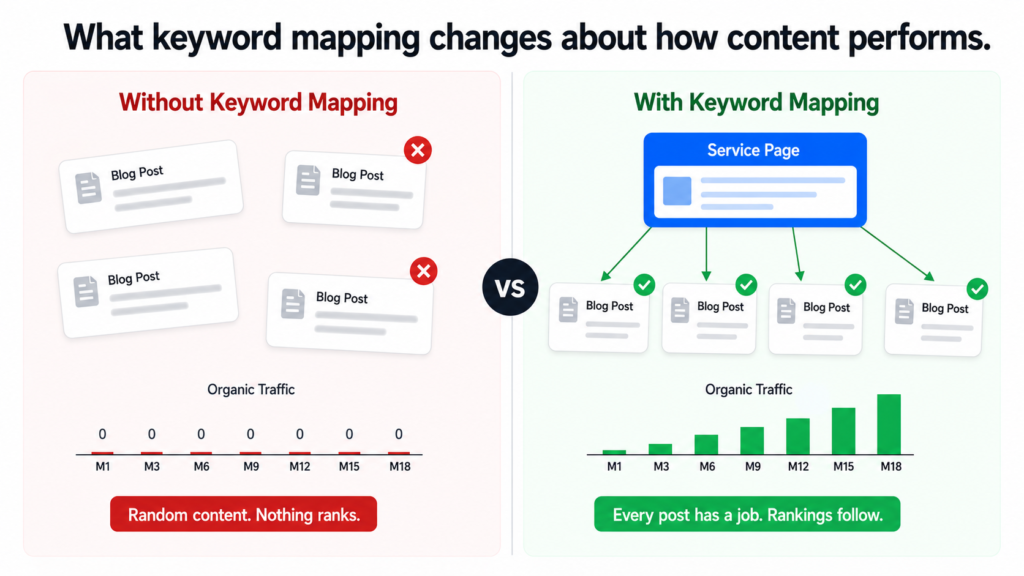
What Good Keyword Mapping Produces
By the time the keyword mapping was done for the Tiger Tail project, every page on the site had a clear primary keyword, a confirmed search volume, an intent classification, and a list of supporting blog topics that would feed it authority over time.
That groundwork meant every brief written after it had a reason to exist. Not just “here is a topic someone might find interesting” but “here is a keyword a real person searches for, here is the page it supports, here is how it fits into the cluster that will eventually rank the parent page.”
Keyword mapping is not a research exercise. It is a structural decision. It determines what gets built, where it lives, and what it is supposed to accomplish. Every hour spent on it saves ten hours of rewriting content that landed in the wrong place.
What Comes Next
With the keyword map in place, the next step was research. Not the generic kind where you read a few articles and summarise them. Proper data-backed research using Perplexity Sonar that produced real statistics, named sources, and proof points for every single post across all 110 briefs.
That process is what I cover in the next post: how I use Perplexity Sonar to research blog topics with real data.
If you want to talk through what keyword mapping would look like for your own website, book a call. I can usually tell within the first conversation whether a site’s content architecture is working for it or against it.
See how I approach SEO strategy →
Dhruv is an SEO consultant working with business owners, founders, and agencies. If organic search is not delivering for your business, this is where to start.
How This Started
The brief was not complicated. A new AI implementation consultancy — Tiger Tail, based in Montclair, NJ — had just launched their website and needed a content strategy. They serve small and mid-size businesses across industries like legal, healthcare, real estate, home services, and finance. The site had industry pages and service pages already mapped out. What it did not have was a blog that could actually build organic traffic over time.
This is a situation I see constantly. The website exists. The pages are live. But without a content layer built around what the target audience is actually searching for, those pages sit there doing nothing. Google has no reason to show the site to anyone because there is no signal of depth, authority, or relevance yet.
The goal was to build that signal. Deliberately, systematically, over 24 months.
The Starting Point: Keywords and Page Mapping
Before writing a single brief or topic idea, the first step was understanding what the site was already trying to rank for and what search volume existed behind each page.
Every industry page and service page got mapped to its primary keywords and monthly search volumes. Not as a rough estimate but with specific data points that shaped priority decisions later.
A few examples from the service pages alone:
keyword-page-mapping.txt
Service Page                          Primary Keyword                    Monthly Searches

/services/ai-audit-strategy            ai strategy consultant                      880
/services/ai-audit-strategy            ai readiness assessment                     720
/services/growth-engineering           ai marketing automation                     720
/services/custom-ai-development        ai integration services                     590
/services/ai-audit-strategy            automation consultant                       480
/services/custom-ai-development        custom ai development company               480
/ai-for-legal                          ai for law firms                          1,300
/ai-for-real-estate                    ai real estate agent                        590
This mapping does two things. First, it tells you which pages matter most from a traffic potential standpoint. Second, it tells you which blog clusters need to be built first to support those pages with topical authority before competitors lock in their positions.
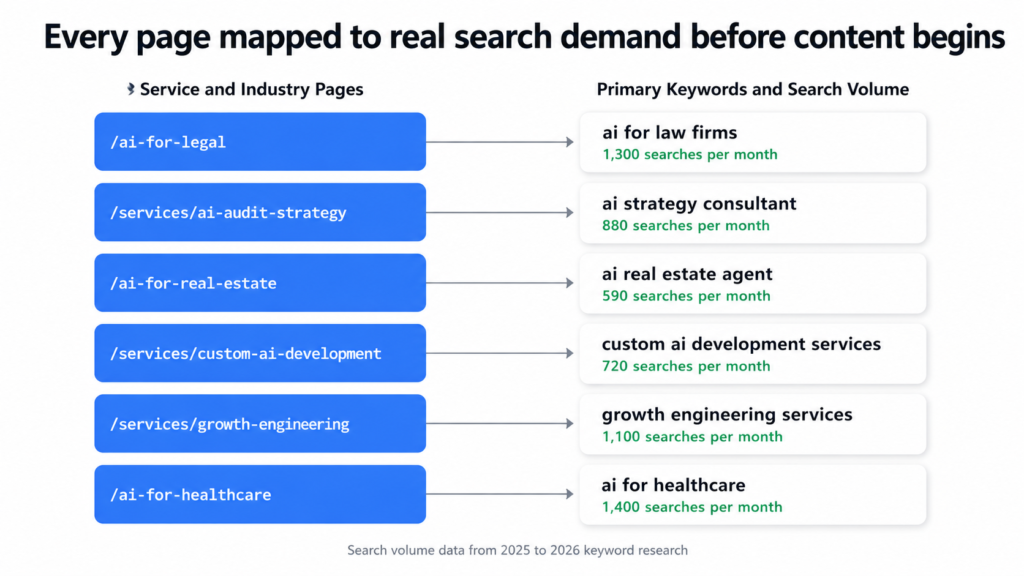
The legal page targeting “ai for law firms” at 1,300 searches per month, for example, is a page worth fighting for. But a new domain cannot rank for that keyword by just having a service page. It needs a cluster of supporting blog content that signals to Google that this site genuinely understands legal AI from multiple angles.
Building the Cluster Architecture
The core structural decision was to organise the entire blog around topical clusters rather than individual posts. Eleven clusters in total, each one mapped to either a service page or an industry page, each containing ten posts.
| Cluster | Parent Page | Posts |
|---|---|---|
| AI Audit and Strategy | /services/ai-audit-strategy | 10 |
| Workflow Automation | /services/workflow-automation | 10 |
| Custom AI Development | /services/custom-ai-development | 10 |
| Systems and Operations Design | /services/systems-operations-design | 10 |
| Growth Engineering | /services/growth-engineering | 10 |
| AI Training and Enablement | /services/ai-training-enablement | 10 |
| Home Services | /ai-for-home-services | 10 |
| Real Estate | /ai-for-real-estate | 10 |
| Legal | /ai-for-legal | 10 |
| Healthcare | /ai-for-healthcare | 10 |
| Finance and Accounting | /ai-for-finance-accounting | 10 |
110 posts total. Each cluster functions as a self-contained body of content on one subject, with every post linking back to the parent page and cross-linking to related posts within the same cluster. The effect builds over time: the more posts in a cluster, the stronger the topical authority signal, and the more likely every post in that cluster is to rank higher than it would in isolation.
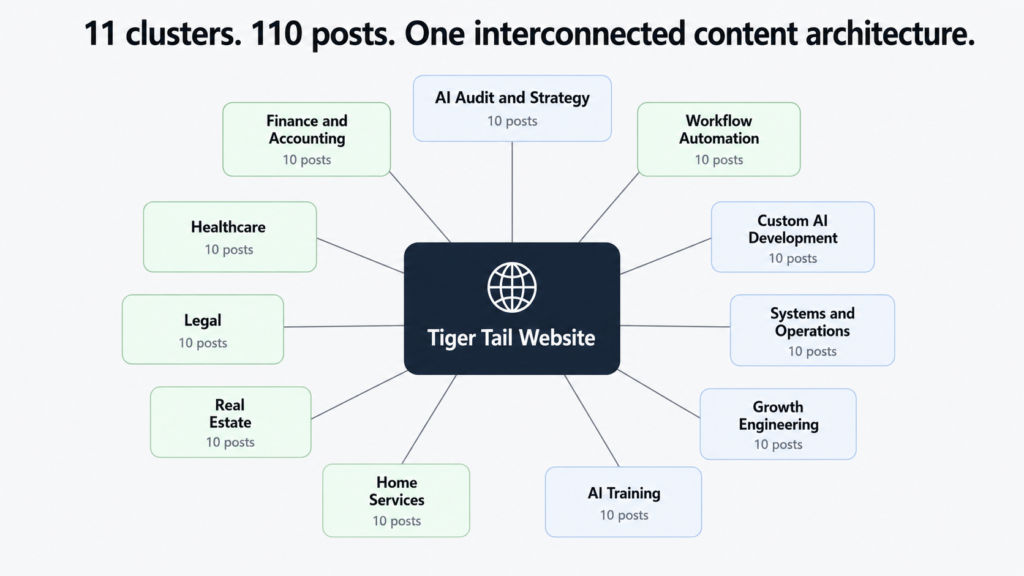
One post about AI for law firms is a blog post. Ten interconnected posts about AI for law firms, each covering a different angle and all linking back to the same service page, is a topical authority signal. Google treats these very differently.
The Research Layer: Where Most Strategies Stop Short
Topic ideas are the easy part. Every SEO agency can give you a list of blog titles. What separates a content strategy that actually performs from one that just fills up a blog page is the research behind each post.
For this project, every single post got its own research data pulled from Perplexity Sonar. Not generic AI training data. Live web research with real statistics, named sources, publication dates, and citation URLs.
The difference this makes is significant. A blog post about physician burnout that says “burnout is a growing problem in healthcare” is forgettable. A blog post that cites the AMA’s finding that 43.2 percent of physicians reported at least one symptom of burnout in 2024, down from 48.2 percent in 2023 but still far above 2011 levels, with a link to the source — that is a post that earns trust and ranks.
I cover exactly how I run the Perplexity Sonar research process in the next post in this series. The short version is that each cluster required a dedicated research prompt designed to return current statistics, pain points with quantified data, ROI benchmarks, and competitor content gaps. That research became the backbone of every brief.
The Publishing Strategy: Pace and Cluster Priority
A common mistake in content strategy is publishing randomly across topics and hoping something sticks. The publishing plan for this project was deliberately sequenced.
publishing-schedule.txt
# Publishing pace

Weeks 1 to 8    1 post per week on Mondays
Week 9 onwards  2 posts per week — Mondays and Thursdays
Total duration  approximately 24 months

# Cluster priority order (lowest to highest competition)

1.  AI Audit and Strategy       — establishes what the business does
2.  Home Services               — lower competition, local long-tail
3.  Workflow Automation         — strong long-tail, less dominated
4.  Legal                        — higher volume, domain has history by now
5.  Real Estate                  — competitive but authority building
6.  Healthcare                   — mid competition
7.  Finance and Accounting
8.  Custom AI Development
9.  Growth Engineering
10. Systems and Operations
11. AI Training and Enablement
The logic behind starting slow and ramping up is that Google needs time to learn a new domain. Publishing 20 posts in the first month on a brand new site does not accelerate that process. Publishing consistently, at a pace the site can sustain, signals stability and intent. The ramp to two posts per week after eight weeks happens once the foundation is established.
The cluster priority order follows a deliberate pattern too. Start with the clusters where competition is lowest so early posts have a realistic chance of ranking while the domain is still young. Build authority there. Then move into more competitive territory once Google has started to trust the site.
Publishing high-competition content too early on a new domain is one of the most common content strategy mistakes. The posts exist, they just sit on page eight indefinitely. Starting with winnable keywords lets early content generate signals that lift everything published later.
What the SEO Timeline Actually Looks Like
Part of building a strategy is being honest with the client about what to expect and when. Content SEO on a new domain does not produce results in the first month. Anyone who tells you otherwise is selling something.
seo-timeline-expectations.txt
Months 1 to 4
Publishing consistently. Very little organic traffic yet.
Google is learning the site. Foundation being built.

Months 4 to 6
First long-tail posts appearing on pages 2 and 3.
Some early page 1 wins on low-competition keywords.

Months 6 to 9
Meaningful organic traffic begins.
Cluster authority starts to show in rankings.

Months 9 to 12
Compounding effect begins.
Domain authority building noticeably.

Months 12 to 18
Consistent inbound leads from organic search.
Earlier posts climbing as domain strengthens.
This timeline is what I shared with the client upfront. Not because it is pessimistic but because it is accurate. Content SEO compounds. The value of every post published in month two does not peak in month two. It peaks in month ten when the domain has authority, the cluster has depth, and Google has seen consistent publishing for nearly a year.
The businesses that give up at month three are the ones that never find out what month twelve would have looked like.
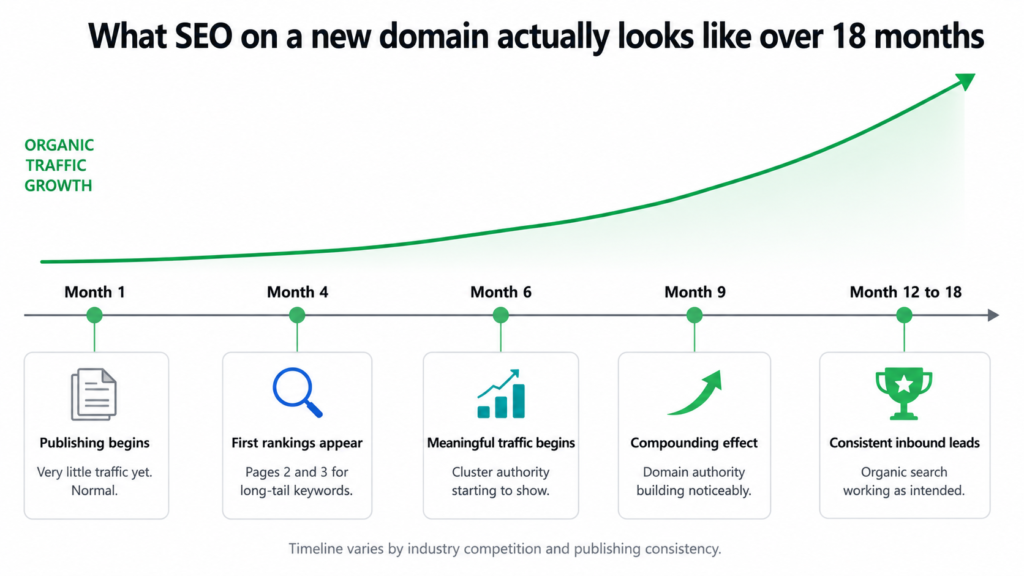
The Writing Framework
With 110 posts across 11 different industries and service areas, consistency of quality was a real challenge. The solution was a master writing prompt that every post gets written through — one that carries the brand voice, tone rules, structural requirements, and humanizer guidelines, and adapts by industry.
The prompt covers things like: never open with “In today’s digital landscape,” no em dashes anywhere, every strong claim backed by a named source with an inline link, and a specific tone shift depending on whether the post is for a home services contractor or a law firm partner. Those two audiences need to be spoken to completely differently even if the underlying AI subject is similar.
I cover the full writing framework and how to build one in the last post in this series.
What This Whole Thing Actually Delivers
At the end of this process, the client had something most businesses never build: a content system with a reason behind every decision. Every post has a cluster it belongs to. Every cluster has a parent page it supports. Every parent page has keywords worth ranking for. And every keyword was chosen because real people search for it when they have a problem the client can solve.
That is not a blog. That is a compounding organic acquisition channel built to run for two years and keep delivering after that.
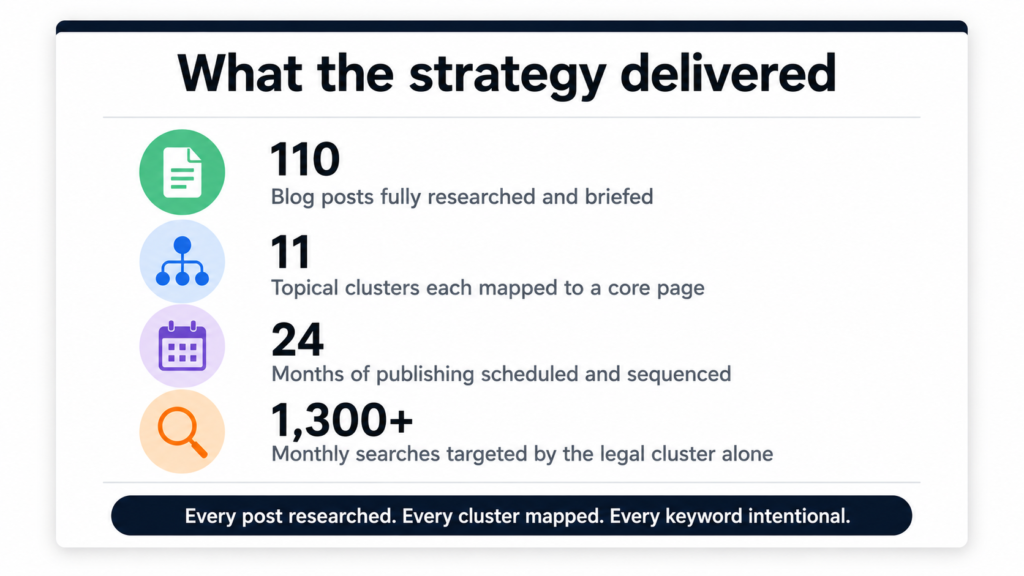
110 posts. 11 clusters. 24 months. Every post researched with real data, every cluster mapped to a page worth ranking, every keyword chosen with intent. This is what a content strategy looks like when it is built to actually work.
Want Something Like This for Your Business?
If you are running a business and your blog is either not working or not started yet, this kind of strategy is what bridges the gap between publishing and actually getting found. It is not about writing more. It is about building the right architecture before the first post goes live.
The next posts in this series go deeper into each layer of the process — keyword mapping, research with Perplexity Sonar, cluster architecture, publishing strategy, and the writing framework. If you want to talk about building this for your own business, book a call.
See how I build SEO strategy →
Dhruv is an SEO consultant working with business owners, founders, and agencies. If organic search is not delivering for your business, this is where to start.
Let's Work Together.
Ready to grow? Pick the way that works for you.